
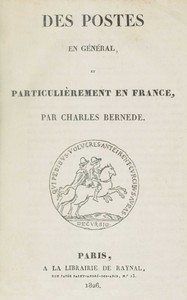
Des postes en général, et particulièrement en France by Charles Bernède
Charles Bernède's Des postes en général, et particulièrement en France is not your typical history book. It doesn't focus on famous leaders or dramatic wars. Instead, it tells the story of something we see every day but rarely think about: the mail.
The Story
Bernède takes us on a journey through the development of the postal system, from its earliest, most rudimentary forms to the organized national service of France. He explains how messages were carried before there was an official post—by travelers, merchants, or royal couriers. The book details the big changes: the creation of post offices, the introduction of standardized rates and stamps, and the massive expansion of routes that connected villages to cities. It's about the engineering of roads and relays, the politics of funding a public service, and the quiet, persistent work of countless postal workers. The 'plot' is the slow, fascinating construction of a network that tied a country together.
Why You Should Read It
What makes this book special is how it makes you see the ordinary world differently. After reading it, you won't look at a mailbox or a postman the same way. Bernède shows that the post office wasn't just a utility; it was a social and economic engine. It allowed families separated by distance to stay connected. It let businesses grow beyond their hometowns. It carried ideas, news, and culture to every corner of the nation. In a way, building a reliable postal system was one of the first steps in building a modern, unified France. The book is full of these insightful connections, presented in a clear, straightforward style that feels more like a great conversation than a lecture.
Final Verdict
Perfect for history buffs who enjoy social history over military history, and absolutely ideal for curious minds who love 'the story behind the thing.' If you've ever enjoyed books like Salt or Cod that explore the history of a single, everyday object, you'll find a similar pleasure here. It's also a great pick for anyone interested in France, infrastructure, or how societies quietly organize themselves. It’s a calm, thoughtful, and genuinely eye-opening read that proves sometimes the most revolutionary stories are hiding in plain sight.
The copyright for this book has expired, making it public property. Knowledge should be free and accessible.
David Moore
10 months agoWhile browsing through various academic sources, it manages to maintain a consistent flow even when discussing difficult topics. A trustworthy resource that I'll keep in my digital library.
Matthew Lopez
1 year agoThis book was worth my time since the atmosphere created is totally immersive. I will read more from this author.
Sandra Hill
1 year agoWithout a doubt, the clarity of the writing makes this accessible. A valuable addition to my collection.
Thomas Miller
5 months agoHaving read this twice, the pacing is just right, keeping you engaged. I will read more from this author.










Barbara Smith
10 months agoThe research depth is palpable from the very first chapter.