
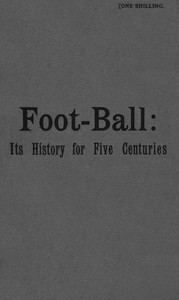
Foot-ball : its history for five centuries by Shearman and Vincent
Forget everything you think you know about football history. This isn't a dry list of facts; it's a story of chaos, confusion, and eventual order. Written in 1885 by Montague Shearman and James Edmund Vincent, this book arrives right when the modern sports of soccer and rugby were splitting apart and writing their official rules. The authors act as historians and detectives, trying to make sense of centuries of messy history.
The Story
The book doesn't follow a single narrative but pieces together a puzzle. It starts in the Middle Ages, describing a wild, often violent free-for-all played between whole towns, with few rules and a ball that was hardly ever kicked. It tracks the game through royal bans (kings hated it because it distracted men from archery practice!) and its adoption by English public schools. This is where the core conflict heats up. Each school—like Rugby, Eton, and Harrow—developed its own version. Some allowed handling and running, others only kicking. The book shows how these clashing 'house rules' eventually led to the great split of 1863, when the Football Association was formed to standardize the game, and the rugby clubs walked away to form their own code. It’s the origin story of a family feud.
Why You Should Read It
What grabbed me was the human element. This isn't just about rules; it's about identity and tradition. You feel the passion of those early players and administrators arguing over what their beloved game should be. The authors have strong opinions (they lean towards the rugby-style game), which makes their historical tour feel lively and personal, not like a textbook. Reading their 19th-century perspective is a trip—they’re documenting history as it’s being made. You get a real sense of how accidental and contentious the creation of our modern sports really was.
Final Verdict
Perfect for sports fans who love a good backstory, or anyone curious about how our traditions are invented. You don't need to be a historian. If you’ve ever argued with a friend about whether 'football' means soccer or the NFL, this book is your ultimate reference. It’s a foundational text, written with the energy of people who were there at the birth of modern sport. It might change how you watch the game this weekend.
There are no legal restrictions on this material. Thank you for supporting open literature.
Paul Thomas
4 months agoIt took me a while to process the complex ideas here, but the case studies and practical examples provided add immense value. Thanks for making such a high-quality version available.
Susan Davis
1 year agoThis was exactly the kind of deep dive I was searching for, the chapter on advanced strategies offers insights I haven't seen elsewhere. This is a solid reference for both beginners and experts.
Emily Anderson
1 year agoI decided to give this a try based on a colleague's recommendation, the concise summaries at the end of each section are a lifesaver. I appreciate the effort that went into this curation.
David Moore
1 year agoThe citations provided are a goldmine for further academic study.




Sarah Lopez
2 months agoInitially, I was looking for a specific answer, but the author doesn't just scratch the surface but goes into meaningful detail. I’ll definitely be revisiting some of these chapters again soon.