
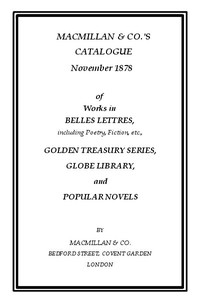
Macmillan & Co.'s Catalogue. November 1878 by Macmillan & Co.
Let's be clear from the start: this is not a storybook. There's no dashing hero, no scheming villain, and the only cliffhanger is whether you'll find a first edition of something. Macmillan & Co.'s Catalogue. November 1878 is exactly what it says on the tin: a publisher's list of books for sale that autumn, over a century ago. It's a practical document, a tool for booksellers and libraries of the time.
The Story
The 'plot' is the catalog's contents. You turn the pages and move through sections: dense history texts, poetry collections, science primers, travelogues of distant lands, and novels with wonderfully dramatic titles. You see names like Thomas Hardy and Alfred Lord Tennyson listed alongside forgotten authors. The prices are in shillings, and the descriptions are brief, matter-of-fact pitches. The narrative arc is the journey of browsing itself—from philosophy to fiction, from academic treatises to what passed for popular science. It's a silent tour of a Victorian mind's available furniture.
Why You Should Read It
This is where it gets cool. Reading this catalog is like finding a time capsule of intellectual appetite. You see what knowledge was valued and packaged for a growing literate public. The emphasis on serious history, theology, and classical works tells you something about their world. But you also see the escape hatches: adventure novels and poetry. It makes you wonder who bought these books. Was it a father building a respectable library? A student? A curious woman ordering by post? The dry lists spark these little human questions. It connects you to the simple, shared act of choosing a book to read, bridging a gap of 145 years.
Final Verdict
This is a niche pick, but a rewarding one. It's perfect for history buffs, bibliophiles, and anyone who loves the tangibility of the past. If you enjoy wandering through antique shops or get a kick out of old newspapers, you'll find the same charm here. It's not a page-turner in the traditional sense, but it is a unique and contemplative experience. Think of it as a quiet museum visit for your brain, offering a raw, unfiltered look at the literary landscape of 1878. Just don't go in expecting a plot twist.
There are no legal restrictions on this material. You can copy, modify, and distribute it freely.
Emily Rodriguez
10 months agoThis was exactly the kind of deep dive I was searching for, the structural organization allows for quick referencing of key points. A rare gem in a sea of mediocre content.
John Taylor
1 year agoMy first impression was quite positive because the footnotes provide extra depth for those who want to dig deeper. Well worth the time invested in reading it.
Michael Brown
4 months agoThe digital formatting makes it very easy to navigate.
James Brown
1 year agoInitially, I was looking for a specific answer, but the structural organization allows for quick referencing of key points. A trustworthy resource that I'll keep in my digital library.




Thomas Perez
2 years agoAs a professional in this niche, the wealth of information provided exceeds the average market standard. A refreshing and intellectually stimulating read.