
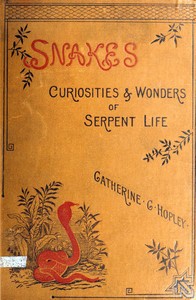
Snakes: Curiosities and Wonders of Serpent Life by Catherine Cooper Hopley
Published in 1882, Snakes: Curiosities and Wonders of Serpent Life isn't a modern field guide. It's something better: a time capsule of wonder. Catherine Cooper Hopley, an English writer and naturalist, wrote this book because she was fed up. She was tired of the fear and disgust snakes provoked, all based on stories and not on looking at the animals themselves. So, she set out to change minds.
The Story
There's no traditional plot here. Instead, Hopley takes us on a tour of the serpent world through her experiences and research. She describes finding snakes in gardens, visiting zoos, and even keeping them herself to study their habits. The "story" is her journey from common prejudice to deep appreciation. She breaks down their anatomy, explains how they move and hunt, and shares wild anecdotes about snake behavior from around the globe. She passionately argues against killing them on sight and details their role in the environment. It's a calm, persistent case for giving these misunderstood animals a fair shake.
Why You Should Read It
This book won me over with its voice. Hopley writes with a mix of scientific curiosity and grandmotherly charm. One minute she's clinically describing scales, the next she's scolding readers for being squeamish. Her respect for the snakes is contagious. You start seeing them not as monsters, but as complex survivors. It's also a fascinating look at how science was done by everyday people in the 19th century. There's no lab coat—just a sharp-eyed woman, a notebook, and a willingness to get close to something everyone else feared. It makes you question your own automatic reactions to the natural world.
Final Verdict
Perfect for history buffs, nature lovers, or anyone who enjoys a unique perspective. If you like Mary Roach's style of blending science with storytelling, you'll appreciate Hopley's pioneer spirit. It's also a great pick for readers interested in the history of women in science. This isn't a fast-paced thriller; it's a slow, thoughtful conversation with a remarkably observant mind. Keep an open mind, and you might just find yourself looking at the grass a little differently on your next walk.
This book is widely considered to be in the public domain. Use this text in your own projects freely.
Barbara Young
2 years agoBeautifully written.
George Taylor
2 years agoText is crisp, making it easy to focus.
Paul Scott
8 months agoLoved it.
Kevin Brown
8 months agoPerfect.


Margaret Lopez
5 months agoThis digital copy caught my eye due to its reputation, the quality of the diagrams and illustrations (if applicable) is top-notch. Finally, a source that prioritizes accuracy over hype.