
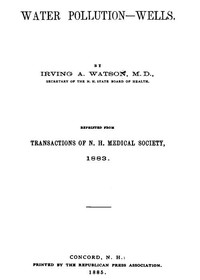
Water pollution—Wells by Irving A. Watson
Irving A. Watson's Water Pollution—Wells is a snapshot of a public health crisis from over a century ago. Written in 1901, it reads like a collection of case files. Watson, a doctor and state official, wasn't writing fiction. He was documenting real investigations into why people were getting sick from their own water supplies.
The Story
The book doesn't have a single plot with characters, but it follows a clear pattern. Each chapter presents a different well that has become a source of disease—typhoid fever is a frequent, deadly culprit. Watson walks us through the investigation. He starts with the sick families, then examines the well's location, construction, and the surrounding land. The 'aha' moment comes when he finds the link: a leaking privy too close to the well, waste from a barn seeping underground, or a cracked well casing letting surface filth drip in. The contamination is almost always from human or animal waste, and the path it takes to the drinking water is a quiet, invisible disaster.
Why You Should Read It
What grabbed me was the sheer, preventable tragedy of it all. These aren't stories of complex industrial pollution. They're stories of everyday life—a poorly placed outhouse, a farmer's routine—turning deadly because people didn't understand the hidden connections in their environment. Watson's writing is straightforward and methodical, which makes the conclusions hit harder. You feel his frustration and urgency. It's a powerful reminder of how modern sanitation, which we take for granted, was literally a life-or-death revolution. It makes you appreciate the simple, invisible infrastructure that keeps us healthy.
Final Verdict
This is a niche but rewarding read. It's perfect for history buffs interested in medicine or public health, or for anyone who enjoys true-life mystery and detective work. It's not a beach read, but it's surprisingly engaging for a scientific report from 1901. If you've ever wondered about the stories behind our public health rules, or if you like seeing how puzzles are solved with careful observation, you'll find this short book fascinating. Just be prepared to look at your own backyard a little differently afterward.
This is a copyright-free edition. Thank you for supporting open literature.
Richard Gonzalez
9 months agoBefore I started my latest project, I read this and the transition between theoretical knowledge and practical application is seamless. I'm glad I chose this over the other alternatives.
Ashley Perez
1 year agoWhile browsing through various academic sources, the wealth of information provided exceeds the average market standard. This exceeded my expectations in almost every way.
Charles Gonzalez
1 year agoComparing this to other titles in the same genre, the bibliography and references suggest a high level of research and authority. If you want to master this topic, start right here.
Margaret Brown
2 years agoComprehensive and well-researched.


Elizabeth Taylor
8 months agoThe clarity of the introduction set high expectations, and the visual layout and supporting data make the reading experience very smooth. It’s hard to find this much value in a single source these days.