1

Little people — Key Ideas to Explore
(0 User reviews)
388
Project Gutenberg
2008
Not confirmed
Alphabet rhymes; Ethnicity -- Juvenile poetry
Readers of public-domain and historical texts
Project Gutenberg digital edition
en
Edition facts
Words
4,691
Reading time
21 min
Text sections
1
This digital edition of Little people — Key Ideas to Explore is described by source-level measurements including 4,691 words, 21 min estimated reading time, and 1 detected text section.
The text analysis averages about 18.3 words per sentence, while the detected sections provide another way to judge how the source is divided.
Project Gutenberg metadata also associates the work with “Alphabet rhymes,” connecting these edition facts with the source record’s subject description.
Source:
Project Gutenberg record #24336
An alphabet of 26 short verses pairing Henry Mayer's illustrations with T. W. H. Crosland's rhymed portraits of national and ethnic types, from Arab to Zany, in the Dumpy Books for Children series.
Editorial Edition Score
4.4/5
★★★★★
★★★★★
Calculated from edition completeness, EPUB availability, text structure and catalogue metadata. Not a user rating.
How this score is calculated
- Description quality20 pts
- Title & short description10 pts
- Source metadata20 pts
- Text length15 pts
- Chapters / structure15 pts
- EPUB file integrity20 pts
Total of 100 points, scaled to a 2.5-5.0 range. Editions with an empty description or a missing EPUB file are not scored.
Edition quality
Read the Text
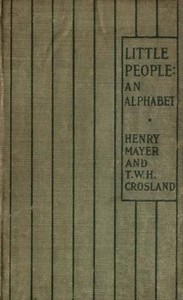
LITTLE PEOPLE: AN ALPHABET
HENRY MAYER AND T.W.H. CROSLAND
The Dumpy Books for Children.
The Dumpy Books for Children.
_Cloth, Royal 32mo, 1/6 each._
I. THE FLAMP, THE AMELIORATOR, AND THE SCHOOLBOY'S APPRENTICE. By E. V. LUCAS. (_Seventh Thousand._)
II. MRS. TURNER'S CAUTIONARY STORIES. (_Fifth Thousand._)
III. THE BAD FAMILY. By MRS. FENWICK. (_Third Thousand._)
IV. THE STORY OF LITTLE BLACK SAMBO. Illustrated in Colours. By HELEN BANNERMAN. (_Thirty-seventh Thousand._)
V. THE BOUNTIFUL LADY. By THOMAS COBB. (_Fourth Thousand._)
VI. A CAT BOOK. Portraits by H. OFFICER SMITH. Characteristics by E. V. LUCAS. (_Eighth Thousand._)
VII. A FLOWER BOOK. Illustrated in Colours by NELLIE BENSON. Story by EDEN COYBEE. (_Eighth Thousand._)
VIII. THE PINK KNIGHT. Illustrated in Colours by J. R. MONSELL. (_Eighth Thousand._)
IX. THE LITTLE CLOWN. By THOMAS COBB.
X. A HORSE BOOK. By MARY TOURTEL. Illustrated in Colours. (_Eighth Thousand._)
XI. LITTLE PEOPLE: An Alphabet. By HENRY MAYER. Verses by T. W. H. CROSLAND. Illustrated in Colours.
LONDON: GRANT RICHARDS, 9, Henrietta Street, W.C.
LITTLE PEOPLE: AN ALPHABET.
PICTURES BY HENRY MAYER.
VERSES BY T. W. H. CROSLAND.
LONDON: GRANT RICHARDS, 1901.
This Arab is upset, I fear; Look at his pretty shield and spear. He's stuck two pistols in his sash, And, dear me, how his eyes do flash!
At home he has a horse to ride; To "scour the desert" is his pride. His horse is of the purest breed; Some people call his horse a steed.
Here is your little brother Boer, Of course, you've heard of him before; He has a naughty Uncle Paul, Who used to want to eat us all.
Although he does not wear a tie He's just as white as you or I, And just as fond of cake and fruit; The difference is that he can shoot.
Li has a pigtail and a fan, And yet he's not a Chinaman; In fact, he is his mother's joy, A merry little Chinaboy.
His father is a Mandarin, His father's name is Loo Too Sin. They put no sugar in his tea, Yet he's as good as good can be.
Miss Gretchen Groople! She is Dutch: In Holland there are many such. Her shoes are wooden, like the floor; How nice she keeps her pinafore!
She says that there is nothing finer Than the Dutch Queen, Wilhelmina; She says that she has never seen a Sweeter Queen than Wilhelmina.
The English are a splendid race, Sturdy of limb, honest of face; They own (this is geography) Much of the land and all the sea.
That is to say, they rule the waves, They never, never will be slaves. They're brave, but do not want to fight, And if you're English you're all right.
The French can cook, and fence, and dance, They're fond of shouting "Long live France!" They make the prettiest hats and frocks, Also French pickles and French clocks.
They shave their poodles, drink much wine, And laugh a great deal when they dine. French boys play soldiers now and then, And must be soldiers when they're men.
Hans, as you see, to town has been; His waistcoat's red, his sunshade green. He lives beside the river Iser, And calls his emperor the Kaiser.
In Germany, no end of toys Are made for English girls and boys. The English children merely break them; Hans sits at home and helps to make them.
In Hungary they hunt and fish; Between ourselves, I often wish I lived there, for it must be grand;-- I've heard the Blue Hungarian Band.
In Hungary a boy wears white Blouses, his knickers fit him tight, He has top boots of patent leather, And in his hat a peacock's feather.
The Indian boy is neatly dressed; He has no shirt, he wears a crest Of eagle's feathers on his head, His skin is of a coppery red.
If you said to him, "You and I Will run and catch a butterfly," The Indian boy would say, "No! No! I wish to chase the buffalo."
The little Japs are rather small, Even their fathers are not tall; They're very fond of parasols, They dress themselves just like their dolls.
They live beneath the sunniest skies, Their hair is black to match their eyes; Their robes are black to match their hair, And, O! what tiny shoes they wear.
This Kaffir looks a trifle sly, He smiles and smiles, I wonder why? Perhaps he's playing at a game, Or thinking of his long, long name.
His name, you know, is Washington Neb-u-chad-nez-zar Solomon Sambo Snowball Timothy Jack Adolphus Rule Britannia Black.
I think the Laplander is nice, He lives among the snow and ice; The reindeer drags his sledge for him, And gives him meat and milk to skim.
Each letter of the alphabet introduces a different 'little people'—a national or ethnic type rendered in a single stanza of four couplets. The verses follow a consistent pattern: a name or label, a physical or cultural detail, a domestic trait, and often a closing couplet that turns toward moral or patriotic sentiment. The Boer entry, for instance, opens with direct address ('Here is your little brother Boer'), then moves through Uncle Paul, a white complexion, and a taste for cake and fruit, before ending on the difference that 'he can shoot.' This compression of identity into eight lines forces every word to carry weight, and the rhyme scheme (AABB) keeps the pace brisk and memorable.
Rhyme as a Container for Stereotype
The alphabet form imposes strict brevity: each entry is exactly eight lines, four couplets, with a fixed meter. Crosland uses this constraint to pack in a surprising amount of assertion. The Arab is 'upset' and has 'pretty shield and spear'; the Chinaboy is 'merry' and his father is a Mandarin named Loo Too Sin. The Dutch girl Gretchen Groople keeps her pinafore nice and praises Queen Wilhelmina. These are not neutral descriptions—they are compressed character sketches that rely on a few vivid, often domestic, details to stand for an entire people. The rhyme itself becomes a mnemonic for the stereotype, making the verses easy to remember and repeat.
Shifts in Tone from Playful to Pointed
While many entries maintain a light, almost nursery-rhyme tone, others introduce sharper notes. The Boer verse mentions a 'naughty Uncle Paul' who 'used to want to eat us all'—a reference to the Boer Wars that would have been current in 1901. The English entry declares the race 'splendid' and claims they 'rule the wave.' The German entry is not included in the excerpt, but the pattern suggests each letter carries a different emotional weight. The Quakeress and the Zany likely offer comic relief, while the Indian and Kaffir entries may reflect colonial attitudes. Readers should note how the voice shifts between affection, condescension, and outright jingoism from one stanza to the next.
The Role of the Illustrations in Pacing
Henry Mayer's pictures are integral to the experience. The text itself refers to visual elements—'Look at his pretty shield and spear'—and the Dumpy Books format (royal 32mo, cloth, 1/6 each) suggests a small, illustrated object meant to be handled. The verses are short enough to be read aloud while a child looks at the facing page. The pace of the book is thus dictated by the turn of the page: each letter gets a spread, and the reader moves through the alphabet at a steady, rhythmic clip. The illustrations likely reinforce the stereotypes in the verses, making the book a coordinated verbal-visual performance of national types.
Because the excerpts are incomplete—only letters A through E are fully shown—readers should be cautious about inferring the overall arc of the book. The later entries (Kaffir, Odalisque, Zany) may introduce different registers or break the pattern. Pay attention to how Crosland handles letters that lack obvious national referents (Q for Quakeress, Z for Zany) and whether the tone remains consistent. The book is best approached as a period artifact of Edwardian children's literature, where rhyme and illustration work together to naturalize a particular view of the world's peoples.
That rainy afternoon, the old Dumpy Book’s whimsical rhymes about strangers felt less like stereotypes and more like lonely doorways—each verse a tiny echo of someone’s inner weather. Later, idly, I found myself reaching for something quieter, deeper. Henry Mayer’s faces haunted me into the mystics’ verses, where all tribes blur into one longing. I opened Songs of Kabir — Text and Context, and the rain seemed to slow, listening with me.
There are no reviews for this eBook.
There are no comments for this eBook.
Reader reflection
Before you leave, reflect on the book
Use these questions to collect your thoughts before moving on.
Your progress
0
/
10
2
How much did you enjoy the reading experience?
3
Would you pass this book on to a friend?
4
What was the reading difficulty like?
5
How valuable was this book for your own interests?
6
Did any part of the book feel personally relevant?
7
Was the book moving at the right speed?
8
How did the reading compare with what you expected?
9
What changed or sharpened your thinking?
10