1

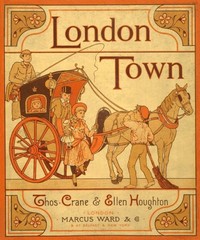
London Town — Inside the Classic
(0 User reviews)
59
Project Gutenberg
2007
Not confirmed
Children's poetry, English; London (England) -- Juvenile poetry
Readers of public-domain and historical texts
Project Gutenberg digital edition
en
Edition facts
Words
6,718
Reading time
30 min
Text sections
2
The source record for London Town — Inside the Classic measures this digital text at 6,718 words, 30 min estimated reading time, and 2 detected text sections.
The text analysis averages about 22.2 words per sentence, while the detected sections provide another way to judge how the source is divided.
Project Gutenberg metadata also associates the work with “Children's poetry, English,” connecting these edition facts with the source record’s subject description.
Source:
Project Gutenberg record #21650
A Victorian children's poetry collection that tours London landmarks and street-life through rhyming verses, following a child named Prue and featuring recurring characters like the muffin man, crossing sweeper, and Punch and Judy.
Editorial Edition Score
4.5/5
★★★★★
★★★★★
Calculated from edition completeness, EPUB availability, text structure and catalogue metadata. Not a user rating.
How this score is calculated
- Description quality20 pts
- Title & short description10 pts
- Source metadata20 pts
- Text length15 pts
- Chapters / structure15 pts
- EPUB file integrity20 pts
Total of 100 points, scaled to a 2.5-5.0 range. Editions with an empty description or a missing EPUB file are not scored.
Edition quality
Read the Text
There was hardly a mouthful for each!
From the ducks and the swans on the lake, to next page-- A much quieter scene--you may pass: Though Westminster Cloisters are hoary with age, Yet green is their velvety grass, And cheerily bright are their gables and peaks, As they glow in the westering sun: 'Tis some house in the Cloisters yon schoolboy seeks-- Don't you wonder, now, which is the one?
In all the land A pile so grand Is scarcely found As this. Around Its old grey walls The shadow falls Of bygone years, And so one fears To raise one's tone, When one is shown Some ancient tomb, Half hid in gloom. Beneath such stones There rest the bones Of monarchs bold, Whose story's told For you and me In history.
From kings of men We wander; then We're quickly brought To kings of thought, For poets lie Interred hard by. Here, too, repose The bones of those Who fought the foe Long, long ago. Brave knights were they; And in the fray They kept from shame The English name, And proved in fight Great Britain's might. Where they are laid Their rest is made As sweet as prayer By music rare: Over their head The sleeping dead Can daily hear The anthem clear Floating along Like angel's song, Until it dies Like angel's sighs.
On the way to the British Museum
Not far from the British Museum there stands An apple stall, painted bright green, Whence a penny may buy from the stall-keeper's hands Three apples, all rosy and clean.
Now the girls of St. George's great Charity School Very often are passing that way, For their governors wise make this very good rule-- They must go for a walk every day.
How wistful the glances they cast as they pass, How they long for an apple to eat; But their pockets are quite without pennies, alas! To purchase so dainty a treat.
These maidens have cheeks that are rosy and sweet As the choicest of fruit on the stall, And the very next time that we meet in this street, I'll buy apples enough for them all.
Goodness gracious! What a noise Baby Bunting's bent on making; It is quite enough to set All the heads around him aching. Still we're sure that Baby has Many griefs if we could see 'em, For with other babes he's come Miles and miles to the Museum. Baby Bunting thought, of course, When he said good bye to mother, That he'd pass in through the gates With big sister and big brother. But poor Baby finds, alas, That his little hopes have flitted, For the nasty notice says "Babes in arms are not admitted."
In the British Museum
If you want to see all sorts of wonderful things, Stuffed crocodiles, mammoths, and sloths, Hairy ducks with four feet, and fishes with wings, Fat beetles, and strange spotted moths;
And enormous winged bulls with long beards, carved in stone, Dug up from Assyria's sand, And old blackened mummies as dry as a bone, Discovered in Egypt's lone land,
And beautiful statues from Greece and from Rome, And other fine things without end,-- You will find you can see half the world here at home, If a day in this place you will spend.
The Underground Railway
Who is this in the Weighing Chair? Why, little Dot, I do declare! Three stone five! "So much as that?" Calls out Miss Dot; "then I _must_ be fat!"
On this and the opposite page you see Dot's mother, and brother, and sisters three. They wait for an underground train to come And carry them swiftly back to their home.
Wonderful trains! From morn till night, Clattering through tunnels without daylight, Hither and thither they run, up and down, Beneath the streets of London Town.
Many prefer these trains instead Of the cabs and "Busses" overhead, For they run much faster than horses can. Miss Dot's papa is a busy man,
And goes to the City every day By the "Underground,"--the quickest way: And One Hundred Millions of people, 'tis found, Are carried each year by the "Underground."
The Zoological Gardens
The book opens with an invitation to climb Saint Paul's and view London as a "busy hive," immediately establishing the dual perspective of spectacle and everyday labor. The first excerpt introduces Prue at the Tower of London, where she jokes about a Beefeater's baby, blending historical awe with childlike humor. The verse form—rhyming quatrains with irregular meter—prioritizes playful observation over strict pedagogy.
Street Vendors and Urban Rhythms
The middle excerpts catalogue London's street traders with rhythmic refrains: the penny-ice man, the muffin man, the cat's-meat man. Each vendor is introduced by a distinctive cry—"all hot! all hot!"—and the poems emphasize the transactional relationship between seller and child. The omnibus poem notes that boys run alongside the bus "hungry all the while," hinting at poverty without moralizing. The verses consistently pair commerce with sensory detail: the chestnut woman's "smoky fire," the flower woman's "pretty posies."
Prue's Perspective and the Child's Gaze
Prue appears in several early poems as a curious guide. At the Tower, she "discovers" a Beefeater's child and exclaims, "You've shown me things that are odd and queer, / A Beefeater's baby I'll show you!" This inversion—the child teaching adults—recurs in the Punch and Judy poem, where the showman "scolds at Toby, beating his Wife" as a familiar routine. The poems rarely explain historical context; instead, they present sights as immediate experiences. The Tower's prison past is mentioned only in passing: "few who got into it ever came out."
Structure and Repetition Across the Collection
The table of contents lists 28 subjects, from the Houses of Parliament to the dustman. Each poem follows a similar pattern: a named location or character, a brief descriptive scene, and often a direct address to the reader. The repeated phrase "London Town" anchors the collection, and the final poems shift toward bedtime—"the dustman's coming, I should think"—creating a circular journey from morning to night. The illustrations by Thomas Crane and Ellen Elizabeth Houghton are not reproduced here, but the text's visual cues ("if upon the picture a glance you cast") suggest they were integral to the reading experience.
Social Observation Without Sentiment
Several poems depict marginal figures: the crossing sweeper is "weak and old," a "poor old Hindoo" who sweeps for coins; the shoeblacks and charity girls appear without commentary on their circumstances. The Happy Family poem—featuring cats, mice, and birds that "all agree"—explicitly contrasts with "girls and boys who scold and tease." The Children's Hospital poem describes Tommy's recovery with a nurse "in her pretty blue gown" and a "shopful of beautiful toys," but avoids clinical detail. These vignettes offer a sanitized, picturesque view of Victorian London's inequalities.
Reading the excerpts in sequence reveals a deliberate arc from public spectacle to domestic closure. The final poem's dustman, whose cry means "Good Night," echoes the opening invitation to "climb Saint Paul's." First-time readers may find the repetitive structure and simple rhymes best appreciated as a cumulative portrait rather than a narrative. The book rewards attention to recurring motifs—the omnibus, the street cries, the child's perspective—that unify its scattered scenes.
I grew up with Prue tramping through London’s rhymes, the muffin man’s bell still echoing somewhere in my head. Returning to those verses now, I find them gentler but sadder, which is why I treasure leafing through War's Embers, and Other Verses — Context and Discussion—it carries that same quiet ache, remembering what a city held before the noise faded. A familiar comfort, that dimming light.
There are no reviews for this eBook.
There are no comments for this eBook.
Reader reflection
Take a moment to reflect on this book
Create a short personal record of your experience with this book.
Your progress
0
/
10
2
What was your overall reaction to the book?
3
Would you pass this book on to a friend?
4
How easy was the book to follow?
5
How would you rate its originality?
6
Did the book give you something worth debating?
7
How clear did the writing feel?
8
Was the book moving at the right speed?
9
What is the main idea you are taking away?
10