1

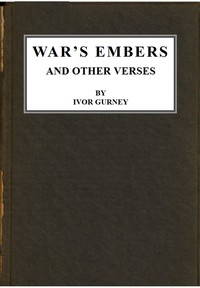
War's Embers, and Other Verses — Context and Discussion
(0 User reviews)
402
Project Gutenberg
2020
Not confirmed
World War, 1914-1918 -- Poetry
Readers of public-domain and historical texts
Project Gutenberg digital edition
en
Edition facts
Words
12,523
Reading time
55 min
Text sections
3
For War's Embers, and Other Verses — Context and Discussion, the stored edition analysis reports 12,523 words, 55 min estimated reading time, and 3 detected text sections.
The text analysis averages about 24.8 words per sentence, while the detected sections provide another way to judge how the source is divided.
Project Gutenberg metadata also associates the work with “World War, 1914-1918 -- Poetry,” connecting these edition facts with the source record’s subject description.
Source:
Project Gutenberg record #63882
Ivor Gurney's 1919 collection of war poems, drawing on his service with the Gloucestershire Regiment, balances front-line grit with pastoral memory. The verses shift from trench slang to lyrical reflection, often framing rest and rural scenes as fragile respites. The catalog subject 'World War, 1914-1918 -- Poetry' fits, but the poems also dwell on music, landscape, and the inner life of a soldier-poet.
Editorial Edition Score
4.5/5
★★★★★
★★★★★
Calculated from edition completeness, EPUB availability, text structure and catalogue metadata. Not a user rating.
How this score is calculated
- Description quality20 pts
- Title & short description10 pts
- Source metadata20 pts
- Text length15 pts
- Chapters / structure15 pts
- EPUB file integrity20 pts
Total of 100 points, scaled to a 2.5-5.0 range. Editions with an empty description or a missing EPUB file are not scored.
Edition quality
Read the Text
O wind that tosses free The children’s hair; Scatters the blossom of Apple and pear; Blow in my heart, touch me, Gladden me here.
You have seen so many things-- Blow in and tell Tales of white sand and golden ’Gainst the sea swell. Bring me fine meadow-thoughts, Fresh orchard smell.
Here we must stare through glass To see the sun-- Stare at flat ceilings white Till day is done: While you, sunshine, starshine, May out and run.
Blow in and bring us all Dear home-delight-- Green face of the Spring earth, Blue of deep night. Blot each of our faces From the others’ sight.
Out of the line we rest in villages Quiet indeed, where heal the spirit’s scars; But even so, lapped deep in sunshine and ease, We are haunted for ever by the shapes of wars.
Green in the sun they lie, secret, deserted, Lovely against the blue the summits show, Where once the bright steel sang, the red blood spurted, And brave men cowed their terrors long ago.
By day their life was easy; but at night, Even now, one hears strange rustlings in the bush; And, straining tensely doubtful ear and sight, The stealthy moving ere the sudden rush;
And flinches from the spear. War’s just-bright embers That Earth still keeps and treasures for the pride In sacrifice there shown; with love remembers The beauty and quick strength of men that died.
Who died as we may die, for Freedom, beauty Of common living, calmly led in peace, Yet took the flinty road and hard of duty, Whose end was life abundant and increase.
But--when Heaven’s gate wide opening receives us Victors and full of song, forgetting scars; Shall we see to stir old memories, to grieve us, Heaven’s never-yet-healed sores of Michael’s wars?
The tossing poplar in the wind Shows underleaf of silver-white; The roughness of the wind unkind Torments her out of all delight. But O that he were here Whose blows and whose caresses alike were dear!
The great oak to the tearing blast Stands steady with strong arms held wide, So over him my anger passed, When his rough usage hurt my pride. But O that once again I might arouse that passion, endure that pain!
Sweet smelling, sweet to handle, fair of hue Tobacco is. The soldier everywhere Takes it as friend, its friendliness to share, Whether in fragrant wreaths it mount faint blue In dug-out low, or surreptitiously to Parapet in rimy night, from hidden lair Of sentry; staying hunger, stilling fear-- The old dreams of comfort bringing anew. For from that incense grows the stuff of dreams, And in those clouds a drowsing man may find All that was ever sweet to his starved mind, Heart long denied--dear friends, hills, horses, trees, Slopes of brown ploughland, sunset’s fading gleams ... The bane of care, the spur to memories.
DAY-BOYS AND CHORISTERS
(TO THE BOYS OF KING’S SCHOOL, GLOUCESTER, 1900-1905)
Under the shade of the great Tower Where pass the goodly and the wise, Year in, year out, winter and summer, With scufflings and excited cries, Football rages, not told in pages Of Fame whereof the wide world hears; A battle of divided Empire-- The day-boys and the choristers.
CHORUS So here’s to the room where the dark beams cross over, And here’s to the cupboard where hides the cane; The paddock and fives-court, great chestnut, tall tower-- When Fritz stops his fooling we’ll see them again.
Golf balls, tennis balls, cricket and footballs, Balls of all sizes and sorts were sent Soaring by wall and arch and ivy High, high over to banishment. (Poor owner that loses!) And oh! but the bruises, Scars, and red hacks to cover the brave Shins of the boldest, when up and down playground Victory surged, Victory, edged like a wave.
CHORUS So here’s to the room where the dark beams cross over, And here’s to the cupboard where hides the cane, The paddock and fives-court, great chestnut, tall tower-- When Fritz stops his fooling we’ll see them again.
Little they knew, those boys, how in Flanders And plains of France, in another day A trial dreadful of nerve and sinew For four long years should test alway That playtime pluck, that yet should carry Them through Hell’s during worst, and how Europe should honour them, a whole world praise them, Though Death tore their bodies and laid them low.
CHORUS So here’s to the room where the dark beams cross over, And here’s to the cupboard where hides the cane; The paddock and fives-court, great chestnut, tall tower-- When Fritz stops his fooling we’ll see them again.
Ivor Gurney's War's Embers, and Other Verses (1919) opens with a dedication that sets a tone of constrained gratitude: 'O, if my wishes were my power, / You should be praised as were most fit.' The collection, published two years after his earlier Severn and Somme, draws on his experience as a private in the Gloucestershire Regiment. The poems included here—some previously printed in The Spectator and The Westminster Gazette—range from the sardonic 'The Volunteer' to the tender 'The Farm.' Gurney's voice is marked by abrupt shifts between colloquial speech and formal lyricism, often within a single stanza.
Catalog Subjects vs. Poetic Range
The catalog assigns this work to 'World War, 1914-1918 -- Poetry' and 'Fantasy & Juvenile Worlds'—a curious pairing. The war subject is evident: poems like 'The Volunteer' describe going 'up against / The naked mouth of Hell,' and 'On Rest' details the routines of a battalion behind the lines. Yet the fantasy classification seems misapplied. Gurney's poems are grounded in specific places—Omiecourt, Twigworth Vicarage, the farmyard with 'tall ricks upstanding clear.' There is no fantastical element; instead, the poems rely on sharp observation of actual landscapes and soldierly life. The 'Juvenile' tag may stem from the collection's occasional simplicity of diction, but the content is adult, dealing with death, memory, and the psychological weight of war.
Recurring Structures: Rest, Memory, and the Pastoral
Several poems share a structural pattern: they begin with a scene of peace or beauty, then pivot to the intrusion of war or memory. In 'The Farm,' a 'creeper-covered house' and 'golden sunlight' are introduced only to be undercut by 'How little of a whole world to remember!' Similarly, 'On Rest' opens with 'It's a King's life, a life fit for a King!' and proceeds to catalogue the pleasures of a rest day—'Porridge and bacon! Tea out of a real cup'—before ending with a soldier wondering about his mother back home. This movement from present comfort to absent home is a recurring device. Gurney also uses direct address to comrades or named individuals, as in the dedications to 'A. L. B.' and 'the Men of the 2/5 Gloucester Regiment,' grounding the poems in specific relationships.
Voice and Diction: Colloquial Shifts and Musicality
Gurney's diction mixes formal phrasing with soldier slang. In 'The Volunteer,' the speaker declares 'I would test God's purposes' but later exclaims 'Aie me!' and uses the colloquial 'Blighty.' The poem 'On Rest' includes lines like 'No whizzbangs,' 'crumps to fear,' and 'dixie against dixie musically clanging.' This blend of registers creates a voice that is both reflective and grounded. Gurney was also a composer, and musical references appear: 'After Music' is a poem title, and 'The Immortal Hour' was published in The Westminster Gazette. The dedication poem mentions 'all my art was poor, / My mind too thought-packed to acquit / My debt,' suggesting a self-awareness about the limits of poetry. The poems often employ regular rhyme and meter, but with enjambments that mimic natural speech.
Readers approaching War's Embers should attend to the tension between Gurney's pastoral imagery and the harsh realities he records. The poems reward attention to place names and dedications, which anchor the verse in lived experience. The collection is best read as a sequence, where the contrasts between poems—from the sardonic 'Volunteer' to the elegiac 'Dicky'—build a composite portrait of a soldier-poet's mind.
I’ve often shelved Gurney’s verses and thought how the mud and trench-slang sit beside such tender pastoral longing. Something in that old Gower, The complete works of John Gower, volume 1 — A Closer Reading, shares that same quiet double-life—courtly form hiding a restless, worn heart. They are brothers under the dust, each finding solace in a remembered measure.
There are no reviews for this eBook.
There are no comments for this eBook.
Reader reflection
Your personal reading reflection
Build a private reading journal entry for this title.
Your progress
0
/
10
2
Was reading this book enjoyable?
3
Is this a title you would suggest to others?
4
How demanding did the text feel?
5
Could you see yourself revisiting this book?
6
Did the story or argument move comfortably?
7
Would you like to discuss this book with someone?
8
How would you rate its originality?
9
What did this book teach you most?
10