1

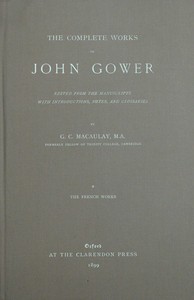
The complete works of John Gower, volume 1 — A Closer Reading
(0 User reviews)
569
Project Gutenberg
2023
Not confirmed
Poetry
Readers of public-domain and historical texts
Project Gutenberg digital edition
en
Edition facts
Words
304,917
Reading time
1326 min
Text sections
100
The catalog record for The complete works of John Gower, volume 1 — A Closer Reading provides practical reading context through 304,917 words, 22 hr 6 min estimated reading time, and 100 detected text sections.
The text analysis averages about 15.2 words per sentence, while the detected sections provide another way to judge how the source is divided.
Project Gutenberg metadata also associates the work with “Poetry,” connecting these edition facts with the source record’s subject description.
Source:
Project Gutenberg record #70998
This volume presents John Gower's French works, edited by G. C. Macaulay from manuscripts, with a preface detailing the editorial process and textual corrections. The excerpts reveal Gower's critique of corrupt friars through allegorical names and biblical allusion, contrasting their hypocrisy with the ideal of apostolic poverty.
Editorial Edition Score
4.9/5
★★★★★
★★★★★
Calculated from edition completeness, EPUB availability, text structure and catalogue metadata. Not a user rating.
How this score is calculated
- Description quality20 pts
- Title & short description10 pts
- Source metadata20 pts
- Text length15 pts
- Chapters / structure15 pts
- EPUB file integrity20 pts
Total of 100 points, scaled to a 2.5-5.0 range. Editions with an empty description or a missing EPUB file are not scored.
Edition quality
Read the Text
Finally, the trick of filling up lines with such tags as _en son degré_, _de sa partie_, &c. (e.g. _Mir._ 373, 865), vividly recalls the similar use of ‘in his degree,’ ‘for his partie,’ by the author of the _Confessio Amantis_ (e.g. _Prol._ 123, 930).
The evidence of which I have given an outline, which may be filled up by those who care to look out the references set down above and in the Notes, amounts, I believe, to complete demonstration that this French book called _Mirour de l’omme_ is identical with the _Speculum Hominis_ (or _Speculum Meditantis_) which has been long supposed to be lost; and, that being so, I consider myself at liberty to use it in every way as Gower’s admitted work, together with the other books of which he claims the authorship, for the illustration both of his life and his literary characteristics.
DATE.--The _Speculum Hominis_ stands first in order of the three books enumerated by Gower, and was written therefore before the _Vox Clamantis_. This last was evidently composed shortly after the rising of the peasants in 1381, and to that event, which evidently produced the strongest impression on the author’s mind, there is no reference in this book. There are indeed warnings of the danger of popular insurrection, as 24104 ff., 26485 ff., 27229 ff., but they are of a general character, suggested perhaps partly by the Jacquerie in France and partly by the local disturbances caused by discontented labourers in England, and convey the idea that the writer was uneasy about the future, but not that a catastrophe had already come. In one passage he utters a rather striking prophecy of the evil to be feared, speaking of the strange lethargy in which the lords of the land are sunk, so that they take no note of the growing madness of the commons. On the whole we may conclude without hesitation that the book was completed before the summer of the year 1381.
There are some other considerations which will probably lead us to throw the date back a little further than this. In 2142 ff. it seems to be implied that Edward III is still alive. ‘They of France,’ he says, ‘should know that God abhors their disobedience, in that they, contrary to their allegiance, refuse by way of war to render homage and obedience to him who by his birth receives the right from his mother.’ This can apply to none but Edward III, and we are led to suppose that when these lines were written he was still alive to claim his right. The supposition is confirmed by the manner in which the author speaks of the reigning king in that part of his work which deals with royalty. Nowhere does he address him as a child or youth in the manner of the _Vox Clamantis_, but he complains of the trust placed by the king in flatterers and of the all-prevailing influence of women, calling upon God to remedy those evils which arise from the monstrous fact that a woman reigns in the land and the king is subject to her (22807 ff.). This is precisely the complaint which might have been expected in the latter years of Edward III. On the other hand there is a clear allusion in one place (18817-18840) to the schism of the Church, and this passage therefore must have been written as late as 1378, but, occurring as it does at the conclusion of the author’s attack upon the Court of Rome, it may well have been added after the rest. The expression in l. 22191,
‘Ove deux chiefs es sanz chevetein,’
refers to the Pope and the Emperor, not to the division of the papacy. Finally, it should be observed that the introduction of the name Innocent, l. 18783, is not to be taken to mean that Innocent VI, who died in 1362, was the reigning pope. The name is no doubt only a representative one.
On the whole we shall not be far wrong if we assign the composition of the book to the years 1376-1379.
FORM AND VERSIFICATION.--The poem (if it may be called so) is written in twelve-line stanzas of the common octosyllabic verse, rhyming _aab aab bba bba_, so that there are two sets of rhymes only in each stanza. In its present state it has 28,603 lines, there being lost four leaves at the beginning, which probably contained forty-seven stanzas, that is 564 lines, seven leaves, containing in all 1342 lines, in other places throughout the volume, and an uncertain number at the end, probably containing not more than a few hundred lines. The whole work therefore consisted of about 31,000 lines, a somewhat formidable total.
This edition of John Gower's French works, prepared by G. C. Macaulay from manuscript sources, opens with a preface that recounts how the editor's study of Chaucer manuscripts led him to the Confessio Amantis and then to the identification of the Speculum Meditantis. The volume's textual apparatus includes silent corrections of typographical errors, such as the adjustment of 'plu8' to 'plus' on page 321 and the reordering of a hyphenated line on page 379. The excerpts from the French text show Gower employing a dense, alliterative style and a critical voice directed at religious orders.
Editorial Foundations and Textual Choices
Macaulay's preface explains that the Delegates of the Oxford University Press required him to edit Gower's French and Latin works alongside the Confessio Amantis, a condition he accepted with hesitation due to doubts about his competence in French. The edition is based on manuscript authorities, with the editor noting the unsatisfactory state of previous editions. The transcriber's notes record specific corrections: on page 414, 'Twelth' was changed to 'Twelfth'; in line 11556, 'd ela' became 'de la'; and the index corrected 'tresepoentablement' to 'tresespoentablement'. These interventions highlight the editorial effort to produce a reliable text from flawed sources.
Gower's Critique of Religious Hypocrisy
The French excerpt launches a sustained attack on friars who feign holiness for gain. Gower uses the names 'Agarreni' and 'Gebal' from the Psalms, explained by Saint Jerome, to characterize false brothers: 'Le primer no u n porta signal / Des ceux q’ont fals le cuer ou pitz' (the first name signified those with false hearts). He compares them to the pseudo-prophet who 'com m e aignel se vestira, / Et cuer du loup il portera' (will dress as a lamb but carry a wolf's heart). The passage contrasts the original poverty of the founders with contemporary friars who seek rich patrons, stating that a poor shepherd's son will not be admitted to the order.
Structural and Stylistic Patterns
Gower's verse employs a consistent octosyllabic line with frequent enjambment and internal rhyme, as seen in 'De les enfantz prist aqeintance / Par do u n ne par losengerie'. The text shifts between direct address ('Mais ore ont p er du celle usance') and biblical citation, quoting Saint Peter's epistle against false teachers. The repeated use of 'Maisq ue' and 'Car' creates a logical argumentative structure. The excerpt's length—over 100 lines—shows Gower's capacity for sustained moral discourse, blending allegory, scriptural reference, and contemporary observation without narrative interruption.
Language and Lexical Texture
The French text is marked by Anglo-Norman orthography, with variations such as 'aqeintance' for acquaintance and 'cov er te' for covered. Gower uses Latin-derived terms like 'pseudo' and 'ypocrisie' alongside vernacular phrases. The editor's notes indicate that spelling has been preserved except for clear errors, allowing readers to observe the linguistic hybridity of late medieval Anglo-French. The passage's vocabulary includes specialized religious terms ('limitours', 'freitours') that reflect the institutional context of Gower's critique.
Readers approaching this volume should attend to the interplay between Macaulay's editorial apparatus and Gower's original text. The preface provides a window into late nineteenth-century textual scholarship, while the French works themselves demand careful reading for their rhetorical strategies and linguistic features. The excerpts offer a concentrated example of Gower's moral verse, but the full scope of his French corpus—including the Mirour de l'Omme—awaits exploration in this edition.
I remember those Gower manuscripts with their weary friars, and how often the old poets warn us about power’s costumes. Somehow, that vigilance lives again in the Mirror for Magistrates, Volume 2, Part 1 — Key Ideas to Explore, where fallen princes speak their own epitaphs. Different tongues, same hush between the lines — a quiet acknowledgment that conscience rarely wears a comfortable robe. I find comfort in that continuity.
There are no reviews for this eBook.
There are no comments for this eBook.
Reader reflection
Your personal reading reflection
Build a private reading journal entry for this title.
Your progress
0
/
10
2
How did the book work for you overall?
3
Is this a title you would suggest to others?
4
What was the reading difficulty like?
5
How understandable was the text?
6
Which part made the strongest impression?
7
How closely did the book connect with your experience?
8
Could you apply anything you learned?
9
What changed or sharpened your thinking?
10