1

Mirror for Magistrates, Volume 2, Part 1 — Key Ideas to Explore
(0 User reviews)
1795
Project Gutenberg
2023
Not confirmed
Shakespeare, William, 1564-1616 -- Sources; Great Britain -- History -- Poetry
Readers of public-domain and historical texts
Project Gutenberg digital edition
en
Edition facts
Words
132,852
Reading time
578 min
Text sections
89
For Mirror for Magistrates, Volume 2, Part 1 — Key Ideas to Explore, the stored edition analysis reports 132,852 words, 9 hr 38 min estimated reading time, and 89 detected text sections.
The text analysis averages about 30.0 words per sentence, while the detected sections provide another way to judge how the source is divided.
Project Gutenberg metadata also associates the work with “Shakespeare, William, 1564-1616 -- Sources,” connecting these edition facts with the source record’s subject description.
Source:
Project Gutenberg record #72464
This 1815 edition of the Tudor verse collection 'Mirror for Magistrates' presents tragic historical narratives in poetic form, with editorial notes by Joseph Haslewood. The excerpts show dramatic monologues of fallen nobles, including a vivid depiction of Buckingham's rage and grief, blending classical allusion with English history.
Editorial Edition Score
4.9/5
★★★★★
★★★★★
Calculated from edition completeness, EPUB availability, text structure and catalogue metadata. Not a user rating.
How this score is calculated
- Description quality20 pts
- Title & short description10 pts
- Source metadata20 pts
- Text length15 pts
- Chapters / structure15 pts
- EPUB file integrity20 pts
Total of 100 points, scaled to a 2.5-5.0 range. Editions with an empty description or a missing EPUB file are not scored.
Edition quality
Read the Text
Life, death, landes, goods,[104] and all by vs was deemed: Whereby with easy paine great gayne wee did in fet,[105] And euery thing was fishe, that came vnto our net.
At sessions and at sises,[106] wee bare the stroake and sway, In patentes and commission, of _quorum_ alwaye chiefe:[107] So that to whether syde soeuer wee did way, Were it by right or wrong, it past, without repriefe: The true man wee let hang[108] somewhiles to saue a thiefe, Of gold, and of siluer, our handes were neuer empty, Offices, fermes, and fees, fell to vs in great plenty.
But what thing may suffice vnto the greedy man? The more hee hath in hold, the more hee doth desire: Happy and twise happy is hee, that wisely can Content himselfe with that, which reason doth require, And moyleth for no more then for his needefull hire: But greedines of minde doth seldome keepe[109] the syse, To whom enough and more doth neuer well suffice.[110]
For like as dropsy pacients drinke and still bee dry, Whose vnstaunchst thirst no liquor can alay, And drinke they nere so much, yet thirst they by and by:[111] So catchers and snatchers[112] toile both night and day, Not needy, but greedy, still prolling[113] for their pray: O endlesse thirste of gold, corrupter of all lawes, What mischiefe is on moulde whereof thou art not cause?
Thou madest vs forget the fayth of our profession,[114] When sergeants wee were sworne to serue the common lawe, Which was, that in no point wee should make digression[115] From approued principles, in sentence nor in sawe: But wee vnhappy wightes[116] without all dread and awe Of the judge eternall, for worlde’s vaine promotion, More to man then God did beare our whole deuotion.[117]
The lawes wee did interprete[118] and statutes of the land, Not truely by the texte, but newly by a glose: And wordes that were most playne, when they by vs were skand, Wee tourned by construction to[119] a _Welshman’s_ hose, Whereby many a one[120] both life and land did lose: Yet this wee made our meane to mount aloft on mules: And seruing times and turnes peruerted lawes and rules.[121]
Thus climing and contending alway to the toppe, From hie vnto higher, and then to bee most hye, The honny dewe of fortune so fast on vs did droppe, That of king _Richarde’s_ counsayle wee came to bee most nye:[122] Whose fauour to attayne wee[123] were full fine and slye: Alway to his profite[124] where any thing[125] might sounde, That way (all were it wrong) the lawes[126] wee did expounde.
So working lawe like waxe, the subiect was not sure Of life, land,[127] nor goodes but at the prince’s will, Which caused his kingdome the shorter time to dure: For clayming power absolute both to saue and spill, The prince thereby presumed his people for to pill, And set his lustes for lawe, and will had reason’s place, No more but hang and drawe, there was no better grace.
Thus the king outleaping the limits of his lawe, Not raigning but raging, as youth[128] did him entice, Wise and worthy persons from court did dayly drawe, Sage counsayle set at naught, proude vaunters were in price, And roysters bare the rule, which wasted all in vice: Of ryot and excesse, grewe scarsity and lacke, Of lacking came taxing, and so went welth to wracke.[129]
The barons[130] of the land not bearing this abuse, Conspiring with the commons assembled by assent, And seeing neyther reason,[131] nor treaty, could induce The king in any thing his rigour to relent, Maugre[132] his might they[133] calde a parliament: Franke and free for all men without checke[134] to debate As well for weale publique, as for the prince’s state.
In this[135] high assembly, great thinges were proponed Touching the prince’s state, his regalty[136] and crowne, By reason that the king[137] (which much was to be moned) Without regarde at all, of honour or renowne, Misledde by ill aduice, had tournde all vpside downe, For surety of whose state, them thought it did behoue His counsaylours corrupt by reason[138] to remoue:[139]
Among whome, _Robert Veer_[140] calde duke of _Irelande_, With _Mighell Delapole of Suffolke_ newe made earle, Of _Yorke_ also the archbishop, dispacht were out of hande,[141] With _Brembre_ of _London_ a full vncurteous churle:[142] Some learned in the lawe in exile they did hurle: But I poore[144] _Tresilian_ (because I was the chiefe) Was dampned to the gallowes most vily as[145] a thiefe.
This volume opens with the third part of the Mirror for Magistrates, a Tudor collection of verse tragedies recounting the downfalls of historical figures. The excerpts reveal a pattern of moralized history: each legend is framed as a warning against misrule, with the ghost of a fallen noble speaking in first-person complaint. The catalog subjects link the work to Shakespeare's sources and British history, but the text itself is a dense web of poetic voices, editorial apparatus, and classical references.
The Structure of the Legends
The table of contents lists legends from the Conquest onward, each keyed to a specific year and attributed to a poet such as Ferrers, Cavyl, or Sackville. The excerpts show that each legend begins with a prose argument and then shifts into verse. For example, the legend of Robert Tresilian is introduced as a tale of a chief justice who misconstrued laws to serve the prince's affections. This structure—prose preface followed by poetic complaint—is consistent throughout. The volume also includes multiple prefaces: one by Baldwin, another by Niccols from the 1610 edition, indicating the work's layered editorial history.
The Voice of the Fallen: Buckingham's Rage
The longest excerpt presents the ghost of Buckingham, who recounts his betrayal by Banastaire. The verse is highly rhetorical, employing similes (the bull chased with darts), classical invocations (Alecto, Phoebe, Jove), and vivid physical description: 'With bloud red iyen hee stareth here and there, / Frothing at mouth.' The ghost's speech is framed by a narrator who observes his 'raging woe' and 'gripes of griefe.' This passage exemplifies the poem's method: historical figures are made to perform their own tragedies, blending pathos with moral condemnation. The language is dense with alliteration and archaic spelling, typical of the period.
Editorial Layers and Historical Notes
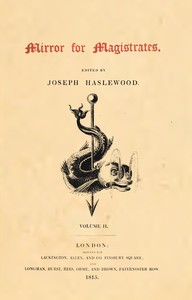
Joseph Haslewood's edition collates various earlier printings and adds historical notes. The title page lists multiple contributors, including Drayton and Churchyard, and notes that parts IV and V are by Richard Niccols. The excerpts do not show the notes themselves, but the table of contents and prefaces indicate a scholarly apparatus. The catalog subject 'Shakespeare, William, 1564-1616 -- Sources' suggests that this collection was mined by later playwrights, though the excerpts do not confirm direct borrowing. The volume's word count (132,852) and 89 text sections point to a substantial work, but the excerpts are limited to the opening and one later legend, leaving the full scope of the historical coverage unclear.
Classical Allusions in a Historical Frame
Despite its English historical subject matter, the poem frequently invokes classical mythology. Buckingham calls on 'Alecto' and 'Sibilla,' and the narrator compares his rage to a bull chased with darts. This blending of classical and British elements is characteristic of Renaissance poetic practice. The verse also employs formal rhetorical devices such as apostrophe and anaphora. Readers should note that the historical accuracy of the legends is secondary to their moral and dramatic purpose; the poem is not a chronicle but a series of exemplary tragedies.
Readers approaching this volume should be prepared for a hybrid work: part historical anthology, part poetic lament, part editorial project. The excerpts suggest that the Mirror for Magistrates rewards attention to its formal structure and its interplay of voices, rather than to factual history. The dense language and classical references may require patience, but the dramatic monologues offer vivid glimpses of Tudor literary culture.
Reading Buckingham’s fury made me think of my grandfather, who recited doom-laden verses by lamplight. He loved how old voices carry grief. That same ache surfaced when I later found Songs and rhymes of a lead miner — A Reader’s Guide, whose quiet laments felt like listening to stones remember. They share that hollow, human echo.
There are no reviews for this eBook.
There are no comments for this eBook.
Reader reflection
What did you think of this book?
Answer a few questions and save a private reflection on this device.
Your progress
0
/
10
2
Did this book hold your interest?
3
How likely are you to recommend this book?
4
How easy was the book to follow?
5
How personally connected did you feel to the book?
6
How distinctive were its ideas or approach?
7
How useful did the reading feel?
8
How well did it match your expectations?
9
What changed or sharpened your thinking?
10