1

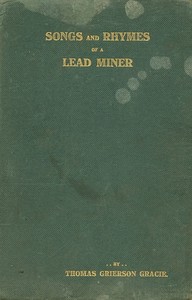
Songs and rhymes of a lead miner — A Reader’s Guide
(0 User reviews)
248
Project Gutenberg
2025
Not confirmed
Scottish poetry; English poetry -- Scottish authors
Readers of public-domain and historical texts
Project Gutenberg digital edition
en
Edition facts
Words
22,924
Reading time
100 min
Text sections
3
The catalog record for Songs and rhymes of a lead miner — A Reader’s Guide provides practical reading context through 22,924 words, 1 hr 40 min estimated reading time, and 3 detected text sections.
The text analysis averages about 23.6 words per sentence, while the detected sections provide another way to judge how the source is divided.
Project Gutenberg metadata also associates the work with “Scottish poetry,” connecting these edition facts with the source record’s subject description.
Source:
Project Gutenberg record #76732
Thomas Grierson Gracie's 1921 collection of Scots and English verse, written from his experience as a lead miner in Wanlockhead, Dumfriesshire. The poems range from descriptive pieces about local landscapes and events to songs, memorial verses, and wartime morale pieces, all grounded in the mining community's life and dialect.
Editorial Edition Score
4.6/5
★★★★★
★★★★★
Calculated from edition completeness, EPUB availability, text structure and catalogue metadata. Not a user rating.
How this score is calculated
- Description quality20 pts
- Title & short description10 pts
- Source metadata20 pts
- Text length15 pts
- Chapters / structure15 pts
- EPUB file integrity20 pts
Total of 100 points, scaled to a 2.5-5.0 range. Editions with an empty description or a missing EPUB file are not scored.
Edition quality
Read the Text
They had nae time the scene tae view, Sae hurried owre the mountain's broo, An' doon the brae they ran pell-mell Tae hae a drink at Katie's Well, "Whaur Black M'Michael's bearded lip Yince fain did dip."
Then doon they ran wi' muckle speed, Tae Nature's charms they paid nae heed, An' didna slack their pace a jot Until they reached the Lucky Pot[1]; Sae awfu' keen an' anxious they Tae see if luck was theirs that day.
Then walin' steps wi' canny care They gaed alang the hill-side bare, Whaur Kelt,[2], the hound, fell aff his steed When Harkness[3] shot him through the heid; The roarin' pool whaur he fell in Has since been known as Kelty's Linn.
There fore-nent them Stey-Guile stood, Defyin' time an' storms an' flood; They gazed upon its steepest side, Doon whaur 'twas said bold Graham[4] did ride, His pony shod wi' deevils' cloots; 'Twas maybe true. "They had some doots."
Owre Dalveen Hill an' doon the brae Richt cheerily they held their way; An' when they High Dalveen had passed They reached the Carron Burn at last; Then fast their taikle they gat oot, Their minds fair set on killin' troot.
Then Wullie, keen his skill tae test, Got started weel afore the rest; He banged oot yin, syne made it twa; When oot cam' three, lie croose did craw. "Come here, ma callans, gin ye wish, I'll show ye hoo tae catch the fish."
"But pleesures are like poppies spread, Ye seize the floo'er, its bloom is shed;" He thocht he was a fisher rare, But, strange tae say, he gat nae mair; An' then he cried "I'll bet a quid It's been the tail en' o' the tid."
But Rab an' Tam, mair skilfu' they, On pools an' streams their flees did play; They played wi' sic a cunnin' wrist The finny tribe couldnae resist, But lap an' danced at bob an' trail; Some e'en were hookit by the tail.
Doon by Stonebutt an' by the Brig, They landed fishes wee an' big; An' when they reached the Carron Mill, O' fishin' they had got their fill: An' here a signboard took their e'e, A maist uncommon sign tae see:
"Ginger-beer an' lemonade, Here as guid as can be made, An' if ye want some more repast, Dinner, supper, or breakfast;" These lines, my friens, depend upon it, Composed were by Grier the Poet.
The landlord there, a sober chiel, Wad hae nae traffic wi' the deil: O' aqua vitae he had nane; Sair did oor weary fishers grane; An' ere they rested on their hurdies, Hied owre the hill tae Tam o' Murdy's.
Tam o' Murdy's, Durisdeer, Was famed for Mountain Dew an' beer, An' ony ither kin' o' drink, But jist for them wha had the clink: For Tammy, tho' a kin'ly man, Could aye look efter num'er wan.
An' there they sat an' smoked an' sang, An' gill stoups toomed o' liquor strang, Which quickly put them a' at ease, In tellin' stories, maistly lees, O' salmon they had landed oot, An' hoo they lost their biggest troot.
Their pooches toom, nae mair tae spen', Their nonsense sune cam' tae an en', An' forced were they tae tak' the gait, Tho' they were in a muddled state. The moon on them was shinin' clear, When leavin' guid auld Durisdeer.
They wandered on, whiles up, whiles doon, An' heard fu' mony an eerie soon; The fitpath wasna' braid aneuch, They tumelt in the burn an' sheuch; They staggered in amang the dreels, O' turnip, kail, an' tattie fiel's.
An' tho' they had nae wish tae tarry, Their legs refused the drink tae carry: An'' doon on Carron's hichts they sank, An' for a time their min's were blank; Hoo they gat hame, what them befel, Deil yin o' them could ever tell.
When man is on enjoyment bent, O' aftermath he should tak' tent, An' no abuse John Barleycorn, Or life o' pleesure will be shorn.
[1] A natural pot formation in the bare rock in the middle of the burn, about twenty yards down from the foot-path from which, if a fisher, in the morning, out of three stones put one in the lucky pot, his luck was in for that day.
[2] Captain of Dragoons searching for Covenanters amongst the hills.
[3] One of the hunted Covenanters.
[4] Graham of Claverhouse, of whom many marvellous stories have been told.
_Song or Recitation._ _Tune: "Tinker's Waddin'."_
In August, when the heather blooms, An' grouse are fairly on the wing, The scented breeze frae hill an' moor, Tae hunters health an' pleesure bring.
Then hunters meet at Auld Troloss, As they hae dune for mony a year: Tam Johnston ready taks the names O' beaters there frae far an' near.
The personal note that opens this collection immediately establishes the author's background: born in 1861 at Wanlockhead, one of ten children, Gracie began work as a lead washer at age thirteen for fivepence a day. The preface frames the poems not as literary exercises but as the output of a working miner who found his voice in the glens and hills of his nativity. Readers should note that the index organizes the work into descriptive pieces, memoriam pieces, songs, and miscellaneous items—a structure that reflects the occasional and community-rooted nature of the verse.
The Personal Note as a Key to the Poems
Gracie's preface is unusually direct about the economic realities of lead mining: he mentions a wage of fifteen to seventeen shillings per week for a miner supporting a large family. This context matters because the poems themselves rarely dwell on hardship. Instead, they celebrate local landmarks, social gatherings, and personal relationships. The reader who keeps the preface in mind will notice how the verse often turns away from the mine itself toward the landscape—'Ridge of Glengonar,' 'Mennock Burn,' 'Heights of Glendyne'—or toward communal events like a wedding or a fishing expedition. The preface also confesses a childhood aversion to school and a love of roaming outdoors, which aligns with the many poems that describe walking the hills and meeting people.
Scots Dialect and the Question of Audience
A striking feature of the collection is the alternation between broad Scots and standard English. Poems such as 'The Bonnie Auld Doric o' Scotland' explicitly defend the Scots tongue, claiming that Robert Burns has made it 'immortal in sang.' Yet other pieces, like 'Cheer Up!' with its chorus about trusting Providence, are in English and address a wider audience—city slum children, young men and maidens, married couples. This shift suggests that Gracie was conscious of different readerships: local folk who would recognize the Doric, and a general public for whom moral uplift in English might be more accessible. The reader may wish to compare the Scots love songs, which use local place-names and dialect endearments, with the English wartime verses that employ patriotic rhetoric and standard imagery.
Recurring Themes: Place, Memory, and the First World War
Several poems in the collection are explicitly about the First World War. 'Sae Wull We Yet' (new version) addresses a 'Tiger' that came forth and made Europe his prey, and it toasts 'oor lads on the land an' the sea.' The memoriam pieces—'Funeral of Private Alex. Howland,' 'Lines on a Friend,' 'Kitchener'—indicate that the war touched this mining community directly. Yet the war poems sit alongside pieces about curling, fishing, and local characters. The reader should note how Gracie moves between these registers without apparent strain: the same voice that celebrates 'Bonnie Banks o' Cree' also urges comrades to 'never say die' against a foreign foe. This juxtaposition gives the collection a documentary quality, recording both the everyday life of a lead-mining district and the larger historical forces that disrupted it.
Structure and the Role of the Index
The index printed at the front of the 1921 edition is more than a table of contents; it is a deliberate classification by the author. Gracie groups poems under headings: Descriptive Pieces, Memoriam Pieces, Songs, and Miscellaneous Pieces. This arrangement invites the reader to approach the book not as a continuous narrative but as a set of thematic clusters. The descriptive pieces tend to be longer and more narrative, often telling a story about a local event. The songs are shorter and more lyrical, many with indicated tunes. The memoriam pieces are occasional, written for specific individuals. A first-time reader might sample one poem from each section to gauge the range before reading straight through. The index also reveals that some titles recur—'Mennock Burn' appears both as a descriptive piece and as a song—suggesting that Gracie revisited certain subjects in different forms.
This collection rewards a reader who pays attention to the interplay between the personal preface and the poems themselves. Gracie does not explain his craft; he simply presents verses that grew out of a specific place and time. The Scots poems may require slow reading or a glossary, but the effort uncovers a voice that is both local and historically situated. For those interested in working-class writing, Scottish dialect poetry, or the social history of lead-mining communities, these pages offer direct testimony rather than literary artifice.
Holding Gracie’s verses, I think of my grandfather’s hands, dark with coal dust, quieting to turn a page. That same gentle pause came to me once with Fables of Flowers for the Female Sex. With Zephyrus and Flora, a Vision — Edition Insights, where every bloom seemed to carry a murmured secret, like a stone’s patient memory of the dark.
There are no reviews for this eBook.
There are no comments for this eBook.
Reader reflection
How will you remember this book?
Save your reaction, strongest insight, and memorable passage.
Your progress
0
/
10
2
Was reading this book enjoyable?
3
Would you recommend this book to another reader?
4
Did the language feel accessible?
5
Did the book offer a fresh perspective?
6
Was the book moving at the right speed?
7
Was the book easy to understand?
8
How much did the book move you?
9
What is the main idea you are taking away?
10