1

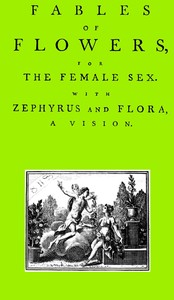
Fables of Flowers for the Female Sex. With Zephyrus and Flora, a Vision — Edition Insights
(0 User reviews)
245
Project Gutenberg
2021
Not confirmed
Fables; Flowers -- Poetry
Readers of public-domain and historical texts
Project Gutenberg digital edition
en
Edition facts
Words
20,903
Reading time
91 min
Text sections
35
The source record for Fables of Flowers for the Female Sex. With Zephyrus and Flora, a Vision — Edition Insights measures this digital text at 20,903 words, 1 hr 31 min estimated reading time, and 35 detected text sections.
The text analysis averages about 21.8 words per sentence, while the detected sections provide another way to judge how the source is divided.
Project Gutenberg metadata also associates the work with “Fables,” connecting these edition facts with the source record’s subject description.
Source:
Project Gutenberg record #65677
An 18th-century collection of fables in verse, each featuring a flower as a moral speaker, framed by a vision of Zephyrus and Flora. The poems use botanical dialogue to deliver refined admonitions, with a preface that frames the work as a courtly amusement for a princess.
Editorial Edition Score
4.8/5
★★★★★
★★★★★
Calculated from edition completeness, EPUB availability, text structure and catalogue metadata. Not a user rating.
How this score is calculated
- Description quality20 pts
- Title & short description10 pts
- Source metadata20 pts
- Text length15 pts
- Chapters / structure15 pts
- EPUB file integrity20 pts
Total of 100 points, scaled to a 2.5-5.0 range. Editions with an empty description or a missing EPUB file are not scored.
Edition quality
Read the Text
strains, Which the whole soul of harmony inspir’d, Pour’d to the wild woods and the lonely plains, Though worthiest still by all to be admir’d.
Such were creation’s first imperfect hours, When the gay heav’ns in early beauty shone, And earth, bedeck’d with beasts, birds, plants, and flow’rs, Spread all her bosom to the genial sun;
Unfinish’d still the mighty work appear’d, Till Man, the lord of all, was bid to rise; With open brow his face divine who rear’d, And sought with upright look his native skies.
Thus as I paus’d, still louder swell’d the notes, From ev’ry bush, and brake, and echoing hill; While choirs cœlestial seem’d to tune their throats, And, with glad voice the chearful chorus fill.
Then, by some magic pow’r swift snatch’d away, Ev’n to the midst of that delightful land, I view’d at once all clad in bright array, A thousand Genii of the gardens stand.
But far above all these a seat was plac’d, Dress’d with each flow’r that ev’ry season knows, Whose vary’d tints, in gem-like order, grac’d The rural theatre which gradual rose.
For lo! the Genius of each blooming flow’r Brought his own fav’rite with peculiar care, To deck the arch of this inchanted bow’r, And, bowing at the throne, he plac’d it there.
A sight more beauteous ne’er did eye behold, Than these bright tribes that glitter’d on the day; And, rich in purple dyes and flaming gold, Did their bright bosoms to the sun display.
Such was the throne;—but oh! what pen can trace The heav’nly beauties of the matchless Two, Who, glowing with each bright cœlestial grace, Sat there aloft, conspicuous to the view!
The first, a youth of sweet and gentle mien, With many a wreath and knotted garland crown’d; Whose beauteous visage glow’d with charms serene, And on whose shoulders purple wings were bound:
These when he spreads, reviving Nature pours Her copious treasures of immortal bloom; Whilst through vast realms he scatters vernal stores, And from his downy pinions shakes perfume.
His name was ZEPHYRUS; and next him sat The beauteous goddess of the blooming year, The constant partner of his rural state, To heav’n and earth, to gods and mortals dear;
FLORA, bright pow’r, who sheds a thousand sweets O’er thousand lands, what time her gifts appear, What time her consort with his kisses greets Her coral lips, and wakes the rising year.
Her beauteous face was deck’d with youthful pride, Her graceful form in flamy robes was dress’d; And ev’ry charm wild Nature could provide, Adorn’d her head, and beam’d upon her breast.
Beside the throne, rang’d in fair order, stood The various Seasons of the rolling year; By all their train of months, weeks, days, pursu’d: And all their various symbols flourish’d here.
First came the SPRING, led by the rosy Hours, With all the Loves and Graces in her train; Deck’d with her wreath of never-fading flow’rs, Diffusing odours o’er the smiling plain.
Next SUMMER came; his cheeks with ardour fir’d, With his own blushing fruits and harvests crown’d; Before whose face the infant Spring retir’d, And with her roses strew’d the russet ground.
Stain’d with the grape’s press’d juice, with steadier pace, Still looking backward on preceding time, Ripe AUTUMN next succeeded in his place; Scatt’ring rich fruits, the growth of ev’ry clime.
Last WINTER comes, with heavy step and flow, A hoary captive bound in icy chains; With haggard eyes, and mantle dipp’d in snow, Who still of cold in Spring’s own realms complains.
Not one of these, but from their various store Some off’ring meet to lovely Flora pay; Not one of these, but with that off’ring more, And her soft reign most willingly obey.
Ev’n WINTER’S self, with look averted, throws, His thin-strewn flow’rets on the goddess’ shrine; Ev’n _his_ cold bosom for a moment glows, When he beholds her radiant form divine.
But now the Genii of each plant and flow’r, Rang’d in fair order, wait her high commands; And each, approaching her delicious bow’r, In expectation of her verdict stands.
For many of the _garden’s_ painted race, And some that with their colours deck the _field_, Rivals in wealth, in beauty, and in grace, Had wag’d high wars, unknowing how to yield.
The preface to Fables of Flowers sets a curious tone: the author claims to have found “health and recreation” in composing these poems, and credits an unnamed “ingenious Lady” for the plan. The work is explicitly written for the amusement of Princess Charlotte, the Princess Royal, and the dedication to Lady Charlotte Finch suggests a courtly, pedagogical purpose. Yet the poems themselves are not simple moral lessons; they stage debates between flowers—the Poppy and the Sun-Flower, the Iris and the Rose—in which each plant defends its character and virtues. The verse form is consistent: each fable uses numbered stanzas of four lines, with an ABAB rhyme scheme, giving the arguments a clipped, epigrammatic quality.
The Poppy’s Defense of Sleep
In Fable XVI, the Sun-Flower accuses the Poppy of being a “noxious weed” that brings drowsiness and blotting out the day. The Poppy’s reply is the longest speech in the excerpt, and it systematically reframes its powers as virtues: “Sleep, gentle God, the ease of grief, / To weary man I bring.” The Poppy claims to aid “the mourning captives,” the poor, and the “love-sick maid.” The final couplet—“More Virtues in Life’s shade will bloom, / Than in her blaze of day”—is a neat inversion of the Sun-Flower’s solar pride. The fable thus becomes a debate about utility versus show, with the Poppy arguing that its quiet, nocturnal gifts are more compassionate than the Sun-Flower’s radiant but indifferent beauty.
The Rose’s Rebuke to the Iris
Fable XVII pits the Iris, or Flower de Luce, against the Rose. The Iris boasts of its name and colours, claiming kinship with the rainbow and monarchs. The Rose, described as “a modest flow’r, / With maiden blushes bright,” retorts bluntly: “Plain Flag thou art;—let that suffice.” The Rose dismisses the Iris’s pretensions to royal symbolism, noting that even France’s lilies fade where roses are known. The fable ends with the Rose vindicated: “Her odour strait proclaim’d her queen / Of all the smiling flow’rs.” The moral is explicit: empty titles and borrowed names are worthless compared to genuine worth. The poem’s structure—a series of accusations and rebuttals in quatrains—mirrors a courtroom or schoolroom debate.
The Visionary Frame and the Author’s Voice
The volume opens with “Zephyrus and Flora, a Vision,” which establishes a mythological frame: the west wind and the goddess of flowers preside over the garden where the fables take place. The preface, written in the first person, reveals the author’s self-consciousness about his “poetical inaccuracies” and hopes that the moral “admonitions” will “throw a veil” over them. This defensive posture is unusual for a didactic work; it suggests the author anticipates criticism. The dedication to a high-ranking noblewoman and the mention of the Princess Royal indicate that the book was intended for an elite, female readership. The language throughout is formal and slightly archaic, with frequent invocations of classical figures (Phoebus, Morpheus, Ceres) and a Miltonic epigraph on the title page.
Readers approaching this text should attend to the way each fable constructs a miniature argument: the flowers are not merely personified but given distinct rhetorical strategies. The Poppy uses pathos, the Rose uses bluntness, the Iris uses bluster. The consistent stanza form makes these debates easy to compare. The preface and dedication also reward attention—they reveal the author’s anxieties and the courtly context that shaped the work. For those interested in 18th-century children’s literature, botanical poetry, or the intersection of natural history and moral instruction, this volume offers a compact, revealing example.
I found myself thinking of my grandmother’s garden, where she’d name each bloom like an old friend. The fables’ gentle admonitions through petals felt familiar, a softer kind of lecture. That same quiet patience surfaced when I once lingered over The complete works of John Gower, volume 1 — A Closer Reading, where every page seemed to ask for unhurried attention. Both felt like sitting with someone who understood time differently.
There are no reviews for this eBook.
There are no comments for this eBook.
Reader reflection
How will you remember this book?
Save your reaction, strongest insight, and memorable passage.
Your progress
0
/
10
2
How did the book work for you overall?
3
How likely are you to recommend this book?
4
How much effort did this book require?
5
How closely did the book connect with your experience?
6
Did the book meet your expectations?
7
How clear did the writing feel?
8
How useful were the ideas in this book?
9
What changed or sharpened your thinking?
10