1

Rambles in Waltham Forest — Background and Themes
(0 User reviews)
1545
Project Gutenberg
2025
Not confirmed
English poetry -- Irish authors; Nature -- Poetry
Readers of public-domain and historical texts
Project Gutenberg digital edition
en
Edition facts
Words
9,077
Reading time
40 min
Text sections
3
Before opening Rambles in Waltham Forest — Background and Themes, the edition data offers a quick orientation: 9,077 words, 40 min estimated reading time, and 3 detected text sections.
The text analysis averages about 26.1 words per sentence, while the detected sections provide another way to judge how the source is divided.
Project Gutenberg metadata also associates the work with “English poetry -- Irish authors,” connecting these edition facts with the source record’s subject description.
Source:
Project Gutenberg record #75349
An 1827 poem by the Countess of Blessington, written to benefit the Wanstead Lying-in Charity. The speaker, a 'stranger' to Waltham Forest, praises its sylvan beauty and domestic peace while weaving in reflections on charity and truth. The verse moves from descriptive nature scenes to moral exhortation, with a self-deprecating authorial voice.
Editorial Edition Score
4.5/5
★★★★★
★★★★★
Calculated from edition completeness, EPUB availability, text structure and catalogue metadata. Not a user rating.
How this score is calculated
- Description quality20 pts
- Title & short description10 pts
- Source metadata20 pts
- Text length15 pts
- Chapters / structure15 pts
- EPUB file integrity20 pts
Total of 100 points, scaled to a 2.5-5.0 range. Editions with an empty description or a missing EPUB file are not scored.
Edition quality
Read the Text
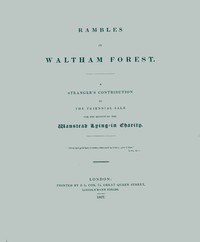
RAMBLES IN WALTHAM FOREST.
STRANGER’S CONTRIBUTION
FOR THE BENEFIT OF THE
=Wanstead Lying-in Charity.=
“Silver and gold have I none;—but such as I have, give I thee.” ACTS, iii. 6.
LONDON: PRINTED BY J. L. COX, 75, GREAT QUEEN STREET, LINCOLN’S-INN FIELDS.
The poem opens with an apostrophe to Waltham Forest as a 'Land of soft showers and far-extending vales,' immediately establishing a tone of pastoral reverence. The speaker, identifying as a 'pilgrim foot' and 'stranger,' frames the work as a charitable contribution, not a personal claim. The verse is formal, with regular couplets and elevated diction, yet the voice remains modest: 'Not mine to wake the poet's golden lyre.' This tension between ambition and humility recurs throughout.
A Self-Conscious Poet in a Pastoral Frame
The speaker repeatedly downplays her poetic skill, calling her work a 'simple lay' and her instrument an 'oaten stop and simple shepherd's reed.' This modesty topos is not merely conventional; it is tied to the poem's charitable purpose. The opening epigraph from Acts—'Silver and gold have I none;—but such as I have, give I thee'—positions the poem itself as the gift. The voice is that of an outsider ('not mine own—but still dear clime'), which allows the poet to praise without presumption. The forest is described in broad, idealized strokes: 'golden meadow,' 'sweet sylvan shades,' 'health-restoring breeze.' There is little specific topography; instead, the landscape functions as a setting for moral and emotional reflection.
From Nature to Charity: The Poem's Turn
After the initial descriptive passage, the poem shifts abruptly to a direct address to 'benignant Charity.' The transition is marked by a change in tone: the gentle, flowing couplets become more urgent and rhetorical. The speaker asks, 'Can’st thou want advocates?' and invokes biblical authority ('Go and do likewise!'). The language becomes more abstract, with personified virtues like Truth and Charity taking center stage. Truth is described as a 'granite column, firm and unadorned,' a striking image that contrasts with the earlier floral and sylvan imagery. This section is less about the forest and more about the moral imperative of giving, suggesting that the poem's real subject is the act of charity itself, with nature serving as a backdrop.
Rhyme, Rhythm, and the Rhetoric of Appeal
The poem's formal structure reinforces its persuasive aim. The consistent iambic tetrameter couplets create a smooth, almost hypnotic rhythm that suits both description and exhortation. However, the poet occasionally varies the pace with exclamations ('Land!—where rich plenty...') and rhetorical questions ('Is there a duty, nearer than the rest...?'). These devices break the monotony and draw attention to key points. The final section, addressing 'Ye!—in whose softer bosoms,' directly appeals to mothers and caregivers, using a series of parallel clauses that build emotional intensity. The poem ends not with a return to nature but with a plea for charitable action, making the forest a symbolic space where moral reflection is prompted.
Readers should note that the poem's title is somewhat misleading: the 'rambles' are not descriptive walks but a structured argument for charity. The forest is a stage for moral sentiment rather than a specific location. Pay attention to how the poet balances self-deprecation with authority, and how the verse form shifts from pastoral calm to rhetorical urgency. The work is best approached as a occasional poem, written for a specific charitable event, and its value lies in its skillful adaptation of poetic convention to a philanthropic purpose.
Reading about the Countess writing for the lying-in charity brought back my grandmother’s quiet insistence that kindness was a form of home. It felt like the same warmth I found lingering in The Kitten's Garden of Verses — Themes and Context, where small creatures and humble rooms somehow held a whole world’s tenderness. That poem felt like an old photograph, slightly faded but familiar. This one too, familiar.
There are no reviews for this eBook.
There are no comments for this eBook.
Reader reflection
What did you think of this book?
Answer a few questions and save a private reflection on this device.
Your progress
0
/
10
2
Was reading this book enjoyable?
3
Would you encourage someone else to read it?
4
How easy was the book to follow?
5
How well did it match your expectations?
6
Do you expect to return to this book?
7
Could you apply anything you learned?
8
Did you relate to its people, ideas, or situations?
9
What changed or sharpened your thinking?
10