
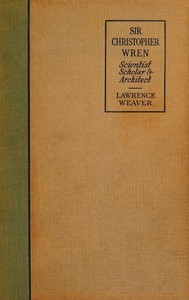
Sir Christopher Wren : Scientist, scholar and architect by Lawrence Weaver
Lawrence Weaver's biography isn't a dry list of dates and buildings. Instead, it paints a full portrait of Christopher Wren, starting long before the Great Fire of London. We meet him first as a brilliant young scientist, making waves in astronomy and anatomy at Oxford. The book shows how this foundation in precise observation and problem-solving became the hidden blueprint for everything he did later.
The Story
The core of the story is a dramatic career pivot. In 1666, the Great Fire destroyed much of London. Almost by accident, Wren—the scholar—was asked to help rebuild it. Weaver guides us through this overwhelming task. We see Wren designing not just the iconic St. Paul's Cathedral, but over 50 city churches, each with its own clever solutions for tight, odd-shaped plots of land. The narrative follows his decades of work, dealing with hesitant committees, changing royal patrons, and the sheer physical challenge of construction in that era. It's the story of a grand vision constantly bumping up against reality, and the resilient genius who kept adapting.
Why You Should Read It
I loved how this book changed my perspective. We remember Wren for his domes and spires, but Weaver makes a compelling case that we should admire him just as much for his mind. The book connects the dots between the curious boy dissecting insects and the man calculating the perfect curve for a cathedral dome. It argues that his scientific rigor is what made his architecture so enduring. You get a real sense of his personality—patient, stubborn, and more dedicated to elegant solutions than to personal fame. It turns a stone monument into a very human story of creativity and perseverance.
Final Verdict
This is a perfect read for anyone who enjoys biographies of fascinating minds, not just architecture fans. It’s for the person who looks at a historical figure and asks, "But how did they actually do that?" Weaver’s writing, though from the early 1900s, is clear and full of respect for his subject without being stuffy. You’ll finish it seeing London’s skyline—and the very idea of a "Renaissance man"—in a completely new light.
No rights are reserved for this publication. It is now common property for all to enjoy.
Steven Hill
3 months agoFast paced, good book.
Matthew Nguyen
10 months agoHaving read this twice, it manages to explain difficult concepts in plain English. Truly inspiring.




Charles Harris
1 year agoLoved it.