
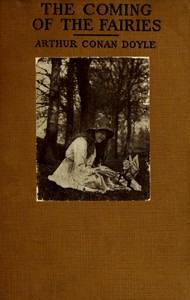
The Coming of the Fairies by Arthur Conan Doyle
Let's set the scene. It's the 1920s. The world is reeling from the unimaginable horrors of World War I. Arthur Conan Doyle, famous for creating the hyper-logical Sherlock Holmes, is personally shattered by the loss of his son and brother. He finds solace in Spiritualism, the belief that the living can communicate with the dead. Into this grieving, hopeful world drops a bombshell: two photographs from Cottingley, England, taken by young cousins Elsie Wright and Frances Griffiths. The pictures show the girls, seemingly interacting with delicate, winged fairies.
The Story
This book isn't a novel. It's Doyle's earnest case file. He lays out the photographs, interviews the girls (who stuck to their story), and consults experts. He argues passionately that the girls were too simple and honest to pull off such a complex hoax, and that the fairies' movements were too natural to be cardboard cutouts. Doyle travels to Cottingley himself, convinced by the rural setting and the girls' sincerity. He publishes the photos and his findings in a magazine, causing a public sensation. The book collects his writings, presenting what he believed was undeniable proof of a magical world, existing just beside our own, finally revealed by modern photography.
Why You Should Read It
The magic here isn't in the fairies—it's in watching a brilliant mind at a crossroads. Doyle isn't a fool; he's a man in profound pain, looking for a crack in a bleak, materialistic world. Reading his arguments, you can feel his yearning. He wants the mystery to be real. He needs there to be more than just the grim reality he's living in. That human desire is far more compelling than any sprite. It transforms the book from a failed detective story into a poignant psychological portrait. You're not just reading about fairies; you're reading about hope, grief, and the stories we tell ourselves to survive.
Final Verdict
This book is perfect for history buffs who love weird cultural moments, for fans of Sherlock Holmes curious about his creator's blind spot, and for anyone fascinated by the psychology of belief. It's not a convincing case for fairies, but it is a stunningly convincing case for the power of human need. If you approach it as a curious artifact of its time—a snapshot of a famous man's heart and mind—you'll find it absolutely captivating.
You are viewing a work that belongs to the global public domain. It serves as a testament to our shared literary heritage.
Barbara Davis
7 months agoMy first impression was quite positive because the author manages to bridge the gap between theory and practice effectively. I'm glad I chose this over the other alternatives.
Joseph Thomas
11 months agoThe layout of the digital version made it easy to start immediately, the attention to detail regarding the core terminology is flawless. A solid investment for anyone's personal development.
Richard Williams
1 year agoAs someone working in this industry, I found the insights very accurate.
Mary Jackson
1 year agoThe digital index is well-organized, making research much faster.


Ashley Brown
1 year agoInitially, I was looking for a specific answer, but the concise summaries at the end of each section are a lifesaver. I feel much more confident in my knowledge after finishing this.