1

The complete works of John Gower, volume 3 — Context and Discussion
(0 User reviews)
1710
Project Gutenberg
2023
Not confirmed
Poetry
Readers of public-domain and historical texts
Project Gutenberg digital edition
en
Edition facts
Words
209,860
Reading time
913 min
Text sections
56
The complete works of John Gower, volume 3 — Context and Discussion can be approached with a clearer sense of reading commitment from its source measurements: 209,860 words, 15 hr 13 min estimated reading time, and 56 detected text sections.
The text analysis averages about 10.5 words per sentence, while the detected sections provide another way to judge how the source is divided.
Project Gutenberg metadata also associates the work with “Poetry,” connecting these edition facts with the source record’s subject description.
Source:
Project Gutenberg record #71433
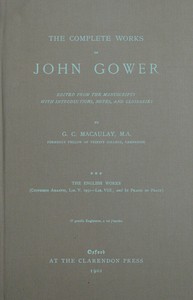
This volume of Gower's English works contains the latter half of Confessio Amantis (Books V–VIII) and the poem In Praise of Peace, edited from manuscripts by G. C. Macaulay with notes and glossary.
Editorial Edition Score
4.9/5
★★★★★
★★★★★
Calculated from edition completeness, EPUB availability, text structure and catalogue metadata. Not a user rating.
How this score is calculated
- Description quality20 pts
- Title & short description10 pts
- Source metadata20 pts
- Text length15 pts
- Chapters / structure15 pts
- EPUB file integrity20 pts
Total of 100 points, scaled to a 2.5-5.0 range. Editions with an empty description or a missing EPUB file are not scored.
Edition quality
Read the Text
ihte achieve With werre Rome forto grieve; Wherof was gret envie tho. And fell that ilke time so, [Sidenote: =P. ii. 196=] That Rome hadde werres stronge Ayein Cartage, and stoden longe The tuo Cites upon debat. Cartage sih the stronge astat[12] 2050 Of Rome in thilke Mirour stonde, And thoghte al prively to fonde To overthrowe it be som wyle. And Hanybal was thilke while The Prince and ledere of Cartage, Which hadde set al his corage Upon knihthod in such a wise,[13] That he be worthi and be wise And be non othre was conseiled,[14] Wherof the world is yit merveiled 2060 Of the maistries that he wroghte Upon the marches whiche he soghte. And fell in thilke time also, The king of Puile, which was tho, Thoghte ayein Rome to rebelle, And thus was take the querele, Hou to destruie this Mirour. Of Rome tho was Emperour[15] Crassus, which was so coveitous, That he was evere desirous 2070 Of gold to gete the pilage; Wherof that Puile and ek Cartage With Philosophres wise and grete Begunne of this matiere trete,[16] And ate laste in this degre Ther weren Philosophres thre, [Sidenote: =P. ii. 197=] To do this thing whiche undertoke, And therupon thei with hem toke A gret tresor of gold in cophres,[17] To Rome and thus these philisophres 2080 Togedre in compainie wente, Bot noman wiste what thei mente. Whan thei to Rome come were, So prively thei duelte there, As thei that thoghten to deceive: Was non that mihte of hem perceive, Til thei in sondri stedes have Here gold under the ground begrave In tuo tresors, that to beholde Thei scholden seme as thei were olde. 2090 And so forth thanne upon a day Al openly in good arai To themperour thei hem presente, And tolden it was here entente To duellen under his servise. And he hem axeth in what wise; And thei him tolde in such a plit, That ech of hem hadde a spirit,[18] The which slepende a nyht appiereth And hem be sondri dremes lereth 2100 After the world that hath betid. Under the ground if oght be hid Of old tresor at eny throwe, They schull it in here swevenes knowe; And upon this condicioun, Thei sein, what gold under the toun [Sidenote: =P. ii. 198=] Of Rome is hid, thei wole it finde, Ther scholde noght be left behinde,[19] Be so that he the halvendel Hem grante, and he assenteth wel; 2110 And thus cam sleighte forto duelle With Covoitise, as I thee telle. This Emperour bad redily That thei be logged faste by[20] Where he his oghne body lay; And whan it was amorwe day, That on of hem seith that he mette Wher he a goldhord scholde fette: Wherof this Emperour was glad, And therupon anon he bad 2120 His Mynours forto go and myne, And he himself of that covine Goth forth withal, and at his hond The tresor redi there he fond, Where as thei seide it scholde be; And who was thanne glad bot he? Upon that other dai secounde Thei have an other goldhord founde, Which the seconde maister tok Upon his swevene and undertok. 2130 And thus the sothe experience To themperour yaf such credence, That al his trist and al his feith So sikerliche on hem he leith, Of that he fond him so relieved, That thei ben parfitli believed, [Sidenote: =P. ii. 199=] As thogh thei were goddes thre. Nou herkne the soutilete. The thridde maister scholde mete, Which, as thei seiden, was unmete 2140 Above hem alle, and couthe most; And he withoute noise or bost Al priveli, so as he wolde, Upon the morwe his swevene tolde To themperour riht in his Ere, And seide him that he wiste where A tresor was so plentivous Of gold and ek so precious Of jeueals and of riche stones, That unto alle hise hors at ones[21] 2150 It were a charge sufficant. This lord upon this covenant Was glad, and axeth where it was. The maister seide, under the glas, And tolde him eke, as for the Myn He wolde ordeigne such engin, That thei the werk schull undersette[22] With Tymber, that withoute lette Men mai the tresor saufli delve, So that the Mirour be himselve 2160 Withoute empeirement schal stonde: And this the maister upon honde[23] Hath undertake in alle weie. This lord, which hadde his wit aweie And was with Covoitise blent, Anon therto yaf his assent; [Sidenote: =P. ii. 200=] And thus they myne forth withal, The timber set up overal, Wherof the Piler stod upriht; Til it befell upon a nyht 2170 These clerkes, whan thei were war Hou that the timber only bar The Piler, wher the Mirour stod,-- Here sleihte noman understod,-- Thei go be nyhte unto the Myne With pich, with soulphre and with rosine, And whan the Cite was a slepe,[24] A wylde fyr into the depe They caste among the timberwerk, And so forth, whil the nyht was derk, 2180 Desguised in a povere arai Thei passeden the toun er dai. And whan thei come upon an hell, Thei sihen how the Mirour fell, Wherof thei maden joie ynowh, And ech of hem with other lowh, And seiden, ‘Lo, what coveitise Mai do with hem that be noght wise!’ And that was proved afterward, For every lond, to Romeward 2190 Which hadde be soubgit tofore, Whan this Mirour was so forlore And thei the wonder herde seie, Anon begunne desobeie With werres upon every side; And thus hath Rome lost his pride [Sidenote: =P. ii. 201=] And was defouled overal. For this I finde of Hanybal, That he of Romeins in a dai, Whan he hem fond out of arai, 2200 So gret a multitude slowh, That of goldringes, whiche he drowh[25] Of gentil handes that ben dede, Buisshelles fulle thre, I rede, He felde, and made a bregge also, That he mihte over Tibre go Upon the corps that dede were Of the Romeins, whiche he slowh there.[26] Bot now to speke of the juise, The which after the covoitise 2210 Was take upon this Emperour, For he destruide the Mirour; It is a wonder forto hiere. The Romeins maden a chaiere And sette here Emperour therinne, And seiden, for he wolde winne Of gold the superfluite, Of gold he scholde such plente Receive, til he seide Ho: And with gold, which thei hadden tho 2220 Buillende hot withinne a panne, Into his Mouth thei poure thanne. And thus the thurst of gold was queynt, [Sidenote: [COVEITISE.]] With gold which hadde ben atteignt. [Sidenote: Confessor.] Wherof, mi Sone, thou miht hiere, Whan Covoitise hath lost the stiere[27] [Sidenote: =P. ii. 202=] Of resonable governance, Ther falleth ofte gret vengance. For ther mai be no worse thing Than Covoitise aboute a king: 2230 If it in his persone be, It doth the more adversite; And if it in his conseil stonde, It bringth alday meschief to honde Of commun harm; and if it growe Withinne his court, it wol be knowe, For thanne schal the king be piled. The man which hath hise londes tiled, Awaiteth noght more redily The Hervest, than thei gredily 2240 Ne maken thanne warde and wacche, Wher thei the profit mihten cacche: And yit fulofte it falleth so, As men mai sen among hem tho, That he which most coveiteth faste Hath lest avantage ate laste. For whan fortune is therayein, Thogh he coveite, it is in vein; The happes be noght alle liche, On is mad povere, an other riche, 2250 The court to some doth profit, And some ben evere in o plit; And yit thei bothe aliche sore Coveite, bot fortune is more Unto that o part favorable. And thogh it be noght resonable, [Sidenote: =P. ii. 203=] This thing a man mai sen alday, Wherof that I thee telle may A fair ensample in remembrance, Hou every man mot take his chance 2260 Or of richesse or of poverte. Hou so it stonde of the decerte, Hier is noght every thing aquit, For ofte a man mai se this yit, That who best doth, lest thonk schal have; It helpeth noght the world to crave, Which out of reule and of mesure Hath evere stonde in aventure Als wel in Court as elles where: And hou in olde daies there 2270 It stod, so as the thinges felle, I thenke a tale forto telle.
This third volume of G. C. Macaulay's edition presents the second half of John Gower's Confessio Amantis (from Book V, line 1971, through Book VIII) and the shorter poem In Praise of Peace. The text is based on manuscript collations, with variant readings and editorial corrections recorded in the apparatus. Macaulay's notes and glossary, included here, reflect a philological approach typical of early twentieth-century scholarship.
Editorial Apparatus and Textual Emendations
The volume opens with a list of corrigenda and addenda that silently corrects punctuation and restores manuscript readings—for instance, changing “inital” to “initial” on page 548 and adjusting line references in footnotes. These emendations, drawn from multiple manuscripts (sigla such as S, Ad, B, T, Δ appear in the notes), show Macaulay's method of collation. The text itself is presented with marginal Latin summaries and occasional glosses, as seen in the passage where the Latin rubric introduces the story of Apollonius and Thaise. Readers should note that the editorial interventions are limited to obvious errors; the Middle English spelling is largely preserved, with forms like “schal” (for “shall”) and “noght” (for “not”) retained.
Narrative Structure in the Apollonius Episode
The excerpt from Book VIII recounts the reunion of King Apollonius with his daughter Thaise, a scene that alternates between direct dialogue and narrated action. Thaise's approach to her father—first through music, then through riddling speech (“in proverbe and in probleme / Sche spak”)—gradually draws him out of despair. The passage uses a repeated structural pattern: Thaise descends into the dark ship, speaks, is rebuffed, persists, and finally touches the king, who strikes her before recognizing her. This sequence of approach, rejection, and recognition is framed by the Latin marginalia, which summarize the action in a different register. The interplay between the English verse and the Latin commentary offers a layered reading experience.
Thematic Concerns: Fortune and Recognition
Within the Apollonius story, the theme of fortune is explicit: “So goth the world, now wo, now wel.” The king's restoration is attributed to divine will (“god, which wot here hol entente”), and the recognition scene hinges on Thaise's patient revelation of her identity. The narrator comments that “a man mai liere / What is to be so sibb of blod,” emphasizing the natural bond of kinship. This episode, while part of a larger confessional framework, stands as a self-contained narrative of loss and recovery. The catalog subject “Poetry” accurately describes the work, but the excerpts reveal a strong narrative and dramatic element that goes beyond lyric or didactic verse.
Readers approaching this volume will benefit from familiarity with Middle English orthography and Macaulay's editorial conventions. The notes and glossary are essential for navigating the text's allusions and lexical choices. The volume is best read alongside the earlier two volumes of the complete works, as Macaulay's introduction and notes for the whole poem appear in Volume 2.
There’s a particular quietness in Gower’s late books, a sense of a man looking back over old stories he no longer fully trusts. I found myself thinking of that same wistfulness while turning through Tales and Novels of J. de La Fontaine — Volume 15 — Edition Insights, where even the lighter fables carry a similar, patient shrug at human folly.
There are no reviews for this eBook.
There are no comments for this eBook.
Reader reflection
How did this book work for you?
Your answers remain private and are stored only in this browser.
Your progress
0
/
10
2
How did the book work for you overall?
3
How likely are you to recommend this book?
4
How much effort did this book require?
5
Would you start a conversation about this book?
6
How did the reading compare with what you expected?
7
What was its emotional impact?
8
How original did the book feel?
9
In one sentence, what did you learn?
10