
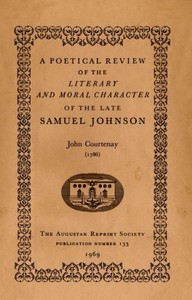
A Poetical Review of the Literary and Moral Character of the late Samuel…
Let's set the scene: London, 1786. The great Samuel Johnson—critic, poet, dictionary-maker—has just passed away. The literary world is in mourning. Then, his friend and fellow MP, John Courtenay, drops this epic poem. It's not a short elegy; it's a full-length, detailed 'review' of the man's life and work, written in rhyming couplets.
The Story
There isn't a plot in the traditional sense. Instead, Courtenay takes us on a guided tour of Johnson's legacy. He starts with genuine praise, celebrating Johnson's brilliant mind and his monumental achievement: the Dictionary of the English Language. He calls him a defender of moral and literary standards. But then, the tone starts to shift. Courtenay doesn't shy away from Johnson's less polished sides. He writes about Johnson's famous bluntness and how it could offend people, his stubborn Tory politics, and even makes gentle (and not-so-gentle) jokes about his large physique and untidy appearance. The poem swings back and forth, from lofty praise to cheeky observation, creating a portrait that is anything but simple.
Why You Should Read It
This book is a personality capsule. It shows us how a contemporary—a friend, no less—saw a legend. Today, Johnson is a marble bust of English literature. Here, he's a real, complicated, and sometimes difficult person. The most compelling part is figuring out Courtenay's true feelings. Is he honoring Johnson by presenting the whole, unfiltered truth? Or is there a layer of resentment or rivalry peeking through the fancy verses? Reading it feels like eavesdropping on 18th-century intellectuals. You get the public praise and the private sighs all in one package. It makes history feel alive, messy, and human.
Final Verdict
Perfect for history buffs who are tired of dry biographies, or for anyone who loves a good literary mystery. If you enjoy Boswell's Life of Johnson but sometimes wished for a bit more gossip, this is your unofficial companion. It’s also a great pick for writers, because it’s a masterclass in layered meaning and subtext. Fair warning: the 18th-century poetic style takes a few pages to get used to, but once you're in, it's utterly absorbing. This isn't a definitive biography; it's a fascinating, opinionated, and unforgettable snapshot.
This is a copyright-free edition. It serves as a testament to our shared literary heritage.
John Jones
1 year agoAfter a thorough walkthrough of the table of contents, the nuanced approach to the central theme was better than I expected. It’s hard to find this much value in a single source these days.
Richard Wilson
9 months agoI stumbled upon this title during my weekend research and the objective evaluation of the pros and cons is very refreshing. This should be on the reading list of every serious professional.


Nancy Perez
8 months agoThe clarity of the introduction set high expectations, and the structural organization allows for quick referencing of key points. I'll be recommending this to my students and colleagues alike.