
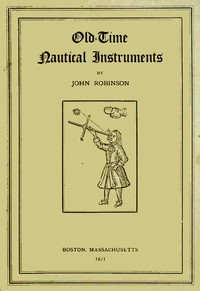
Old-Time Nautical Instruments by John Robinson
John Robinson's Old-Time Nautical Instruments is a journey back to the days when maps had dragons on the edges and navigation was part guesswork, part prayer, and part sheer genius. Published in the early 20th century, Robinson acts as a guide through centuries of maritime technology, from the simple magnetic compass to the complex mariner's astrolabe.
The Story
There isn't a single plot with characters, but there is a clear narrative: humanity's fight against a vast, trackless sea. Robinson starts with the basics, like the log line (used to measure speed) and the lead line (for checking depth). He then walks us through the evolution of tools for 'finding latitude'—how far north or south you are. This is where things get fascinating. We see the cross-staff, where a sailor literally had to stare at the sun (ouch!), and its successor, the back-staff, which was a bit easier on the eyes. The crown jewel is the sextant, the instrument that finally gave sailors reliable accuracy. Robinson explains how each one worked in plain language, often pointing out their flaws and why they were so hard to use on a rocking ship in the middle of a storm.
Why You Should Read It
What makes this book special is that it never loses sight of the people. It's not just a catalog of gadgets. When Robinson describes a navigator taking a noon sight with an astrolabe, you feel the pressure. One mistake in the calculation could mean missing a tiny island and sailing on to oblivion. It turns cold brass and wood into symbols of hope and desperation. You gain a huge appreciation for the explorers we read about in school. Columbus, Magellan, Cook—they weren't just brave; they were technically skilled, interpreting shaky data from these instruments to pull off the impossible. It completely changes how you see those old sea voyages.
Final Verdict
This is the perfect book for anyone with a curious mind about how things used to work. It's a hit for history buffs, especially those into maritime or exploration history. Sailors and boaters will love seeing the ancient roots of their modern GPS. It's also great for makers and tinkerers, as the descriptions of mechanical ingenuity are brilliant. Fair warning: it's an older book, so don't expect flashy pictures. But if you enjoy a clear, respectful explanation of lost technology and the human drama behind it, you'll be hooked. It's a quiet, powerful reminder of how we found our way before satellites.
There are no legal restrictions on this material. You can copy, modify, and distribute it freely.
Melissa Jones
1 year agoI started reading out of curiosity and the depth of research presented here is truly commendable. I learned so much from this.
Mary Martin
2 months agoI started reading out of curiosity and the pacing is just right, keeping you engaged. I couldn't put it down.
Thomas Thompson
3 months agoGreat digital experience compared to other versions.
Andrew Torres
1 year agoAs someone who reads a lot, the character development leaves a lasting impact. One of the best books I've read this year.








Mark Jackson
1 year agoGreat reference material for my coursework.