1

An Elegy on the Glory of Her Sex, Mrs. Mary Blaize — A Closer Reading
(0 User reviews)
1952
Project Gutenberg
2005
Not confirmed
Humorous poetry, English; Picture books for children
Readers of public-domain and historical texts
Project Gutenberg digital edition
en
Edition facts
Words
3,615
Reading time
16 min
Text sections
1
The source record for An Elegy on the Glory of Her Sex, Mrs. Mary Blaize — A Closer Reading measures this digital text at 3,615 words, 16 min estimated reading time, and 1 detected text section.
The text analysis averages about 22.7 words per sentence, while the detected sections provide another way to judge how the source is divided.
Project Gutenberg metadata also associates the work with “Humorous poetry, English,” connecting these edition facts with the source record’s subject description.
Source:
Project Gutenberg record #17117
Oliver Goldsmith's mock elegy for Mrs. Mary Blaize, illustrated by Randolph Caldecott, uses ironic praise and contradictory couplets to satirize social pretension, while the cataloging as 'Science Fiction & Utopias' clashes with its humorous, 18th-century verse.
Editorial Edition Score
4.4/5
★★★★★
★★★★★
Calculated from edition completeness, EPUB availability, text structure and catalogue metadata. Not a user rating.
How this score is calculated
- Description quality20 pts
- Title & short description10 pts
- Source metadata20 pts
- Text length15 pts
- Chapters / structure15 pts
- EPUB file integrity20 pts
Total of 100 points, scaled to a 2.5-5.0 range. Editions with an empty description or a missing EPUB file are not scored.
Edition quality
Read the Text
That had she lived a twelvemonth more,-- _She had not died to-day._
* * * * * * * * * * * * * *
Oliver Goldsmith's An Elegy on the Glory of Her Sex, Mrs. Mary Blaize (1766) is a mock-heroic poem that, in eight quatrains, eulogizes a woman whose virtues are undercut by the poet's sly contradictions. The opening couplet—'Good people all, with one accord, / Lament for Madam Blaize'—immediately establishes a communal call to mourning, but the next line reveals that she 'never wanted a good word— / From those who spoke her praise,' hinting at a gap between reputation and reality. The poem's brevity and rhythmic simplicity belie its layered irony.
Ironic Praise and Contradictory Virtues
Goldsmith constructs Mrs. Blaize's character through a series of paradoxes. She 'freely lent to all the poor— / Who left a pledge behind,' suggesting charity that is not entirely disinterested. Her social graces are similarly double-edged: 'She strove the neighbourhood to please / With manners wondrous winning; / And never follow'd wicked ways— / Unless when she was sinning.' The rhyme of 'winning' with 'sinning' undercuts the praise, implying that her virtue is conditional. Even her piety is suspect: 'At church, in silks and satins new, / With hoop of monstrous size, / She never slumber'd in her pew— / But when she shut her eyes.' The final line transforms a denial of drowsiness into an admission of sleep, using the physical act of shutting eyes as a punchline.
The Mock-Elegiac Structure and Its Subversions
The poem follows the conventional elegy form—lament, praise, and consolation—but subverts each element. The lament is undercut by absurd details: her suitors include 'twenty beaux and more,' and 'The King himself has follow'd her— / When she has walk'd before.' The praise is undermined by the contradictions noted above. The consolation, typically a turn toward eternal reward, is replaced by a bathetic medical report: 'The Doctors found, when she was dead / Her last disorder mortal.' The final stanza offers a mock-consolation: 'That had she lived a twelvemonth more,— / She had not died to-day.' This circular logic parodies the genre's tendency to find meaning in death, reducing it to a tautology.
Cataloging Anomalies: Science Fiction & Utopias
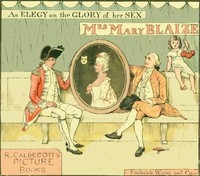
The Project Gutenberg record categorizes this work under 'Science Fiction & Utopias,' a classification that bears no evident relation to the poem's content. The excerpts contain no speculative technology, future settings, or ideal societies. Instead, the poem is a humorous, satirical elegy set in contemporary 18th-century London (referencing Kent Street). This mismatch likely stems from cataloging conventions or errors, not from the text itself. Readers should approach the poem as a period piece of social satire, not as science fiction. The illustrations by Randolph Caldecott, known for his humorous children's books, further reinforce the comic tone, as noted in the publisher's advertisement describing his drawings as 'simply irresistible.'
Goldsmith's poem rewards attention to its verbal economy: each stanza delivers a compact joke or ironic reversal. The illustrations by Caldecott, though not reproduced in this text-only edition, were integral to the book's humor. Readers may wish to seek out a facsimile to see how the images interact with the verse. The poem's brevity makes it ideal for multiple readings, each revealing new layers of mockery.
Years after shelving Goldsmith’s sly little elegy and Caldecott’s gentle mockery, I find myself returning to Ireton, a Poem — Themes and Context with the same fond patience—both works whisper that our grandest postures are often best understood through quiet irony, not loud judgment. There is comfort in that shared, winking honesty.
There are no reviews for this eBook.
There are no comments for this eBook.
Reader reflection
How will you remember this book?
Save your reaction, strongest insight, and memorable passage.
Your progress
0
/
10
2
Was reading this book enjoyable?
3
Would you recommend this book to another reader?
4
How much effort did this book require?
5
What did you think about the pace?
6
Would you like to discuss this book with someone?
7
How strongly did the book affect you emotionally?
8
Did the book deliver what you hoped for?
9
What did this book teach you most?
10