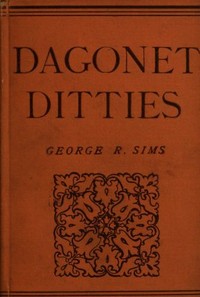
Dagonet Ditties — Key Ideas to Explore

(3 User reviews)   579
Sims, George R. (George Robert), 1847-1922 Project Gutenberg 2018 Not confirmed
English poetry -- 19th century Readers of public-domain and historical texts
Project Gutenberg digital edition en

Edition facts

Words 27,444
Reading time 120 min
Text sections 7

The catalog record for Dagonet Ditties — Key Ideas to Explore provides practical reading context through 27,444 words, 2 hr estimated reading time, and 7 detected text sections.

The text analysis averages about 22.7 words per sentence, while the detected sections provide another way to judge how the source is divided.

Project Gutenberg metadata also associates the work with “English poetry -- 19th century,” connecting these edition facts with the source record’s subject description.

George R. Sims's 1891 collection of light verse from 'The Referee' showcases his sharp eye for London life, social satire, and comic narratives, with a distinctive blend of Cockney dialect, topical humor, and rhythmic play.
Share
Editorial Edition Score 4.6/5

Calculated from edition completeness, EPUB availability, text structure and catalogue metadata. Not a user rating.

How this score is calculated
  • Description quality20 pts
  • Title & short description10 pts
  • Source metadata20 pts
  • Text length15 pts
  • Chapters / structure15 pts
  • EPUB file integrity20 pts

Total of 100 points, scaled to a 2.5-5.0 range. Editions with an empty description or a missing EPUB file are not scored.

Edition quality

Read the Text

odish time then; And she answered me tenderly, “Poppet,” As she came to the top of the stair, “If you see a cab pass you can stop it, For I’ve only to finish my hair.”

It was ten by the clock of St. Stephen’s As I sat and looked glum in the hall, And I offered to wager her evens She would never be ready at all. I counted the half and the quarters-- At eleven I ventured to swear; Then she answered, like one of Eve’s daughters, “All right, dear--I _must_ do my hair.”

I waited till daylight was waning, I waited till darkness began, Upbraiding myself for complaining Like a selfish and bad-tempered man. But when midnight rang out from the steeple I ventured to whisper a prayer, And she answered, “I hate surly people; You _must_ let me finish my hair!”

I paid for the cab and dismissed it, I took off my coat and my hat, I held her fair hand and I kissed it, And I curled myself up on the mat. And when I awoke on the morrow, I cried, “Oh, where art thou, my fair?” And she answered, “Oh, run out and borrow A hairpin or two for my hair.”

The summers have faded to winters, The winters have melted to springs; My patience is shivered to splinters, And still, as she “puts on her things,” My sweet, though I’m weary of waiting, And groan in my bitter despair, Contents herself simply by stating “She’s just got to finish her hair.”

If she’s here when the world’s at its finish, And lists to the last crack of doom, She will watch our poor planet diminish From the window upstairs in her room. And when the last trumpet is blowing, And the angel says, “Hurry up, there!” She will answer, “All right, sir, I’m going, But you _must_ let me finish my hair!”

The Artist’s Dilemma.

The artist was out on the stormy seas, When his vessel turned upside down, And his body was blown by the autumn breeze To the shores of a seaside town. The fisher-folk spied him miles away, And, raising a hearty cheer, They rowed the lifeboat across the bay, And shouted that help was near.

The artist had sunk for the second time, He’d a shark on his starboard tack, But he looked on the boat with a look sublime, And he told them to take it back. “My bones may bleach in the mermaid’s cave, But to art will I e’er be true, And never a man my life shall save In a boat of that vulgar blue.”

They found his body at break of day, It lay on the briny beach, But he soon got better and stole away To the house of a local leech. He took a draught, and he went to bed In a garret that was to spare; And when he awoke his host had fled, For the place had begun to flare.

He was up in a garret against the sky, And a fire had broken out, The flames about him were broad and high, And he heard the people shout. “Oh, come to the window!” the people cried, As they bellowed a mighty cheer; “You’d better come down before you’re fried, For the fire-escape is here.”

He opened the casement wide, and reeled Back through the flame and smoke-- For the fire-escape the light revealed-- And then to the crowd he spoke: “I’ll leap in the jaws of the flames that gape, For I’d rather be picked up dead Than save my life in a fire-escape That is painted a vulgar red.”

They gathered him up with a broom and pan From the pavement where he fell, And they sent for the undertaker’s man, And they toll’d him a passing bell. They gave him a funeral plain but good, And out of the local purse They bought him a coffin of polished wood, Which they put in a pair-horse hearse.

But the artist-spirit in death was strong, And it lifted the coffin-lid While the horses lazily jogged along, And out of the hearse it slid. It raised its body and yelled a curse, And it shouted and cried “Alack! I’m blest if I ride in a beastly hearse That is painted a vulgar black.”

She was a housemaid, tall and slim, A well-conducted, modest girl; Her dress was always neat and trim, She never sported fringe or curl. She did her work, and kept her mind Intent upon her household cares; One fault alone there was to find-- She left her dustpan on the stairs.

She loved her mistress very much, She held her master in respect; Her grief the hardest heart would touch When they’d occasion to correct; But still, in spite of all they said-- In spite of scolding and of prayers-- Ah, me! to what at last it led!-- She left her dustpan on the stairs.

One morn while breakfasting below, And glancing at the _Morning Post_, She heard a wild and sudden “Oh!” That made her drop her buttered toast. She heard a heavy fall--and groans; The master, taken unawares, Had slipped and broken sev’ral bones-- She’d left the dustpan on the stairs.

They sent for doctors by the score, They fetched in haste Sir Andrew Clark; But master’s sufferings soon were o’er-- That night he sat in Charon’s barque. Now in a cell at Colney Hatch A gibbering housemaid groans and glares, And tries with trembling hands to snatch A ghostly dustpan from the stairs.

Ye housemaids who this tale may read, Remember, backs are hard to mend, And injured noses freely bleed, And falls may cause untimely end; Your masters are but mortal men, A neck once broken naught repairs. Oh! think of this, ye housemaids, when You leave the dustpan on the stairs.

(WRITTEN AFTER ONE BOTTLE.)

In the market-place or forum, If you’re dull, my cockalorum, Never heed the censor morum, But just brew yourself a jorum, In a beaker or a cup, Of this stimulating liquor, Which, when life begins to flicker, And your soul grows slowly sicker, And you feel a bucket-kicker, Is a patent pick-me-up.

It was near the Yorkshire Stingo That in modern London lingo, With a face like a flamingo, Said a friend of mine, “By Jingo! What a wretched wreck you are!” I replied, “I’m melancholic, And my pains are diabolic. I, who once was frisk and frolic, Now am glum and vitriolic-- Every nerve is on the jar!”

Then a smile that was sardonic Beamed about his brow Byronic, And he said, “This is masonic, But I think you want a tonic-- Try the famous (something) wine.” And he further said with unction That I need have no compunction In obeying his injunction, ’Twould renew each vital function, And just suit a case like mine.

I have drunk and I’m a giant Quite refreshed and grown defiant; All my limbs are free and pliant, And now neither May nor Bryant Can supply a match to me. Now my pen again grows graphic, And my verse is strictly sapphic, And my tricycle in traffic I can ride with smile seraphic, From all nervous tremors free.

I can laugh at Punch and Judy, And enjoy a book from Mudie; I am spick and span and dudey, And I freely spend my scudi, And I feel that I could fly. I’ve a bearing that is regal, All my acts are strictly legal, And I’ll wager that an eagle, Though he’d taken Mother Seigel, Couldn’t show as clear an eye.

So in market-place or forum, If you’re dull, my cockalorum, Never heed the censor morum, But just brew yourself a jorum, In a beaker or a cup, Of this stimulating liquor, Which, when life begins to flicker, And your soul grows slowly sicker, And you feel a bucket-kicker, Is a patent pick-me-up.

O heart, my heart, that faintly flutters And sinks within my coward breast At every sound a demon utters-- The demon of a wild unrest-- What poison is it in you lurking That taints the rich red stream of life, And leaves your trembling owner shirking The storm and stress of daily strife?

The skies are black as Night’s dark daughters, The Haven’s far, and fierce the sea; Ill-omened birds above the waters Fly low and shriek with evil glee. O, sinking heart, to hope a traitor, If through the storm’s the peace we prize, Bid me sail on--the risk is greater For him who here at anchor lies.

Beat, heart, again with brave endeavour; Beat, heart, with faith in God’s right hand, Stretched out to those who ask it ever To lead them to the Promised Land. Mine eyes to earth no more inclining, I watch the storm that clears the sky; Who’d see the sun in splendour shining Must boldly fix his gaze on high.

Write it up with falt’ring fingers, Write it with a blush of shame, Since no ray of glory lingers ’Mid the temples of our fame. O’er a Christian Church blaspheming, Which has dragged the name of God Through the mire of party scheming, Write the legend “Ichabod.”

Write it where our peers assemble, Dullards decked in solemn state, Though their sires made Europe tremble In the days when we were great. Peers to-day the land encumber, Lazy lords no spur can prod; O’er the House where now they slumber Write the legend “Ichabod.”

Shrined in History’s grandest pages Are the deeds of those who bent Tyrant kings in kingly rages To the will of Parliament. Now but placemen, bores, and traitors Tread the halls that Hampden trod; O’er the House of idle praters Write the legend “Ichabod.”

Once old England’s pride and glory Was that all her sons were free; Ah, to-day how changed the story! Where is now our liberty? Cranks and faddists forge our fetters, Every day we feel the rod, “Grandmamma” in sampler letters Works o’er England “Ichabod.”

Mud in my eyes, and mud on my cheek, My hat that drips, and my boots that leak, And a voice so hoarse that I scarce can speak-- That’s how I went to the Derby.

A fight with a man at the station-gate, Apoplexy through being late, A score in a carriage that seated eight-- That’s how I went to the Derby.

Never a cab for love or oof, The dye running out of my waterproof, Through chalk and water I pad the hoof-- That’s how I got to the Derby.

Smashed and crushed in a crowded pen, Bruised and battered by bustling men, A lamb in a roaring lion’s den-- That’s how I saw the Derby.

“The favourite’s beat!” the millions cry, The next umbrella extracts my eye, And I’ve laid two thousand to one with Fry-- That’s how I liked the Derby.

I’ve lost my temper, I’ve lost my tin; Where is my watch--my chain--my pin? And my boots are letting the water in-- That’s how I left the Derby.

A couple of doctors by my bed, A block of ice on my burning head, And somehow I wish that I was dead-- That’s what came of the Derby.

The brokers in on a bill of sale, Pills and potions of no avail, A jerry-built tomb with a rusty rail-- That’s what came of the Derby.

R.I.P. on a soot-grimed stone, And under my name these words alone: “The biggest juggins that ever was known” Has gone where’s there no more Derby.

Ah, love, my love, as hand in hand, This glorious autumn weather, We stroll along the golden strand, And watch the ships together, We murmur vows we mean to keep, But by next year’s September, How many made beside the deep Shall We Remember?

Old love is dead; new love awakes, And hearts are playthings ever; Though change may mar, ’tis change that makes; Time every link can sever; Though dull love’s fire, to glowing gold We fan the dying ember-- Yet in new love, the love of old Shall We Remember?

The race of life is to the strong, The pace grows fast and faster, The leader takes the field along, And brings the weak disaster. The prize is won! Yet what is fame? A rushlight in November. In twelve short months the victor’s name Shall We Remember?

Paradise and the Sinner.

One morn a sinner at the gate Of Eden stood disconsolate, And as he pondered on the things In life he’d done, his wild oats sowing, He felt the pang that conscience brings, And both his cheeks with shame were glowing.

He thought of all the vows he’d broken, He thought of falsehoods lightly told, Of all the hasty words he’d spoken, And all the tricks he’d played for gold. “Ah me!” he cried, “I own my sin, So, pitying angel, let me in!”

The angel heard the sinner’s tale, He blushed not, neither turned he pale, But “Think you then,” in wrath he cried, “For crimes like these to pass inside? Your life’s not been so badly spent; You must do something worse by far. Come back with something to repent, And then I’ll raise the crystal bar.”

The sinner he flew from the spot sublime Away to the earth below, “I wonder,” he thought, “what kind of crime Is reckoned the worst _en haut_.” He picked a pocket and stole a purse; He plotted against the Crown; He changed two babies put out to nurse, And he left a dog to drown.

“Good,” said the angel as he heard A list of the sinner’s sins; “But this is only about a third Of the crime that entrance wins. Your record, I trow, must be blacker far Before I can raise the crystal bar.”

The sinner flew back to the earth once more, And he steeped his hands in his brother’s gore; He poisoned his wife by slow degrees, And hanged his twins on a couple of trees; And then with a broken and rusty saw He cut off the head of his mother-in-law; And he cried, as a shuddering world turned sick, “If the chaplain’s right I have done the trick.”

Once more he stood before the gate And told his tale and asked his fate. The angel smiled--said, “Right you are,” And swiftly raised the crystal bar. But oh, when the sinner was once inside, “There is some mistake!” he in terror cried, As down in the bottomless pit he fell, And found he had knocked at the gate of hell.

“It was your mistake,” the angel said, “To think that because your hands were red You could pass at once to the realms above, The beautiful realms of peace and love. The clerical gents may tell you so, _But this is the place to which murderers go_.”

Oh, Goschen, hear us groan, Relieve our burdened backs; We weep and wail and moan, “Reduce the income tax!”

It is a wicked plan, And decency it lacks; It makes a Christian man Say, “Hang the income tax!”

Poor Job, he had to bear Some very nasty smacks, But nothing to compare With this infernal tax.

Not all his pains and aches Could put him in a wax; But he’d have shouted, “Snakes!” If asked for income tax.

Oh, take the curse away, The cruel curse that racks: Why should free Britons pay This most un-British tax?

For years has raged the fight, Be yours the cry of “Pax,” And, Britain’s wrongs to right, Remove the income tax.

On earth that deed shall dwell Till all creation cracks, And Fame’s last trumpet tell How Goschen killed the tax.

Do this, and you will forge A deathless battle-axe For England’s new St. George Who slew the income tax.

The Strand was in a dreadful state, And so was Mary Ann They’d gone and raised the postal rate ’Twixt her and her young man.

She might have sent by parcels post Her lover’s Christmas card, But gales were raging round the coast, And it was freezing hard.

What was a poor distracted maid To do in such a case, When only half the odds were laid An hour before the race?

She had a right to see the rules, According to the law; But as the staff were mostly fools, The time was all she saw.

So, losing heart, she gave a groan And, taking off her socks, She dropped them (they were not her own) Inside the pillar-box.

(Her socks, as you may shrewdly guess, Were stockings, truth to tell; For as to-day young ladies dress Socks would not look so well.)

She left her boots to mark the place, And went to Drury Lane; But there was that in Gus’s face Which filled her heart with pain.

He would not pass her to the pit; She said, “I’m on the Press.” She thought he would have had a fit, And burst his evening dress.

“If you are on the Press,” he cried, “You ought to wear your shoes But, as there’s room for one inside, I cannot well refuse.”

He put her in a private box, Which hid her to the knees; And sent to Alias for some frocks, And whispered, “Choose from these.”

She chose a page’s trunks and hose, A fairy’s skirt of gauze, And while she dressed Augustus rose And left amid applause.

Then back she went a fairy queen Into the G.P.O.; She passed the rows of clerks between, And all were bowing low.

They weighed her card with smirk and smile, The stamps with care imposed; The postage was a pound a mile, Because the ends were closed.

But in her fairy garment she Did look so sweet a gal, “O.H.M.S.” was put by the Postmaster-General.

And ere her card her love unclosed Another knot was tied: The P.M.G. himself proposed, And now she is his bride.

If information you would ask, When P.O. clerks are pressed, You’ll find it aid you in your task If you go nicely dressed!

The Feast of Folly is spread, Let us eat and drink and be merry; While the fountains are running red With the juice of the glorious berry. Let us carry the forts of Joy With a series of madcap dashes, Ere the Feast of Flesh, my boy, Gives way to the Fast of Ashes.

We have but a breath of life, A whiff off the world’s wide pleasure; A year of its strain and strife, For a day of its dancing measure. So, hey for the fatted calf, While the carnival music crashes! At the Feast of Flesh we’ll laugh, Ere we weep at the Fast of Ashes.

O, sage with the grim gray face, With our quips is there cause to quarrel? We know ere we run our race We shall master the Mardi’s moral. We shall be as the monks who scourge Their skins with a hundred lashes: Youth’s Feast of the Flesh we must purge With our manhood’s Fast of Ashes.

The bigot, with his narrow mind, Can ill in every pleasure find; He makes his God a god of gloom, The pulsing world a living tomb, A curse in every blessing sees, And, thinking Heaven to appease, He cuts--Religion is his knife-- The blossom from the Tree of Life.

From fogs, that gave that bigot birth, Far off, in many a land of mirth Hearts full of faith in God above Look on Him as a God of Love-- A God who bids His children play, And smiles to see His loved ones gay: As earthly fathers smile to see Their children sing and dance with glee.

Oh, British Sabbath, bigot bred, Our youth’s despair, our childhood’s dread! God does not scowl in solemn state Behind a gloomy prison gate; He smiles enthroned in sunny skies, Where only joyous songs arise. To make God’s day, then, ’twere as well, Seem more like heaven and less like hell.

The captain of the _Cuckoo_ took His glasses from the starboard hook; He gazed across the raging main, Then put his glasses back again. The _Cuckoo’s_ mate remarked, “I guess You saw a signal of distress?” “I did, but it must be ignored; You see, we’ve got the mails aboard.”

George R. Sims, writing under the pen name 'Dagonet,' published these verses in The Referee before collecting them in 1891. The poems range from topical squibs—such as 'A Mild December,' which mocks London's climate and foreign tourists—to character sketches like 'The Reminiscences of Mr. John Dobbs,' where the narrator's voice is filtered through a 'literary friend' who corrects his spelling and grammar. Sims's diction oscillates between colloquial directness and mock-heroic flourishes, as when he addresses the fog as 'sweet fog' and praises its power to 'put the day to rout.'

Rhyme and Meter as Comic Engines

Sims frequently uses anapestic and trochaic rhythms to propel his jokes. In 'The Last Duke,' the meter gallops along with lines like 'They had taken the brightest, the nicest, the best; / They had carefully sorted and sampled the rest,' mimicking the breathless pace of a marriage-market chase. The same poem deploys a regular ABAB rhyme scheme that reinforces the comic inevitability of the duke's escape to France. Elsewhere, in 'To the Fog,' the iambic tetrameter is more stately, but the rhyme pairs 'gloom' with 'room' and 'flare' with 'square,' creating a cozy, sardonic tone. Sims often breaks his own patterns for effect: in 'A Mild December,' the final couplet—'Tis not the clerk (so scandal says) / But I who have been dining'—shifts from broad satire to a self-deprecating punchline, the rhyme 'says/dining' deliberately off-kilter to underscore the speaker's tipsy confession.

Dialect, Class, and the Edited Voice

The most striking formal device in the collection is the framing of 'The Reminiscences of Mr. John Dobbs' as a manuscript 'corrected' by a literary friend. The excerpts show Dobbs's own words—'My pa was a gent who had ha...'—interrupted by the editor's interventions, creating a layered text where class and education are performed through language. Sims does not simply mock Dobbs; the poem's humor derives from the tension between the narrator's earnest self-account and the patronizing polish applied by the friend. This technique recurs in 'Bill Sikes's Protest,' where the voice of a Dickensian villain is ventriloquized in verse, and in 'The Pickpocket Poems,' where criminal slang is set to meter. Sims uses dialect not as mere decoration but as a structural element that raises questions about who gets to tell a story and how.

London as a Stage for Social Satire

Sims's London is a city of contrasts, rendered through specific, concrete details. 'London Day by Day' opens with 'smoke in vaster volumes rolls' and 'the fever fiend takes larger tolls,' immediately establishing a tone of urban decay. Yet the same poem pivots to comic targets: 'Buggins builds on swampy site, / And Eiffel houses block the light.' The reference to the Eiffel Tower, completed in 1889, anchors the satire in contemporary debates about architecture and progress. 'A Mild December' imagines a world where 'the Riviera breaks its heart' because tourists flock to London instead, only to undercut the fantasy with the speaker's hangover. Sims rarely moralizes; instead, he lets incongruous juxtapositions—'The Roman lolls in Drury Lane, / The Turk in Holborn ponders'—do the work of critique. His fog is not a symbol of gloom but a welcome excuse to stay indoors and write.

Recurring Motifs: Fashion, Food, and Folly

Several poems return to the absurdities of fashion and consumption. 'The Eiffel Bonnet' and 'The Shirt Buttons' treat clothing as a site of social anxiety, while 'A Ballad of Soap' elevates hygiene to epic proportions. Sims's eye for the mundane is precise: in 'Those Boots,' a pair of shoes becomes the subject of a comic monologue, and 'The Early Milk-Cart' finds poetry in the clatter of morning deliveries. Food appears as a marker of class and aspiration—'The Income Tax' grumbles about the cost of living, and 'A Domestic Tragedy' turns on a kitchen mishap. These motifs are not random; they build a portrait of a society obsessed with appearances and status, where even the fog is valued for its ability to 'wrap the town in your embrace' and justify a fire. Sims's humor is gentle but pointed, finding the ridiculous in the everyday without losing affection for his subjects.

Readers approaching Dagonet Ditties should listen for the shifts in register—from the mock-heroic to the demotic, from the editor's polish to the raw voice of Mr. Dobbs. Sims wrote for a newspaper audience that appreciated topical jokes and familiar rhythms, but his best poems reward attention to craft: the way a rhyme can undercut a sentiment, or a meter can mimic a character's gait. These are verses meant to be read aloud, and doing so reveals the skill behind their apparent lightness.

There’s something tender about Sims’s London—the rhyme tripping through Cockney alleys, catching a sigh between jokes. I remember finishing Dagonet Ditties and feeling oddly homesick for a city I never knew. Later, Little Songs — Text and Context sat beside it on my shelf, quieter, older somehow. They make strange companions, yet both hum that same low tune: how we laugh because we must.

Jack Jones
2 weeks ago

Matthew Young
3 weeks ago

Daniel Hernandez
4 weeks ago

4.5
4.5 out of 5 (3 User reviews )

Add a Review

Your Rating *
  • ...
    Angela Turner - 1 month ago
    Dagonet Ditties has its charming moments—some jingles are witty and memorable. However, the quality is uneven, with a few pieces feeling forgettable. Fans of light verse will still find pleasure here.

  • ...
    Angela Nguyen - 2 weeks ago
    Dagonet Ditties tries too hard to be clever, but the humor falls flat. Many pieces lack substance, and the verse feels strained. A stronger selection might have saved this collection from mediocrity.

  • ...
    Dustin Bowman - 2 weeks ago
    Dagonet Ditties is a delightful blend of wit and wisdom. The ditties are playful yet profound, with a musicality that makes them easy to enjoy. A refreshing read that leaves a smile and food for thought.


Reader reflection

Take a moment to reflect on this book

Create a short personal record of your experience with this book.

Your progress 0 / 10
1

Which reading stage best describes you?

2

How did the book work for you overall?

3

Would you recommend this book to another reader?

4

Did the language feel accessible?

Related eBooks