1

A Little Book of Bores — Inside the Classic
(0 User reviews)
63
Project Gutenberg
2018
Not confirmed
Humorous poetry; Limericks
Readers of public-domain and historical texts
Project Gutenberg digital edition
en
Edition facts
Words
4,084
Reading time
18 min
Text sections
2
This digital edition of A Little Book of Bores — Inside the Classic is described by source-level measurements including 4,084 words, 18 min estimated reading time, and 2 detected text sections.
The text analysis averages about 22.2 words per sentence, while the detected sections provide another way to judge how the source is divided.
Project Gutenberg metadata also associates the work with “Humorous poetry,” connecting these edition facts with the source record’s subject description.
Source:
Project Gutenberg record #56697
Oliver Herford's alphabet of bores satirizes 26 social types in limericks, from the Autograph Bore to the Kaiser, with wit and precise rhyme.
Editorial Edition Score
4.5/5
★★★★★
★★★★★
Calculated from edition completeness, EPUB availability, text structure and catalogue metadata. Not a user rating.
How this score is calculated
- Description quality20 pts
- Title & short description10 pts
- Source metadata20 pts
- Text length15 pts
- Chapters / structure15 pts
- EPUB file integrity20 pts
Total of 100 points, scaled to a 2.5-5.0 range. Editions with an empty description or a missing EPUB file are not scored.
Edition quality
Read the Text
E-text prepared by Richard Tonsing, David Edwards, and the Online Distributed Proofreading Team (http://www.pgdp.net) from page images generously made available by Internet Archive (https://archive.org)
Note: Project Gutenberg also has an HTML version of this file which includes the original illustrations. See 56697-h.htm or 56697-h.zip: (http://www.gutenberg.org/files/56697/56697-h/56697-h.htm) or (http://www.gutenberg.org/files/56697/56697-h.zip)
Images of the original pages are available through Internet Archive. See https://archive.org/details/littlebookofbore00herfrich
Enclosed italics font in _underscores_.
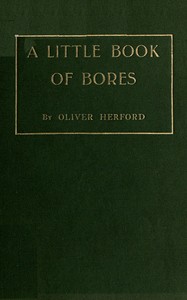
A LITTLE BOOK OF BORES
London Gay and Hancock, Ltd.
------------------------------------------------------------------------
A is the Autograph Bore Whom Authors and Actors deplore, Tho’ it’s evident quite If the Dears ceased to write They’d deplore even more than before.
B is a Bounder _blasé_ Who likes to appear quite _au fait_; He purses his lips As his Rhine wine he sips, Tho’ he doesn’t know Hock from Tokay.
C’s a Critic. Far be it from me With a time-honoured craft to make free. All praise I accord _Good_ Critics—but lord! What a Bore a _bad_ Critic can be!
D is a Decadent Dreary Whose Works are depressing and eerie; If you ask his excuse For existence, or use, I’m afraid I can’t answer your query.
E is the Egotist dread Who, as some one has happily said, Will talk till he’s blue About _my_self, when you Want to talk about _your_self instead.
F’s a Frankly Familiar Friend Who loves free advice to extend; He declares, for his part, He knows nothing of Art, But he thinks that your time you misspend.
G is a Grumbler gruff Whom everything puts in a huff; If he chances to gain Heaven’s gate, he’ll complain Of his Halo or Harp, like enough.
H is a Humorist glum. Why sits he so silent and dumb? He’s concocting some Gay Impromptu to say When the Opportune Moment shall come.
I’s the Intensely Intense Who dilates on the _Whither_ and _Whence_, The _Ego_ (or “I”), And the _Wherefore_ and _Why_, Not to mention the _Hither_ and _Hence_.
J is the “Johnnie”—a Thing Much affected by Fairies who sing. He is human in shape, With the brain of an ape, And generally tied to a string.
K is the Kaiser unnerving, With the Terrible Moustache upcurving. One man who can bore A planet——and more Is surely of mention deserving.
L’s the Loquacious variety, That is found in all sorts of society. He will drink in the sound Of his own voice—till drowned In a species of self-inebriety.
M’s a Methodical Man Who prates with precision and plan. Beware, how you balk The stream of his talk, Lest he go back to where he began.
N is a Newly-rich boor, Whom no one pretends to endure. Some cases with care And complete change of Heir Take three generations to cure.
O is an Optimist glad Who doesn’t know how to be sad; If he wakes up some day In Hades, he’ll say, “Well, really it isn’t so bad.”
P’s a Poetical bore Who recites his own things by the score. The ladies, poor dears, Are all moved to tears, While strong men are moved—to the door.
Q is a Quoter who’ll cite His favourite authors all night. Tho’ teeming with Thought, Like the Moon he is naught But a second-hand dealer in Light.
R’s a Rampant Reformer whose prose Insures you a Health-giving doze. You wouldn’t much mind If he’d only be kind And _not_ slam the door when he goes.
S is a Satirist rude Who subsists on Leguminous Food, Which he shyly maintains So enforces his brains, Even Shakespeare beside him seems crude.
T is a Terrible Tot Who says things he’d much better not. A child of that age Should be kept in a cage, And fed—if at all—through a slot.
U is the Unco Guid Man, And all his unspeakable clan, With their _Braw bonnie brae_, _Bide a wee, Scots wha hae_, _Aweel, Dinna ken_, and _Hoot man_.
V is a Vain Virtuoso. If you ask, “Pray what makes your hair grow so; Do you think it a sign Of Genius divine?” He replies, “I don’t think so, I _know_ so.”
W’s a Well-informed Wight Who aims to set every one right; If you chance to misspell Or misquote, he will swell With holy and chastened Delight.
X is Old Xmas, a dear Old Impostor who comes once a year, With wassail, and wishes, And death-dealing dishes, And chilblains, and chimes, and good cheer.
Oliver Herford's A Little Book of Bores (1912) is a compact alphabet of annoyance, each letter introducing a different species of tedious person in a limerick. The opening poem, 'A is the Autograph Bore,' sets the tone: a wry complaint about those who pester authors and actors for signatures, yet would 'deplore even more than before' if the celebrities stopped writing. The book's structure is its primary joke—a taxonomy of bores, each neatly pinned in five lines.
The Alphabet as a Cage for Bores
Herford uses the alphabet not as a mnemonic but as a formal constraint that mirrors the rigidity of the bores themselves. Each limerick follows a strict AABBA rhyme scheme, and the poet rarely deviates from the pattern. The 'Bounder blasé' who 'purses his lips / As his Rhine wine he sips' is trapped in his own pretension, just as the poem is trapped in its form. The 'Decadent Dreary' and 'Egotist dread' are similarly confined. This structural choice suggests that bores are predictable, their behaviors as fixed as the letters of the alphabet.
Rhyme as a Weapon of Satire
Herford's rhymes are often surprising and pointed. The 'Critic' is praised in general, but 'lord! / What a Bore a bad Critic can be!'—the exclamation 'lord!' breaking the meter to emphasize frustration. The 'Frankly Familiar Friend' who 'knows nothing of Art' but thinks you 'misspend' your time uses a rhyme that lands like a dismissal. The 'Grumbler gruff' who would complain of his 'Halo or Harp' in heaven uses a double rhyme that undercuts the grumbler's seriousness. These verbal tricks keep the reader alert, matching the poet's impatience with his subjects.
Social Types and Their Telltale Details
Herford's bores are recognizable by specific, often trivial behaviors. The 'Loquacious' bore 'will drink in the sound / Of his own voice—till drowned / In a species of self-inebriety.' The 'Methodical Man' who 'prates with precision and plan' threatens to 'go back to where he began' if interrupted. The 'Newly-rich boor' requires 'three generations to cure.' These details are not just funny; they reveal Herford's observation of Edwardian social rituals. The 'Humorist glum' sits 'silent and dumb' while 'concocting some Gay Impromptu'—a paradox that captures the performative nature of wit.
The Kaiser and the Limits of Satire
The inclusion of 'K is the Kaiser unnerving, / With the Terrible Moustache upcurving' is a striking departure from the domestic bores. Herford calls him 'One man who can bore / A planet—and more,' a rare moment of political commentary. The Kaiser's moustache becomes a synecdoche for his menace. This entry suggests that the book's satire can extend beyond social comedy to geopolitical critique, though the rest of the alphabet stays closer to home. The contrast between the Kaiser's scale and the petty bores of everyday life is itself a kind of joke.
Reading A Little Book of Bores as a sequence rewards attention to the cumulative effect: each bore adds a new shade of tedium, and the alphabet form creates a sense of exhaustive cataloging. Herford's limericks are best enjoyed one at a time, but the whole reveals a coherent vision of social irritation. The book's brevity (about 4,000 words) makes it easy to revisit, and the alphabetical structure invites dipping in at any letter.
Reading Herford’s bores, I remembered my uncle, who could turn any silence into a lecture. He’d dissect a sunset until it felt like a specimen. Then I found On poetic interpretation of nature — Reading Notes, and it softened that memory, showing me how naming things can be a kind of tenderness, not just a pinning down.
There are no reviews for this eBook.
There are no comments for this eBook.
Reader reflection
Before you leave, reflect on the book
Use these questions to collect your thoughts before moving on.
Your progress
0
/
10
2
Did this book hold your interest?
3
Would you pass this book on to a friend?
4
What was the reading difficulty like?
5
Did the book give you something worth debating?
6
Do you expect to return to this book?
7
Which aspect of the book did you value most?
8
What was its emotional impact?
9
Which lesson or insight stayed with you?
10