1

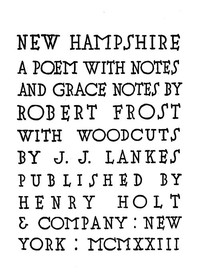
New Hampshire, A Poem; with Notes and Grace Notes — Themes and Context
(0 User reviews)
232
Project Gutenberg
2019
Not confirmed
American poetry -- 20th century; New Hampshire -- Poetry
Readers of public-domain and historical texts
Project Gutenberg digital edition
en
Edition facts
Words
23,534
Reading time
103 min
Text sections
4
Before opening New Hampshire, A Poem; with Notes and Grace Notes — Themes and Context, the edition data offers a quick orientation: 23,534 words, 1 hr 43 min estimated reading time, and 4 detected text sections.
The text analysis averages about 19.5 words per sentence, while the detected sections provide another way to judge how the source is divided.
Project Gutenberg metadata also associates the work with “American poetry -- 20th century,” connecting these edition facts with the source record’s subject description.
Source:
Project Gutenberg record #58611
Robert Frost's 1923 collection combines a long title poem satirizing state-boosting with notes and grace notes—shorter lyrics including 'Stopping by Woods on a Snowy Evening' and 'Fire and Ice.' The excerpts show a conversational, anecdotal voice and a preoccupation with selling, work, and the supernatural.
Editorial Edition Score
4.6/5
★★★★★
★★★★★
Calculated from edition completeness, EPUB availability, text structure and catalogue metadata. Not a user rating.
How this score is calculated
- Description quality20 pts
- Title & short description10 pts
- Source metadata20 pts
- Text length15 pts
- Chapters / structure15 pts
- EPUB file integrity20 pts
Total of 100 points, scaled to a 2.5-5.0 range. Editions with an empty description or a missing EPUB file are not scored.
Edition quality
Read the Text
raveyards And vindicate the state’s humanity. “Just the way Steffanson runs on,” I murmured, “About the British Arctic. That’s what comes Of being in the market with a climate.”
I met a poet from another state, A zealot full of fluid inspiration, Who in the name of fluid inspiration, But in the best style of bad salesmanship, Angrily tried to make me write a protest (In verse I think) against the Volstead Act. He didn’t even offer me a drink Until I asked for one to steady _him_. This is called having an idea to sell.
It never could have happened in New Hampshire.
The only person really soiled with trade I ever stumbled on in old New Hampshire Was someone who had just come back ashamed From selling things in California. He’d built a noble mansard roof with balls On turrets like Constantinople, deep In woods some ten miles from a railroad station, As if to put forever out of mind The hope of being, as we say, received. I found him standing at the close of day Inside the threshold of his open barn, Like a lone actor on a gloomy stage— And recognized him through the iron grey In which his face was muffled to the eyes As an old boyhood friend, and once indeed A drover with me on the road to Brighton. His farm was “grounds,” and not a farm at all; His house among the local sheds and shanties Rose like a factor’s at a trading station. And he was rich, and I was still a rascal. I couldn’t keep from asking impolitely, Where had he been and what had he been doing? How did he get so? (Rich was understood.) In dealing in “old rags” in San Francisco. Oh it was terrible as well could be. We both of us turned over in our graves.
Just specimens is all New Hampshire has, One each of everything as in a show-case Which naturally she doesn’t care to sell.
She had one President (pronounce him Purse, And make the most of it for better or worse. He’s your one chance to score against the state). She had one Daniel Webster. He was all The Daniel Webster ever was or shall be. She had the Dartmouth needed to produce him.
I call her old. She has one family Whose claim is good to being settled here Before the era of colonization, And before that of exploration even. John Smith remarked them as he coasted by Dangling their legs and fishing off a wharf At the Isles of Shoals, and satisfied himself They weren’t Red Indians but veritable Pre-primitives of the white race, dawn people, Like those who furnished Adam’s sons with wives; However uninnocent they may have been In being there so early in our history. They’d been there then a hundred years or more. Pity he didn’t ask what they were up to At that date with a wharf already built, And take their name. They’ve since told me their name— Today an honored one in Nottingham.
As for what they were up to more than fishing— Suppose they weren’t behaving Puritanly, The hour had not yet struck for being good, Mankind had not yet gone on the Sabbatical. It became an explorer of the deep Not to explore too deep in others’ business.
Did you but know of him, New Hampshire has One real reformer who would change the world So it would be accepted by two classes, Artists the minute they set up as artists, Before, that is, they are themselves accepted, And boys the minute they get out of college. I can’t help thinking those are tests to go by.
And she has one I don’t know what to call him, Who comes from Philadelphia every year With a great flock of chickens of rare breeds He wants to give the educational Advantages of growing almost wild Under the watchful eye of hawk and eagle— Dorkings because they’re spoken of by Chaucer, Sussex because they’re spoken of by Herrick.
She has a touch of gold. New Hampshire gold—[2] You may have heard of it. I had a farm Offered me not long since up Berlin way With a mine on it that was worked for gold; But not gold in commercial quantities. Just enough gold to make the engagement rings And marriage rings of those who owned the farm. What gold more innocent could one have asked for?
The title poem of Robert Frost's 1923 collection opens not with landscape but with a series of encounters on a train. A lady from the South declares her family never worked or sold anything; a traveler from Arkansas boasts of diamonds and apples; a Californian claims no one dies a natural death there. Frost's speaker undercuts each boast with a dry, deflating remark. This pattern—state-boosting met with skepticism—sets the tone for a poem that is less a celebration of New Hampshire than a meditation on what it means to have something to sell, whether goods, climate, or ideas. The excerpts reveal a voice that is colloquial, anecdotal, and wary of salesmanship.
Conversational Encounters and the Critique of Boasting
The opening of 'New Hampshire' is structured as a series of reported conversations. Each visitor promotes their state with a claim that strains credulity: the Southerner's pride in idleness, the Arkansan's commercial diamonds, the Californian's climate that prevents natural death. Frost's speaker responds with pointed understatement—'I see the porter's made your bed'—or a murmured comparison to Arctic explorer Steffanson. The poem's voice is that of a listener who lets others talk themselves into absurdity. This technique establishes a skeptical, ironic stance toward regional pride and the rhetoric of selling. The speaker himself admits to having worked, but the disgrace, he suggests, lies in having something to sell. The excerpts do not reveal whether the poem ever turns to a direct description of New Hampshire itself, leaving the reader to wonder if the state is defined mainly by contrast.
The Supernatural in Domestic Settings
The note 'The Witch of Coös' presents a ghost story told in dialect by a mother and son. The mother describes a skeleton that climbed from the cellar to the attic, its bones moving 'like a pile of dishes' and 'like lightning or a scribble.' The son interrupts to ask about the headboard pushed against the attic door. The mother's narrative is matter-of-fact, even humorous—she struck the hand off 'brittle on the floor' and later finds a finger-piece in her button-box. The supernatural here is not gothic but domestic, embedded in the details of a rural household: a bulkhead double-locked, cellar windows banked with sawdust, a bed 'just as well be ice.' The poem's power comes from the tension between the mother's casual tone and the eerie event. The excerpts do not reveal the poem's resolution, leaving the skeleton's motive ambiguous.
Structure and the Role of the 'Grace Notes'
The collection is divided into three parts: the long title poem, 'Notes,' and 'Grace Notes.' The excerpts from the table of contents show that the 'Notes' include narrative poems like 'The Witch of Coös' and 'Paul's Wife,' while the 'Grace Notes' are shorter lyrics such as 'Fire and Ice,' 'Nothing Gold Can Stay,' and 'Stopping by Woods on a Snowy Evening.' This structure suggests a deliberate contrast between the expansive, conversational mode of the title poem and the compressed, often epigrammatic style of the grace notes. The woodcuts by J. J. Lankes, mentioned on the title page, are not represented in the text excerpts, but their presence indicates a visual component that may complement the poems' rural imagery. The catalog subjects list 'American poetry -- 20th century' and 'New Hampshire -- Poetry,' but the excerpts show that the book's engagement with place is mediated through irony and anecdote rather than straightforward description.
Readers approaching this collection should attend to the interplay between the long title poem and the shorter pieces that follow. The excerpts suggest that Frost is less interested in documenting New Hampshire than in using it as a foil for exploring human attitudes—boasting, selling, believing in ghosts. The conversational openings and the domestic supernatural of 'The Witch of Coös' reward attention to voice and detail. The grace notes, though brief, may resonate with themes introduced earlier. The woodcuts by Lankes, though not excerpted, are worth seeking in the original edition for their visual commentary.
I keep thinking about Frost’s quiet awe before snow and fire, that way he turns ordinary weather into something haunting. It reminded me of another old friend’s verses, where everyday work and homesickness feel just as gently strange. Boys and Girls The Verses of James W. Foley — Inside the Classic sits beside it in my mind, soft and unhurried, like two voices sharing a porch at dusk.
There are no reviews for this eBook.
There are no comments for this eBook.
Reader reflection
What was your reading experience?
Capture what you thought, learned, and would like to remember.
Your progress
0
/
10
2
How much did you enjoy the reading experience?
3
How likely are you to recommend this book?
4
How much effort did this book require?
5
Would you read this book again?
6
Would you like to discuss this book with someone?
7
Was the book what you thought it would be?
8
How would you describe its reading pace?
9
Which lesson or insight stayed with you?
10