1

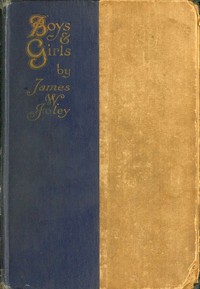
Boys and Girls The Verses of James W. Foley — Inside the Classic
(0 User reviews)
1516
Project Gutenberg
2020
Not confirmed
American poetry -- 20th century; Children's poetry, American
Readers of public-domain and historical texts
Project Gutenberg digital edition
en
Edition facts
Words
39,567
Reading time
173 min
Text sections
8
For Boys and Girls The Verses of James W. Foley — Inside the Classic, the stored edition analysis reports 39,567 words, 2 hr 53 min estimated reading time, and 8 detected text sections.
The text analysis averages about 31.5 words per sentence, while the detected sections provide another way to judge how the source is divided.
Project Gutenberg metadata also associates the work with “American poetry -- 20th century,” connecting these edition facts with the source record’s subject description.
Source:
Project Gutenberg record #63514
James W. Foley's 1913 collection of over 80 poems for children, featuring recurring images of play, family, and small-town life, with a focus on the structure of childhood routines and the movement between indoor and outdoor scenes.
Editorial Edition Score
4.7/5
★★★★★
★★★★★
Calculated from edition completeness, EPUB availability, text structure and catalogue metadata. Not a user rating.
How this score is calculated
- Description quality20 pts
- Title & short description10 pts
- Source metadata20 pts
- Text length15 pts
- Chapters / structure15 pts
- EPUB file integrity20 pts
Total of 100 points, scaled to a 2.5-5.0 range. Editions with an empty description or a missing EPUB file are not scored.
Edition quality
Read the Text
ildren as though there’s just one!
BILLY PEEBLE’S CHRISTMAS
Billy Peeble, he ain’t got no parents--never had none, ’cause When he’s borned he was an orfunt; an’ he said ’at Santa Claus Never didn’t leave him nothin’, ’cause he was a county charge, An’ the overseer told him that his fambly was too large To remember orfunt children; so I ast Ma couldn’t we Have Bill Peeble up to our house, so’s to see our Christmas tree. An’ she ast me if he’s dirty; an’ I said I guessed he was, But I didn’t think it makes no difference with Santa Claus.
My his clo’es was awful ragged! Ma, she put him in a tub An’ she poured it full of water, an’ she gave him such a scrub ’At he ’ist set there an’ shivered; an’ he told me afterwurds ’At he never washed all over out to Overseer Bird’s! ’En she burned his ragged trousies an’ she gave him some of mine; My! she rubbed him an’ she scrubbed him till she almost made him shine, Nen he ’ist looked all around him like he’s scairt for quite a w’ile, An’ even w’en Ma’d pat his head he wouldn’t hardly smile.
’En after w’ile Ma took some flour-sacks an’ ’en she laid ’Em right down at the fireplace, ’ist ’cause she is afraid Santa Claus ’ll soil the carpet when he comes down there, you know; An’ Billy Peeble watched her, an’ his eyes stuck out--’ist so! ’En Ma said ’at in the mornin’ if we’d look down on the sacks ’At they’d be ’ist full of soot where Santa Claus had made his tracks; Billy Peeble stood there, lookin’! An’ he told me afterwurds He was scairt he’d wake right up an’ be at Overseer Bird’s.
Well, ’en she hung our stockin’s up an’ after w’ile she said: “Now, you an’ Billy Peeble better go right off to bed, An’ if you hear a noise tonight, don’t you boys make a sound, ’Cause Santa Claus don’t never come with little boys around!” So me an’ Billy went to bed, an’ Billy Peeble, he Could hardly go to sleep at all--’ist tossed an’ tossed. You see We had such w’ite sheets on the bed an’ he said afterwurds They never had no sheets at all at Overseer Bird’s.
So we ’ist laid an’ talked an’ talked. An’ Billy ast me who Was Santa Claus. An’ I said I don’t know if it’s all true, But people say he’s some old man who ’ist loves little boys An’ keeps a store at the north pole with heaps an’ heaps of toys W’ich he brings down in a big sleigh, with reindeers for his steeds, An’ comes right down the chimbly flue an’ leaves ’ist what you needs. My! he’s excited w’en I told him that! An’ afterwurds He said they never had no toys at Overseer Bird’s.
I’m fallin’ pretty near asleep w’en Billy Peeble said: “Sh-sh! What’s that noise?” An’ w’en he spoke I set right up in bed Till sure enough I heard it in the parlor down below, An’ Billy Peeble, he set up an’ ’en he said: “Le’s go!” So we got up an’ sneaked down stairs, an’ both of us could see ’At it was surely Santa Claus, ’ist like Ma said he’d be; But he must heard us comin’ down, because he stopped an’ said: “You, Henry Blake an’ William Peeble, go right back to bed!”
My goodness, we was awful scairt! An’ both of us was pale, An’ Billy Peeble said up stairs: “My! Ain’t he ’ist a whale!” We didn’t hardly dare to talk and got back into bed An’ Billy pulled the counterpane clear up above his head, An’ in the mornin’ w’en we looked down on the flour-sacks, W’y sure enough we saw the soot where he had made his tracks, An’ Billy got a suit of clothes, a drum, an’ sled an’ books, Till he ’ist never said a word, but my! how glad he looks!
’En after w’ile it’s dinner time an’ Billy Peeble set Right next to Pa, an’ my! how he ’ist et an’ et an’ et! Till he ’ist puffed an’ had to leave his second piece of pie
James W. Foley's Boys and Girls (1913) gathers over eighty poems that repeatedly return to the physical and emotional geography of childhood. The verses move between kitchen windows, schoolyards, swimming holes, and makeshift battlefields, tracking the daily rhythms of play, chores, and quiet moments. Foley often anchors a poem in a single, vivid scene—a child lost in thought, a group of cadets marching with whittled lath guns—then shifts the perspective to reveal the adult world waiting just beyond the frame.
The collection's structure reinforces this back-and-forth: poems about vacation time and circus days sit alongside lullabies and prayers, while recurring characters like Henry Blake and the Boyville Cadets appear across multiple pieces. Foley's voice is consistently colloquial, favoring dialect and direct address, and his imagery draws heavily on sensory details—the smell of doughnuts, the sound of hoofbeats, the feel of a woolen shirt used as a flag.
Marching Orders and Make-Believe Armies
The Boyville Cadets appear in several poems, most notably in a long narrative that follows their mock battle from formation to funeral. Foley builds the scene through precise, rhythmic details: the clatter and patter of feet, a fife and drum, a willow pole with a red woolen shirt for a flag. The cadets are described as 'mostly barelegged and coatless and brown,' a make-believe army that nonetheless follows strict orders—'Attention! Right shoulder! Guide right!'—until a mother's call breaks the spell. The poem ends with a return to domestic duty: 'there's wood to be split and there's water to get / In the dull private life of the Boyville Cadet.' This movement between grand illusion and mundane reality is a structural pattern Foley repeats throughout the collection.
The Recurring Figure of the Lost Child
Foley returns to the image of a child who is lost—or who feels lost—in several poems. In 'The Lost Child,' the speaker describes a child wandering away from home, while 'The Lost Boy' and 'The Lost Heart' treat emotional absence as a kind of vanishing. The poems often begin with a concrete setting—a street, a garden, a rainy night—then shift inward to the child's perspective. In 'Lonesome,' the speaker notes, 'I quite forgot my cares with him, nor could I well be sad, / As long as he was at my side.' The structure of these poems tends to move from external observation to interior feeling, then back to a resolution that reconnects the child with a parent or home. This pattern gives the collection a consistent emotional arc, even as the subjects vary.
Kitchens, Doughnuts, and Domestic Interiors
Many of Foley's poems are set in or around the kitchen, a space that functions as both a literal and symbolic center. 'Doughnutting Time' describes the smell and bustle of baking, while 'Kitchen Miracles' treats ordinary household tasks as wondrous. The poem 'A Domestic Ripple' uses the kitchen as a stage for family conflict and reconciliation. Foley's attention to sensory detail—the 'nozzle agin' th' bank' in a poem about Paul Revere, the 'old woolen shirt' used as a shroud—grounds these domestic scenes in tangible objects. The movement between kitchen and outdoors is a recurring structural device: a poem may begin with a child at a window, then follow the child outside, only to return to the kitchen at the end. This back-and-forth mirrors the daily rhythm of childhood, where adventure and safety are never far apart.
The Adult World as a Distant Echo
Foley frequently contrasts the child's world with the adult one, often through a shift in tone or perspective. In 'The Strenuous Life,' the speaker mocks adult seriousness, while 'When Grandpa Plays' shows an adult joining a child's game. The poem 'The Barriers' explicitly names the divide: 'They say it's all untrue!'—referring to stories of Paul Revere and Barbara Frietchie that adults dismiss as fiction. Foley's structure here is notable: he builds a vivid, believable scene from a child's point of view, then undercuts it with an adult's skepticism, only to reaffirm the child's version. This three-part movement—innocence, doubt, reaffirmation—appears in several poems, including 'The Delusion of Ghosts' and 'A Modern Miracle.' The adult world is never fully absent; it hovers at the edges of the poems, a reminder of the constraints that await.
Foley's Boys and Girls rewards attention to its small structural patterns: the way a poem about a lost child mirrors a poem about a lost toy, or how the cadets' mock battle echoes the real battles of history that adults debate. Readers may find it useful to track the recurring images of flags, woolen shirts, and wooden swords, and to notice how often a poem ends with a return to the domestic sphere. The collection is best read not as a sequence but as a set of variations on a few themes, each poem a different angle on the same fleeting moment of childhood.
Reading Foley’s poems about children drifting between lamplit kitchens and dusky yards, I remembered my own screen-door summers, that hinge between inside and out. Stray Birds — A Closer Reading gave me that same ache—not for a specific moment, but for the quiet shape of a day that has already passed. Just a soft echo, really.
There are no reviews for this eBook.
There are no comments for this eBook.
Reader reflection
How did this book work for you?
Your answers remain private and are stored only in this browser.
Your progress
0
/
10
2
How much did you enjoy the reading experience?
3
Would you encourage someone else to read it?
4
How much effort did this book require?
5
How understandable was the text?
6
Which part made the strongest impression?
7
How closely did the book connect with your experience?
8
How distinctive were its ideas or approach?
9
What did this book teach you most?
10