1

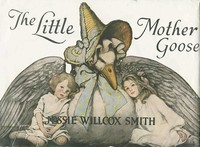
The Little Mother Goose — Background and Themes
(0 User reviews)
297
Project Gutenberg
2007
Not confirmed
Children's poetry; Nursery rhymes
Readers of public-domain and historical texts
Project Gutenberg digital edition
en
Edition facts
Words
19,080
Reading time
83 min
Text sections
6
For The Little Mother Goose — Background and Themes, the stored edition analysis reports 19,080 words, 1 hr 23 min estimated reading time, and 6 detected text sections.
The text analysis averages about 19.6 words per sentence, while the detected sections provide another way to judge how the source is divided.
Project Gutenberg metadata also associates the work with “Children's poetry,” connecting these edition facts with the source record’s subject description.
Source:
Project Gutenberg record #20511
This edition of Mother Goose rhymes, illustrated by Jessie Willcox Smith, pairs nursery classics with moral tags and game instructions. The collection's structure—alternating verse, morals, and play directions—reveals how the rhymes were used to teach behavior, counting, and social roles.
Editorial Edition Score
4.6/5
★★★★★
★★★★★
Calculated from edition completeness, EPUB availability, text structure and catalogue metadata. Not a user rating.
How this score is calculated
- Description quality20 pts
- Title & short description10 pts
- Source metadata20 pts
- Text length15 pts
- Chapters / structure15 pts
- EPUB file integrity20 pts
Total of 100 points, scaled to a 2.5-5.0 range. Editions with an empty description or a missing EPUB file are not scored.
Edition quality
Read the Text
Jockey was a piper's son 40
John, come sell thy fiddle 14
Joseph Smith bought a rake 27
Ladies and gentlemen, come to supper 152
Lady bird, lady bird, fly away home 87
Lady-bug, lady-bug 48
Lazy Tom, with jacket blue 53
Little Bo-Peep has lost her sheep 16
Little Boy Blue, come blow your horn 8
Little Cock Robin peeped out of his cabin 32
Little drops of water 31
Little girl, little girl, where have you been? 33
Little Jack Horner 100
Little King Boggen he built a fine hall 173
Little lad, little lad 32
Little maid, little maid 50
Little maid, pretty maid 34
Little Miss Donnet 41
Little Miss Muffet 32
Little Nancy Etticote 30
Little Poll Parrot 41
Little Polly Flinders 119
Little Robin Red-breast sat upon a rail 29
Little Tommy Grace 43
Little Tommy Tittlemouse 77
Little Tommy Tucker 99
Love your own, kiss your own 40
Lucy Locket lost her pocket 24
Make three-fourths of a cross 71
Margaret wrote a letter 11
Margery Mutton-pie and Johnny Bopeep 82
Mary had a little lamb 68
Mary had a pretty bird 86
Mary, Mary, quite contrary 73
Merry are the bells 130
Miss Jane had a bag 93
Monday's bairn is fair of face 139
Multiplication is vexation 60
My little old man and I fell out 77
My maid Mary, she minds the dairy 5
My mother, and your mother 71
My pussy-cat has got the gout 129
Nancy Dawson has grown so fine 128
Nose, nose, jolly red nose 108
Now go to sleep, my little son 104
Of all the gay birds that e'er I did see 114
Oh, dear, What can the matter be? Johnny's so long 62
Old Father Grey Beard 40
Old Grimes is dead 128
Old King Cole was a merry old soul 175
Old Mother Hubbard 162
One, he loves; two, he loves 46
One misty, moisty morning 37
One, two, buckle my shoe 51
One, two, three, four, Mary at the cottage door 114
One, two, three, four, five, catching fishes all alive 114
1, 2, 3, 4, 5! I caught a hare alive 67
On Saturday night it shall be my whole care 25
Over the water and under the water 15
Pat-a-cake, pat-a-cake 2
Pease-porridge hot 4-158
Peter, Peter, pumpkin-eater 57
Peter Piper picked a peck 129
Peter White will ne'er go right 165
Phoebe rode a nanny-goat 13
Pickeleem, pickeleem pummis-stone 35
Pit, pat, well-a-day 31
Play, play every day 29
Polly, put the kettle on 13
Polly, Dolly, Kate and Molly 12
Pussy-Cat, pussy-cat, where have you been? 109
Pussy sits beside the fire 37
Rain, rain, go away 65
Ride a cock-horse to Banbury Cross to see a fine lady 89
Ride a cock-horse to Shrewsbury Cross 44
Riddle-me, riddle-me, riddle-me-ree 91
Ring-a-round-a roses 40
Robert Barnes, fellow fine 94
Robin and Richard were two pretty men 101
Robin the Bobbin, the big-bellied Ben 138
Rock-a-bye, baby, thy cradle is green 74
Rosemary green, and lavender blue 44
Rowley Powley, pudding and pie 175
See a pin and pick it up 83
See-saw Jack in the hedge 29
See-saw, Margery Daw, Jacky shall have a new master 101
See-saw, Margery Daw, Jenny shall have a new master 9
See-saw, sacaradown, sacaradown 25
Shoe the horse and shoe the mare 27
Sing a song of sixpence 70
Sing, sing! What shall I sing? 10
Smiling girls, rosy boys 129
Sneeze on Monday, sneeze for danger 157
Some little mice sat in a barn to spin 20
Speak when you're spoken to 137
St. Swithin's Day, if thou dost rain 114
Swan, swam over the sea 107
Taffy was a Welshman 145
Ten little Injuns standing in a line 124
The calf, the goose, the bee 69
The cock's on the housetop blowing his horn 33
The cuckoo's a fine bird 74
The dove says, "Coo, coo, what shall I do?" 6
The girl in the lane, that couldn't speak plain 34
The greedy man is he who sits 45
The King of France went up the hill 7
The lion and the unicorn 174
The man in the moon came tumbling down 121
The man in the moon looked out of the moon 93
The man in the wilderness asked me 92
The North wind doth blow 152
The old woman must stand at the tub 54
The Queen of Hearts 146
The rose is red, the violet is blue 20
The winds they did blow 78
There dwelt an old woman at Exeter 85
There was a crooked man 71
There was a little boy and a little girl 31
There was a little girl who had a little curl 45
There was a little girl who wore a little hood 23
There was a little green house 79
There was a little man and he had a little gun 116
There was a little one-eyed gunner 80
There was a man in our town and he was wondrous wise 63
There was an old crow 29
There was an old woman, and what do you think 28
There was an old woman, as I've heard tell 153
There was an old woman and nothing she had 117
There was an old woman called Nothing-at-all 73
There was an old woman had three cows 44
There was an old woman, her name it was Peg 38
There was an old woman in Surrey 43
There was an old woman lived under a hill, and if she's not gone 19
Jessie Willcox Smith’s 1918 edition of The Little Mother Goose presents nursery rhymes not as static verses but as interactive tools. The collection intersperses familiar rhymes with explicit morals—such as “Better to go to bed supperless than to rise in debt” after “Jack Spratt”—and includes game instructions, like the arch-and-capture game following “How many miles is it to Babylon?” This structure suggests the rhymes were meant to be performed, not merely recited.
Smith’s illustrations, noted as “in full color and black and white,” frame the verses visually, but the text itself carries the weight of instruction. The inclusion of counting rhymes, riddles, and seasonal proverbs (e.g., “A sunshine shower / Won’t last half an hour”) points to a deliberate arrangement that moves from simple lullabies to more complex wordplay, guiding a young reader through stages of language and moral learning.
Moral Tags as Structural Anchors
Several rhymes in this collection are followed by capitalized “MORAL” tags, a feature that sets it apart from simpler nursery rhyme books. After “Jack Spratt,” the moral reads: “Better to go to bed supperless than to rise in debt.” The pig-rhyme ends with a blunt instruction: “Take hold of his tail, / And eat off his head, / And then you will be sure / The pig-hog is dead.” These tags transform playful verses into lessons about thrift, consequence, and even butchery. The moral after “Ding, dong, bell” (“He that injures one threatens a hundred”) extends the cat-in-the-well rhyme into a warning about collective harm. This pattern suggests the editor or compiler intended the book to serve as a vehicle for ethical training, not just entertainment.
Movement Between Verse and Play
The collection includes at least one explicit game instruction, set off in brackets after “Cock a doodle doo.” It describes a line of children passing under an arch made by two others, with the last child caught when arms lower. The dialogue—“How many miles is it to Babylon?”—is answered in the rhyme, and the game enacts the journey. This blending of text and physical play recurs in counting rhymes like “Hickery, dickery, 6 and 7,” which uses nonsense syllables (“Alabone, crackabone”) to mimic rhythmic movement. The book thus becomes a script for group activity, where words prompt action. Other rhymes, such as “Ring around a rosie” (not in excerpts but implied by the list), likely served similar purposes, reinforcing the idea that these verses were tools for social bonding and coordination.
Recurring Images of Animals and Domestic Life
Animals dominate the rhymes: cats, cows, pigs, frogs, birds, and mice appear repeatedly. The cat is a particularly versatile figure—fiddling in “Heigh, diddle, diddle,” trapped in a well in “Ding, dong, bell,” and hiding in a cupboard in “Great A, little a.” These varied roles give the cat a symbolic range from trickster to victim. Domestic settings are equally persistent: kitchens, barns, beds, and streets form the backdrop. The rhyme “When I was a bachelor” describes a man seeking a wife to solve a rat problem, only to face a comical disaster with a wheelbarrow. Such scenes ground the fantastical elements—like a cow jumping over the moon—in everyday troubles. The repetition of these images creates a consistent world where animals and humans interact in predictable, often humorous, patterns.
Counting, Riddles, and the Shape of Language
Counting rhymes are scattered throughout, from “One for the money, / Two for the show” to “Hickery, dickery, 6 and 7.” These verses teach numbers through rhythm and repetition, often embedding arithmetic in nonsense. Riddles, such as “A hill full, a hole full” (likely a riddle about a sieve or a thimble), challenge the listener to connect words to objects. The alphabet rhyme “A was an archer” (listed but not excerpted) extends this pattern to letters. The collection also includes proverbs like “A red sky at night” and “As the day lengthens, / So the cold strengthens,” which blend observation with prediction. These varied forms—counting, riddling, proverbial—train a child’s ear for pattern and inference, making the book a primer for linguistic dexterity as much as for moral instruction.
Readers approaching The Little Mother Goose will find a work that rewards attention to its arrangement. The placement of morals, game directions, and varied rhyme types suggests a deliberate pedagogical design. Rather than reading straight through, consider how each rhyme might have been used—as a bedtime lullaby, a counting lesson, or a group game. Smith’s illustrations, though not analyzed here, likely amplify these functions. This edition offers a window into how nursery rhymes once served as tools for teaching behavior, language, and community.
There are no reviews for this eBook.
There are no comments for this eBook.
Reader reflection
What was your reading experience?
Capture what you thought, learned, and would like to remember.
Your progress
0
/
10
2
What was your overall reaction to the book?
3
Is this a title you would suggest to others?
4
How easy was the book to follow?
5
How original did the book feel?
6
Would you like to discuss this book with someone?
7
Did this book create an emotional response?
8
What was the strongest part of the book?
9
In one sentence, what did you learn?
10