1

Christmas offering — Themes and Context
(0 User reviews)
1307
Project Gutenberg
2020
Not confirmed
American poetry -- 19th century; Christian poetry, American
Readers of public-domain and historical texts
Project Gutenberg digital edition
en
Edition facts
Words
6,052
Reading time
27 min
Text sections
1
Christmas offering — Themes and Context can be approached with a clearer sense of reading commitment from its source measurements: 6,052 words, 27 min estimated reading time, and 1 detected text section.
The text analysis averages about 20.1 words per sentence, while the detected sections provide another way to judge how the source is divided.
Project Gutenberg metadata also associates the work with “American poetry -- 19th century,” connecting these edition facts with the source record’s subject description.
Source:
Project Gutenberg record #64093
Mrs. Elizabeth Dimond's 1847 collection of Christian poems, written at age 84, moves from a Creation narrative with a watchman's opening to domestic and pastoral scenes, using repeated celestial imagery and a conversational dedication.
Editorial Edition Score
4.3/5
★★★★★
★★★★★
Calculated from edition completeness, EPUB availability, text structure and catalogue metadata. Not a user rating.
How this score is calculated
- Description quality20 pts
- Title & short description10 pts
- Source metadata20 pts
- Text length15 pts
- Chapters / structure15 pts
- EPUB file integrity20 pts
Total of 100 points, scaled to a 2.5-5.0 range. Editions with an empty description or a missing EPUB file are not scored.
Edition quality
Read the Text
did safe on its axle-tree hang! And Jesus, our Savior, was present, For his was the word of command; He spangled those orbs in their greatness, For good and for glory to man.” The angels in wonder stood gazing, Till Sol darts his beams to their view; “What is there in the East that is blazing-- That pearls all the drops of the dew?” “’Tis the Sun,” Great Messiah then answered, “’Tis the Sun,” say the angels, “’tis true; From thee it beams glory and greatness, And bears up thy own title too.”
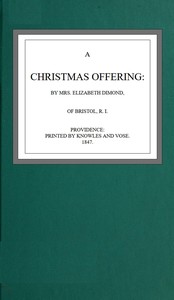
Mrs. Elizabeth Dimond, writing at age eighty-four, opens her 1847 collection with a dedication to a friend, framing the poems as musings on God's mercy. The first poem, 'Thoughts on Creation,' begins with a watchman's question—'And what of the night?'—that immediately establishes a pattern of light and darkness. Dimond then moves through the Genesis story, from chaos to the sun's creation, where she has the Messiah declare, ' 'Tis the Sun,' and the angels echo the phrase. This moment of echoed speech recurs later in the collection, as do images of pearls, dew, and spangled skies.
A Watchman’s Voice and a Cosmic Frame
The collection opens with a watchman figure who asks, 'And what of the night?'—a question that sets a tone of vigilance and moral reflection. Dimond answers by describing chaos as 'dark and gloomy' and then recounts the creation of light, the sun, moon, and stars. She uses the phrase 'spangled those orbs' to describe the stars, and later refers to 'spangled skies' when the moon rises. This repetition of 'spangled' ties the celestial order to divine craftsmanship. The watchman’s voice returns implicitly in later poems, such as 'On the Death of a Young Lady,' where the speaker muses on the brevity of life. The structure thus moves from cosmic origins to personal endings, with the watchman’s opening question lingering as a motif.
Garden, River, and the Loss of Eden
In 'Thoughts on Creation,' Dimond lingers on the Garden of Eden, describing it as 'walled so rich and fair' with 'silver rivulets' and 'golden pebbles' in the stream. She emphasizes the abundance of fruits and the presence of animals, birds, and a 'majestic form'—Adam. The poem then shifts abruptly to the prohibition of the 'hallow'd tree,' and Adam 'bows assent.' This garden scene is the most detailed physical setting in the collection. Later poems, such as 'On the Death of a Young Lady,' evoke a different kind of garden—a grave—where 'the sweetest flowers that blow' are planted. The contrast between Eden’s living garden and the grave’s floral memorial underscores a movement from innocence to loss.
Domestic Scenes and Named Individuals
Several poems address specific people: 'A Wish for the Sailor' hopes for a safe voyage and a ship 'loaded with a pressure of oil'; 'On Seeing a Lovely Child' names 'the dear little girl, Abby Bell'; and the dedication is to 'Mrs. Smith, Providence, R. I.' These named figures ground the collection in Dimond’s immediate social world. The poem 'On the Death of a Young Lady' includes a footnote explaining that 'Gillyflower' was a nickname denoting 'freshness and vivacity.' Another footnote describes a winter scene with sleds and 'merry bells.' These details suggest that Dimond’s Christian reflections are not abstract but tied to real people and local customs, such as the 'Elam Place' farm between Bristol and Newport.
Repetition of Celestial and Floral Imagery
Across the excerpts, certain images recur with notable frequency. The sun is called 'Great Sol' and addressed directly: 'Great Sol, arise! and spread thy lustre high.' The moon is 'silver' and 'pearly,' and stars are 'spangled.' Dew appears as 'pearls all the drops of the dew.' Flowers are described as 'variegated blooms' and 'the sweetest flowers that blow.' In 'On Seeing a Lovely Child,' the child is a 'beautiful bud' that 'has expanded.' This consistent use of natural imagery—celestial bodies, flowers, and gems—creates a cohesive symbolic language. Dimond often links these images to divine action: the sun 'bears up thy own title too,' referring to Christ as the Sun of Righteousness. The repetition is not merely decorative but serves to connect the physical world to spiritual meaning.
Dimond’s collection rewards attention to its small-scale details: the named individuals, the footnoted local references, and the recurring images of light and growth. Readers may find it useful to track how the watchman’s opening question echoes through later poems, or how the garden of Eden contrasts with the graves described in the elegies. The poems are brief and direct, often shifting from cosmic scope to intimate address within a few lines.
Mrs. Dimond’s watchman keeps his lonely vigil, and I think of its quiet echo in Ireton, a Poem — Themes and Context. Both hold a candle to the same domestic hush, that hour when the house settles and only the fire talks. They never met, yet share a certain shelf-like patience, waiting for a kindred reader’s lamp.
There are no reviews for this eBook.
There are no comments for this eBook.
Reader reflection
Your personal reading reflection
Build a private reading journal entry for this title.
Your progress
0
/
10
2
How did the book work for you overall?
3
Is this a title you would suggest to others?
4
How much effort did this book require?
5
How much did the book move you?
6
What was the strongest part of the book?
7
Could you apply anything you learned?
8
How strong was your personal connection to the text?
9
What changed or sharpened your thinking?
10