
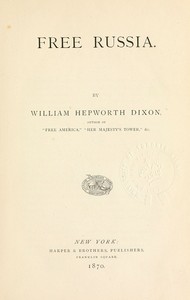
Free Russia by William Hepworth Dixon
Imagine getting a backstage pass to 19th-century Russia, not from a dry textbook, but from a sharp-eyed journalist who walked its streets and talked to its people. That's what William Hepworth Dixon gives us in Free Russia.
The Story
This isn't a novel with a single plot, but a real-life investigation. Dixon travels across Russia in the late 1860s, after the serfs were freed. He's looking for proof that the country isn't just a giant prison, but a place where new ideas are taking root. The 'story' is his journey to find these pockets of freedom. He meets liberal nobles on their country estates, intellectuals in St. Petersburg salons, and everyday citizens. He describes the tension in the air—the heavy hand of the Tsar's government on one side, and the growing desire for legal rights, a free press, and modern education on the other. The book follows his quest to understand if real change is possible, or if the old ways are too strong to break.
Why You Should Read It
What grabbed me was how immediate it feels. Dixon writes with the energy of a reporter filing a dispatch. You get his excitement when he finds a progressive school, his frustration with censorship, and his genuine hope for the people he meets. He makes historical figures feel like real characters. You're not just learning that reforms were debated; you're sitting in the room while it happens. It completely shatters the lazy idea of pre-revolutionary Russia as a monolith. He shows the cracks, the debates, and the human cost of autocracy, which makes the eventual revolutions of the 20th century make so much more sense.
Final Verdict
Perfect for history buffs who want to go beyond dates and battles, and for anyone who loves immersive travel writing from a lost world. If you enjoyed books like Black Lamb and Grey Falcon for its deep dive into a culture, you'll appreciate Dixon's approach. It’s also a great pick for readers curious about how societies change—or resist change. Fair warning: it's a product of its time, so some of Dixon's perspectives are dated, but that itself is part of the fascination. Think of it as a compelling, first-hand report from a nation on the brink of unimaginable transformation.
This masterpiece is free from copyright limitations. It is now common property for all to enjoy.



Thomas Johnson
1 year agoExactly what I was looking for, thanks!