
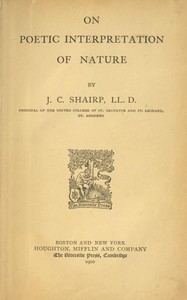
On poetic interpretation of nature by John Campbell Shairp
Published in the 19th century, John Campbell Shairp's On Poetic Interpretation of Nature is a thoughtful essay that feels like a long conversation with a wise, slightly worried friend. Shairp was watching the rapid advances of science and industry of his time and saw a danger: that in our rush to measure and master the natural world, we might forget how to truly feel it.
The Story
There isn't a plot in the traditional sense. Instead, Shairp builds a persuasive case. He walks you through the ways different poets—like Wordsworth, Shelley, and Tennyson—have captured the spirit of nature in their work. He shows how they didn't just describe a mountain or a river; they connected it to human emotion, memory, and spirit. The 'story' is the journey from seeing nature as a mere backdrop to recognizing it as a living, meaningful presence that speaks to us, if we're willing to listen with more than just our rational minds.
Why You Should Read It
This book surprised me. I expected something dusty and academic, but Shairp's worry is so relatable today. We live in a world of data and headlines, often feeling disconnected from the physical world. Reading this was a reminder to slow down. When Shairp praises a poet for capturing the 'mood' of a cloudy sky, it made me want to go outside and actually look at one. It's not anti-science; it's pro-wonder. He argues that science tells us how a rainbow works, but poetry reminds us why it takes our breath away. We need both to be whole.
Final Verdict
Perfect for thoughtful readers who love nature, poetry, or ideas about how we perceive the world. It's especially good if you feel a bit numb to the constant digital noise and crave a deeper connection. It's a short, meditative read that doesn't demand you agree with every point, but simply asks you to consider a different way of seeing. If you enjoy the essays of someone like Henry David Thoreau or even modern writers who bridge science and spirit, you'll find a kindred spirit in Shairp. Just be ready for its 19th-century pace—it's a walk in the woods, not a sprint.
This historical work is free of copyright protections. Thank you for supporting open literature.
Sandra King
6 months agoThis is one of those stories where the narrative structure is incredibly compelling. Exactly what I needed.
Karen Gonzalez
1 year agoHonestly, the pacing is just right, keeping you engaged. This story will stay with me.
Charles Johnson
8 months agoAfter finishing this book, it challenges the reader's perspective in an intellectual way. Worth every second.
Kevin Anderson
1 year agoI stumbled upon this title and the author's voice is distinct and makes complex topics easy to digest. A true masterpiece.






Sandra Anderson
10 months agoCompatible with my e-reader, thanks.