1

The complete works of John Gower, volume 4 — Edition Insights
(0 User reviews)
614
Project Gutenberg
2023
Not confirmed
Poetry
Readers of public-domain and historical texts
Project Gutenberg digital edition
en
Edition facts
Words
159,746
Reading time
695 min
Text sections
58
Before opening The complete works of John Gower, volume 4 — Edition Insights, the edition data offers a quick orientation: 159,746 words, 11 hr 35 min estimated reading time, and 58 detected text sections.
The text analysis averages about 17.9 words per sentence, while the detected sections provide another way to judge how the source is divided.
Project Gutenberg metadata also associates the work with “Poetry,” connecting these edition facts with the source record’s subject description.
Source:
Project Gutenberg record #72396
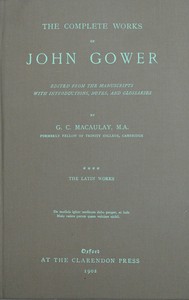
This volume collects John Gower's Latin works, including Vox Clamantis and Cronica Tripertita, edited by G.C. Macaulay with critical apparatus. The excerpts reveal a moralizing voice that critiques clerical and monastic corruption through allegorical figures like Genius, while the editor's introduction candidly acknowledges the scarcity of biographical records.
Editorial Edition Score
4.9/5
★★★★★
★★★★★
Calculated from edition completeness, EPUB availability, text structure and catalogue metadata. Not a user rating.
How this score is calculated
- Description quality20 pts
- Title & short description10 pts
- Source metadata20 pts
- Text length15 pts
- Chapters / structure15 pts
- EPUB file integrity20 pts
Total of 100 points, scaled to a 2.5-5.0 range. Editions with an empty description or a missing EPUB file are not scored.
Edition quality
Read the Text
A ‘hard collection’ it may be, but no harder than many others that have been made by biographers, and Leland’s ‘vir equestris ordinis[7]’ must certainly go the way of his other statements, being sufficiently refuted, as Stow remarks, by the ‘Armiger’ of Gower’s epitaph. Leland in calling him a knight was probably misled by the gilt collar of SS upon his recumbent effigy, and Fuller afterwards, on the strength of the same decoration, fancifully revives the old theory that he was a judge, and is copied of course by succeeding writers[8]. On the whole it may be doubted whether there is anything but guesswork in the statements made by Leland about our author, except so far as they are derived from his writings or from his tomb.
That John Gower the poet was of a Kentish family is proved by definite and positive evidence. The presumption raised by the fact that his English writings certainly have some traces of the Kentish dialect, is confirmed, first by the identity of the arms upon his tomb with those of Sir Robert Gower, who had a tomb in Brabourne Church in Kent, and with reference to whom Weever, writing in 1631, says, ‘From this family John Gower the poet was descended[9],’ secondly, by the fact that in the year 1382 a manor which we know to have been eventually in the possession of the poet was granted to John Gower, who is expressly called ‘Esquier de Kent,’ and thirdly, by the names of the executors of the poet’s will, who are of Kentish families. It may be added that several other persons of the name of Gower are mentioned in the records of the time in connexion with the county of Kent. Referring only to cases in which the Christian name also is the same as that of the poet, we may note a John Gower among those complained of by the Earl of Arundel in 1377, as having broken his closes at High Rothing and elsewhere, fished in his fishery and assaulted his servants[10]; John Gower mentioned in connexion with the parishes of Throwley and Stalesfield, Kent, in 1381-2[11]; John Gower who was killed by Elias Taillour, apparently in 1385[12]; John Gower who was appointed with others in 1386 to receive and distribute the stores at Dover Castle[13]; none of whom can reasonably be identified with the poet. Therefore it cannot be truly said, as it is said by Pauli, that the surname Gower, or even the combination John Gower, is a very uncommon one in the records of the county of Kent[14].
Before proceeding further, it may be well to set forth in order certain business transactions recorded in the reign of Edward III, in which a certain John Gower was concerned, who is identified by Nicolas with the poet[15].
They are as follows:--
39 Ed. III (1365). An inquiry whether it will be to the prejudice of the king to put John Gower in possession of half the manor of Aldyngton in Kent, acquired by him without licence of the king from William de Septvans, and if so, ‘ad quod damnum.’ This half of Aldyngton is held of the king by the service of paying fourteen shillings a year to the Warden of Rochester Castle on St. Andrew’s day[16].
Under date Feb. 15 of the same year it was reported that this would not be to the prejudice of the king, and accordingly on March 9 John Gower pays 53 shillings, which appears to be the annual value of the property, and is pardoned for the offence committed by acquiring it without licence[17].
39 Ed. III (June 23). William Sepvanus, son of William Sepvanus knight, grants to John Gower ten pounds rent from the manor of Wygebergh (Wigborough) in Essex and from other lands held by him in the county of Essex[18].
By another deed, acknowledged in Chancery on June 25 of the same year, the same William Sepvanus makes over to John Gower all his claims upon the manor of Aldyngton, and also a rent of 14_s._ 6_d._, with one cock, thirteen hens and 140 eggs from Maplecomb[19].
42 Ed. III (1368). Thomas Syward, pewterer and citizen of London, and Joanna his wife, daughter of Sir Robert Gower, grant to John Gower and his heirs the manor of Kentwell. Dated at Melford, Wednesday before the Nativity of St. John Baptist[20].
43 Ed. III. Fine between John Gower on the one hand, and John Spenythorn with Joan his wife on the other, by which they give up all right to the Manor of Kentwell, Suffolk, except £10 rent, John Gower paying 200 marks[21].
This was confirmed in the king’s court, 3 Ric. II.
This fourth volume of G. C. Macaulay's edition of John Gower's complete works gathers the poet's Latin writings, chief among them the Vox Clamantis and the Cronica Tripertita. The editor's introduction frankly admits that 'to write anything like a biography of Gower, with the materials that exist, is an impossibility,' setting a tone of scholarly caution that pervades the apparatus. The excerpts show Gower employing a dense, allegorical mode: the figure Genius appears as 'Sacerdos Dee Veneris' (priest of the goddess Venus), and the text repeatedly returns to the frailty of women under religious vows, a theme treated with a mixture of moral severity and physiological speculation.
Editorial Framing and Biographical Gaps
Macaulay's introduction, reproduced here, opens with a striking admission: the only authentic records of Gower's life are his marriage-licence, his will, and his tomb. Earlier accounts, from Leland to Todd, are dismissed as 'almost entirely worthless' and 'guesswork' copied without criticism. This frankness is unusual in a scholarly edition of the period and shapes how a reader approaches the poems that follow. The editor singles out Sir Harris Nicolas's 1828 article as 'the one source of authentic information,' noting that Nicolas confined his search largely to the British Museum and relied on secondary abstracts for documents in the Record Office. The result is a portrait of a poet known almost entirely through his works, with the editor's own labor—collating manuscripts, supplying notes and glossaries—standing in for the missing biography.
Allegorical Critique in the Latin Poems
The excerpts from the Vox Clamantis and related poems reveal a sustained moral critique delivered through allegorical personifications. Genius, defined as 'Sacerdos Dee Veneris,' is depicted as governing cloisters and acting as confessor, a role that the poem treats with irony: 'Sub specie iuris in claustro visitat ipsas, / Quas veniens thalamis, iure negante, regit' (Under the guise of law he visits them in the cloister, and coming to their chambers, he rules them, though law forbids). The text repeatedly links physical frailty to moral failure, especially in women: 'Nam pes femineus nequit vt pes stare virilis' (For the female foot cannot stand like the male foot). These passages are not merely doctrinal; they draw on naturalistic imagery—'Dum nouus in viridi iuuenescit cortice ramus' (While a new branch grows young on the green bark)—to argue that women's instability is inherent.
Structure and Scholarly Apparatus
The volume is organized as a critical edition: after the introduction, the Latin texts are presented with marginal notes, followed by extensive endnotes, a glossary, and an index to the notes. The contents list shows a mix of longer works (Vox Clamantis runs from page 3 to 313) and shorter poems, including the Cronica Tripertita and several pieces labeled 'Last Poems.' The excerpts include a passage where the text itself comments on its method: 'Nota quod Genius secundum poetas Sacerdos Dee Veneris nuncupatus est' (Note that Genius according to the poets is called the priest of the goddess Venus). This self-annotating habit, combined with the editor's own notes, creates a layered reading experience. The glossary and index suggest the volume was designed for sustained study rather than casual reading.
Readers approaching this volume should be prepared for Latin poetry that is both learned and polemical, with a strong interest in ecclesiastical satire. Macaulay's editorial work—the collation of manuscripts, the critical notes, the glossary—provides essential guidance, but the poems themselves reward attention to their allegorical structures and rhetorical strategies. The volume stands as a resource for understanding Gower's Latin output, a body of work that complements his better-known English and French writings.
Holding this volume, I remembered the old librarian who taught me that fragmentary lives leave the truest echoes—Gower’s scanty records felt like that. Flipping to Macaulay’s admission, I was back to The Troubadours — Edition Insights, where anonymity whispered just as loudly. Neither book shouts; both let absence breathe, and I lingered there, quiet.
There are no reviews for this eBook.
There are no comments for this eBook.
Reader reflection
What did you think of this book?
Answer a few questions and save a private reflection on this device.
Your progress
0
/
10
2
Did this book hold your interest?
3
Would you recommend this book to another reader?
4
How demanding did the text feel?
5
Would this book work well in a reading group?
6
How would you describe its reading pace?
7
Did the book deliver what you hoped for?
8
Which part made the strongest impression?
9
What changed or sharpened your thinking?
10