1

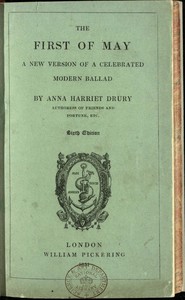
The first of May: a new version of a celebrated modern ballad sixth edition — Key Ideas to Explore
(0 User reviews)
718
Project Gutenberg
2021
Not confirmed
Great Exhibition (1851 : London, England) -- Poetry
Readers of public-domain and historical texts
Project Gutenberg digital edition
en
Edition facts
Words
5,177
Reading time
23 min
Text sections
1
The source record for The first of May: a new version of a celebrated modern ballad sixth edition — Key Ideas to Explore measures this digital text at 5,177 words, 23 min estimated reading time, and 1 detected text section.
The text analysis averages about 25.9 words per sentence, while the detected sections provide another way to judge how the source is divided.
Project Gutenberg metadata also associates the work with “Great Exhibition (1851 : London, England) -- Poetry,” connecting these edition facts with the source record’s subject description.
Source:
Project Gutenberg record #65625
Anna Harriet Drury's comic ballad recounts the planning and controversies surrounding the 1851 Great Exhibition, using a mock-heroic voice, recurring imagery of letters and packages, and shifts between royal anxiety and public satire.
Editorial Edition Score
4.3/5
★★★★★
★★★★★
Calculated from edition completeness, EPUB availability, text structure and catalogue metadata. Not a user rating.
How this score is calculated
- Description quality20 pts
- Title & short description10 pts
- Source metadata20 pts
- Text length15 pts
- Chapters / structure15 pts
- EPUB file integrity20 pts
Total of 100 points, scaled to a 2.5-5.0 range. Editions with an empty description or a missing EPUB file are not scored.
Edition quality
Read the Text
That was never seen before. By the Cinque Ports he swore it, And named an opening day: And letters wrote to left and right, To bid the universe unite Upon the First of May.
Left and right the letters went, To city, realm, and coast; And answers came most civilly, By the return of post. Shame on the lazy Nation, That will not join her share, With Albert and Britannia, To swell the World’s great Fair!
The parcels and the packages Come bundling in amain, By many a creaking waggon; By many a flying train; By many a van of Pickford’s, That filled with ponderous care, Makes every passer by exclaim, “Good gracious, just look there!”
From autocratic Russia, Where growls the unctuous Bear, Who covers native Poles with grief, And British polls with hair; From France, the land of elegance, And witty elocution, Whose clever hands make all things well Except a constitution;
From the far-off Republic, On Transatlantic waves, Who blazons stars of liberty Upon the stripes of slaves; From where the Alpine snows surround The workshops of the free; From where in fettered sadness burns The muse of Italy!
The Prince and the Commission A weary life they led: No time had they for dining, And rather less for bed. They couldn’t choose a building, They couldn’t find a site: And our good Queen Victoria Grew tired--as well she might.
For good advice in pamphlets, And prophecies in calf, And groans to make him shudder, And sneers to make him laugh, And hints and threats and warnings, Plan, diagram, and view, Choked up the Prince’s davenport, And filled his pockets too.
“To eastward and to westward,” ’Twas said, “alarm is spreading; “The foreigners will eat us “Out of house and home and bedding; “Taxation will be trebled, “And sadder far to tell, “Thanks to the horrid papers, “_The tickets will not sell!_”
I wis, in all the Palace There was no heart so bold, But wished himself well out of it, When that ill news was told. Up rose at length Prince Albert, Up rose the whole Commission, And at the footstool of the throne They laid the Exhibition.
Just then burst in a messenger, With cold sweat on his brow: “Look here, look here, my gracious Prince! “They say there’ll be a row!” Upon the fatal newspaper Prince Albert turned his eye, And saw a night of wretchedness Darken his sunny sky.
And plainly and more plainly In history’s page he read, The gibes and jeers and sarcasms, Heaped on his luckless head: And the stigma of ridiculous, More terrible than guilt, Stamped by unborn Macaulays, On “the House that Albert built.”
And plainly and more plainly He heard the words of doom, When all the year’s expenses Are checked by Joseph Hume; And the outcry of the journals, And the angry people’s hisses, And his loving consort’s mild reproof, “You know whose doing _this_ is!”
And the Prince’s voice was sad, And dim his eye of blue: “It’s come to this, my gracious wife, “We don’t know what to do! “There’s not a soul contented; “The tickets will not sell; “And now the papers prophesy “Such things I fear to tell!
“The French will spoil our morals, “The Russians cheat and _knout_ us-- “They’ll haunt us like musquitoes, “Like snakes they’ll twine about us-- “The Chartist and the Communist “Will hand in hand combine, “And break the Crystal Palace “About your head and mine!
Then out spake Queen Victoria, And brightly glanced her eye: “I never heard such nonsense! “I only wish they’d try! “Don’t mind those vile reports, dear-- “’Twill all come right, you’ll see: “Just keep the workmen moving, “And leave the rest to me!
“I’ll order out the carriage, “My royal robes I’ll wear, “And though the crowd be millions deep, “No matter--I’ll be there! “And in the face of rough John Bull, “Whate’er he means to do, “I’ll smile until he smiles again, “And gives a cheer for you!
“There’ll be some foolish people there, “Indeed, where are they not? “Perhaps they’ll throw a stone or two, “Or fire a little shot: “They never hit me yet, dear, “Except upon my bonnet; “So don’t persuade me not to go-- “I’ve set my heart upon it!
“Unpack the parcels, gentlemen, “As quickly as ye may: “Tell all your foreign colleagues, “I’ll hear of no delay! “Though foemen league in millions, “We’ll charm away their malice, “And walk together, arm in arm, “Right through the Crystal Palace!”
Anna Harriet Drury's The First of May is a comic ballad that chronicles the lead-up to the 1851 Great Exhibition, casting Prince Albert as a beleaguered hero. The poem opens with a mock-heroic vow: Prince Albert swears by the Cinque Ports to create an exhibition "never seen before." This sets a tone of playful grandeur that persists throughout. The narrative moves rapidly from the dispatch of letters to the arrival of parcels, then to the Prince's mounting worries. Drury's voice is brisk and satirical, punctuated by exclamations and direct addresses. The structure follows a chronological arc from planning to crisis, but the poem's energy comes from its accumulation of concrete details—creaking wagons, flying trains, and the Prince's choked davenport—rather than from plot development.
Letters, Parcels, and the Machinery of Preparation
The poem's first movement is dominated by images of correspondence and transport. Prince Albert writes letters "to left and right," and answers return "by the return of post." This bureaucratic frenzy is soon literalized in the arrival of parcels and packages, which come "bundling in amain" via "many a creaking waggon" and "many a flying train." Drury names Pickford's vans, a specific carrier, grounding the fantastical scale in recognizable commerce. The repetition of "many a" creates a cumulative rhythm that mirrors the piling up of goods. The stanza describing Russia, France, the United States, and Italy uses a series of compact, satirical portraits—each nation reduced to a single trait or product. This catalogue structure, common in ballad tradition, serves both to celebrate international participation and to mock national stereotypes.
The Prince's Burden and the Weight of Public Opinion
As preparations stall, the poem shifts focus to Prince Albert's personal ordeal. He and the Commission have "no time for dining" and "rather less for bed." The physical details—the Prince's davenport choked with plans, his pockets filled with pamphlets—make his anxiety tangible. Drury introduces a chorus of public voices: warnings that "foreigners will eat us out of house and home," and fears that tickets will not sell. The ballad's meter, with its alternating four-stress and three-stress lines, lends a galloping pace to these complaints. The climax of this section is the arrival of a messenger "with cold sweat on his brow," bearing news of a potential riot. Prince Albert reads the newspaper and sees "a night of wretchedness" darken his sky. The poem here verges on melodrama, but Drury undercuts it with the wry image of "unborn Macaulays" stamping ridicule on "the House that Albert built."
Shifting Scenes: From Palace to Public Sphere
Drury moves the action between intimate royal spaces and the broader public realm. The palace is a place of sleepless anxiety, where the Prince and Queen Victoria grow tired. Yet the poem also leaps to the streets, where passersby exclaim at the vans, and to the pages of newspapers that spread alarm. This alternation creates a sense of a nation collectively holding its breath. The ballad's structure reinforces this: each stanza is a self-contained vignette, often beginning with a new location or speaker. The repeated phrase "By the Cinque Ports he swore" acts as a refrain, anchoring the poem to its opening vow even as the scene shifts. The effect is cinematic, cutting from the Prince's study to the loading dock to the throne room, all within a few lines.
Satirical Catalogues and the Ballad's Comic Voice
Drury's satire operates through accumulation and incongruity. The catalogue of nations is a set piece: Russia is a "growling" bear that "covers native Poles with grief, / And British polls with hair"; France is a land of "elegance" that cannot produce a constitution; the United States "blazons stars of liberty / Upon the stripes of slaves." These couplets are sharp but not bitter, their humor deriving from the compression of complex politics into a single rhyme. The poem also mocks the British public's fears—the foreigners who will eat them "out of house and home and bedding"—and the press that spreads panic. Drury's voice is that of a wry observer, not a partisan. She uses the ballad's simple meter and rhyme to deliver punchlines with deadpan timing, as when the Prince's davenport is "choked" with plans. The result is a poem that entertains while slyly critiquing the very event it celebrates.
The First of May rewards attention to its verbal play and structural patterning. Readers may note how Drury balances the epic scale of the Exhibition with the intimate frustrations of its organizers. The poem's brisk stanzas and shifting scenes invite comparison to other comic ballads of the period, but its specific focus on logistics and public opinion gives it a documentary quality. For those interested in Victorian popular verse or the cultural reception of the Great Exhibition, this ballad offers a lively contemporary perspective.
I often think how cheerful the 1851 Exhibition’s fussy letters must have felt, all those packages of plans. And then I recall The shipwreck — Themes and Context, where a different kind of correspondence arrives—not paper, but waves. Both speak of expectation and disaster, though one laughs while the other drowns. A quiet kinship, that. The shipwreck — Themes and Context stays with me like an old tide mark.
There are no reviews for this eBook.
There are no comments for this eBook.
Reader reflection
What did you think of this book?
Answer a few questions and save a private reflection on this device.
Your progress
0
/
10
2
What was your overall reaction to the book?
3
Is this a title you would suggest to others?
4
Did the language feel accessible?
5
Which part made the strongest impression?
6
How distinctive were its ideas or approach?
7
Did the story or argument move comfortably?
8
Would this book work well in a reading group?
9
What changed or sharpened your thinking?
10