1

Hazel bloom — A Closer Reading
(0 User reviews)
1514
Project Gutenberg
2025
Not confirmed
American poetry -- 19th century
Readers of public-domain and historical texts
Project Gutenberg digital edition
en
Edition facts
Words
27,056
Reading time
118 min
Text sections
89
Hazel bloom — A Closer Reading can be approached with a clearer sense of reading commitment from its source measurements: 27,056 words, 1 hr 58 min estimated reading time, and 89 detected text sections.
The text analysis averages about 28.3 words per sentence, while the detected sections provide another way to judge how the source is divided.
Project Gutenberg metadata also associates the work with “American poetry -- 19th century,” connecting these edition facts with the source record’s subject description.
Source:
Project Gutenberg record #76279
This 1899 poetry collection by Julia Carter Aldrich (writing as Petresia Peters) uses precise natural imagery and domestic scenes to explore motherhood, memory, and spiritual longing. The poems balance formal verse with intimate, conversational moments.
Editorial Edition Score
4.8/5
★★★★★
★★★★★
Calculated from edition completeness, EPUB availability, text structure and catalogue metadata. Not a user rating.
How this score is calculated
- Description quality20 pts
- Title & short description10 pts
- Source metadata20 pts
- Text length15 pts
- Chapters / structure15 pts
- EPUB file integrity20 pts
Total of 100 points, scaled to a 2.5-5.0 range. Editions with an empty description or a missing EPUB file are not scored.
Edition quality
Read the Text
efrain— “’Tis wisdom that mingles the sorrow and pain. The sunlight, that gilds, with its glory the earth, Would blight with its blaze, but for clouds and the rain, And lives would be arid and smitten with dearth If beamed on forever with joy and mirth— _In blessing I weave in the sorrow and pain_.”
When meadows are strewn with the buttercup’s gold, There’s gladness for childhood that song never told; The laugh of a child, bubbling up from the heart, Is linked with the spring, a most beautiful part.
A bevy of children—sweet far away dream!— They trip o’er the sward, lit with dandelion gleam— We’ll join in their sports with a heartiness true; Our own vanished springtime, with them, we’ll renew.
The woods, (that are reached by a romp thro’ the lane Where the grass is made velvet by sunshine and rain) Have infinite beauty, in blossom outspread— Delights for the gods in the fragrance they shed.
Come, drink in the perfume of blossoming trees— Take lessons of patience from murmuring bees, And listen to brooklets—they’ll sing you a song As, wild in their glee, they go leaping along.
Come, watch the wild birds as they cheerily dart— Their music, with sunshine, take into your heart— Let the gladness of childhood thrill you, and be gay, Thus keeping your soul in perpetual May.
When Nature is robing her forests anew, And heaven spreads over her loveliest blue— When earth is aglow with spring’s ravishing bloom, Ingratitude only sits shrouded in gloom.
When Somnus is giddy and flies from my pillow, And care’s elfin throngs come to vex me— When mem’ry, perverse, all the sweet things forgetting, Will mention but those that perplex me, I ask that monotony’s rigid insistence Shall drive out the gibberous crew; They flee from his presence—will hie back to elfland, Where their Night shade and astrofell grew—
Ask thought for a theme that’s subduing in power— The sea, with its billows all hushed to a calm— Not mantled with darkness, but lit with the sunset, When Day, unto Evening, is chanting her psalm. All life’s petty griefs in the grandeur evanish, The spirit is freed from its thrall, And unto the faint heart a trustfulnesss whispers, “Be brave—there’s a God over all.”
In fancy I launch on the shimmering sea That’s lighting with glory its waters for me; Like a sprite of the ocean the boat seems to glide, As lightly the oars dip the opaline tide, Till out in expanses, afar from the shore, Away from life’s din and tumultuous roar Where, gently I’m rocked on the breast of the deep, While symphonic waves woo the Lethe of Sleep. A broad, shining pathway is westward unrolled— I watch the bright wavelets, with tresses of gold, Run out in wild play to the visual rim Where the sky bends to kiss them in distance so dim, Till thought is enchanted—anxiety flees, And weariness slips into somnolent ease; The silences seem to have rhythmical beat— ’Tis footfalls of wakefulness, now in retreat. Forgetfulness softly creeps into the mind, Suspecting no trace of resistance to find, But wakefulness turns back, commands and forbids— Yet, Slumber steals past her and touches the lids; Then Morpheus bears me away in his arms To his realm that’s swept of all fears and alarms Where, lulled with his stupors, of poppy and rose, I dreamily, dreamily sink to repose.
When evening falls softly, with far away dreaming, Oft steals o’er my spirit a rapturous seeming— I feel the light touch of her hand as of old, When bending above me with good night caresses, She lovingly pushed back the long heavy tresses, And smoothed out the tangles of gold.
Touch memory’s harp in the silence of even, And loved ones will leave e’en the raptures of heaven, And come to us then when the gates are ajar: With mother’s face, ever most central and tender, They light all the Past with a rosy-hued splendor And the soul’s secret chamber’s unbar.
From hidden recesses they bring out its treasures— Among them are shining youth’s dream-lighted pleasures, When mother-love blent with, and hallowed them all; The haunts that the years with their sunsets have gilded, The castles of beauty that child-fancy builded, All come in the gloaming at memory’s call.
’Twas down by the river, where bluebells were sweetest And swift-footed hours forever ran fleetest, Enthralled by the charm, that I loved most to roam— To watch where the sunshine and ripple wove wimples, Like smiles, on a rosy face, dancing with dimples, Forgetful of duty till mother called home.
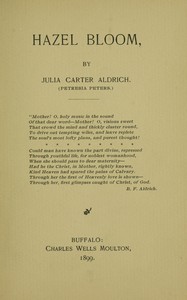
Julia Carter Aldrich, writing under the pen name Petresia Peters, opens Hazel Bloom with a dedication that frames the entire collection: “To the Mothers—The Home-makers of our land.” The book’s first poem, “The Weaver,” immediately establishes a metaphor of textile craft for poetic creation, describing “the loom of thought” and “threads of fine spun gold.” This image recurs throughout, linking domestic labor with artistic making.
The collection’s 89 poems move between tightly rhymed quatrains and looser, more narrative passages. Aldrich often addresses a “you” directly, as in “Hill-Crest Home,” where she promises to “tell of my humble old home” but lets her pen wander into remembered landscapes. These shifts in address create an intimate, almost epistolary quality.
The Weaver’s Loom: Craft and Domestic Metaphor
The opening poem, “The Weaver,” sets a pattern for the collection: the speaker “besought / The thronging sprites, that feed the loom of thought” to gather “shining woof” from distant lands. This image of weaving—of gathering threads into a finished fabric—recurs in later poems. In “Hill-Crest Home,” Aldrich describes a “picture, you rave over there on the wall” as “weak by the one hung in memory’s hall,” contrasting art bound by “rules of perspective” with the mind’s free-ranging composition.
Other poems extend the metaphor. “Life’s Shuttle” likely plays on the same loom imagery, and “The Weaver” itself ends with a plea to the “dame whose tireless hand doth hold / The distaff.” These repeated references suggest that Aldrich saw poetic creation as a form of domestic craft, deliberate and patient.
Memory as Landscape: The Hill-Crest Home
“Hill-Crest Home” is the collection’s longest and most detailed poem. Aldrich reconstructs a childhood home through sensory specifics: “the river, that knit a bright edge on the farm,” “the song of the stream,” and “a shadowy nook / With a rustic root-bench.” The poem’s structure mimics memory’s digressions—she promises to describe the house but spends lines on “the ravishment held in the notes of a thrush” and “the sun-gleams, aflash in the dew-spangled glen.”
The language is precise: “a gauzy, white chrisom cloth lightly it lies / O’er the rosy-faced morning.” Aldrich uses compound adjectives (“love-lighted beauty,” “wind-warring tree”) and enjambment to create a flowing, unhurried pace. The poem ends with a direct address to the reader, “Come, stand ’neath that maple with me,” reinforcing the sense of shared recollection.
Motherhood and the Divine Feminine
The dedicatory poem by B. F. Aldrich frames motherhood as a revelation of the divine: “Through her the first of Heavenly love is shown— / Through her, first glimpses caught of Christ, of God.” Julia Carter Aldrich’s own poems return to this theme. In the untitled poem beginning “There’s naught in God’s infinitude,” she calls motherhood “the crowning gift of woman’s life” and describes how it “transmute[s] to dear delight / Each humble task.”
This is not abstract praise. Aldrich grounds the ideal in concrete experience: “home and wife, / And happy, blessed motherhood” are “gifts” that “keep home’s sacred altar bright / With love’s sweet offerings there.” The poem “Mother” (appearing twice in the index) likely continues this thread. The collection’s title, Hazel Bloom, may itself refer to a child or a flowering of maternal love.
Formal Range: From Rondeaux to Narrative Verse
Aldrich experiments with several poetic forms. The index lists “Rondeaux,” a fixed form with a refrain, and “Endymion,” a classical subject. “Night-Blooming Cereus” suggests a poem about a flower that opens at night, perhaps using the plant as a metaphor for delayed revelation. Other titles like “For Insomnia” and “Questionings” indicate a personal, reflective mode.
The majority of poems use regular rhyme and meter, often iambic tetrameter or pentameter. But Aldrich varies line length for effect: in “Hill-Crest Home,” short lines like “Bright fern fringes bordered its soft rug of moss” give way to longer, more conversational passages. This formal flexibility keeps the collection from becoming monotonous, even as it maintains a consistent lyrical voice.
Readers approaching Hazel Bloom will find a poet who values precision over ornament. Aldrich’s diction is concrete—she names flowers, birds, and household objects—and her syntax often mirrors speech. The collection rewards attention to its recurring images: looms, threads, homes, and landscapes that blur the line between memory and imagination. Because the excerpts are incomplete, the full arc of the book—whether it moves toward consolation, doubt, or affirmation—remains to be discovered.
I’ve shelved Hazel Bloom for decades, and its quiet longing still hums near the spine. Years later, leafing through Sketches of Southern life — Edition Insights, I felt that same hush—a porch-lit patience, the weight of memory tucked into everyday rooms. They keep each other company on my desk now, two old friends who never once raise their voices.
There are no reviews for this eBook.
There are no comments for this eBook.
Reader reflection
How will you remember this book?
Save your reaction, strongest insight, and memorable passage.
Your progress
0
/
10
2
Did this book hold your interest?
3
Would you recommend this book to another reader?
4
How easy was the book to follow?
5
How clear did the writing feel?
6
Would this book work well in a reading group?
7
How did the pace of the book feel?
8
What was the strongest part of the book?
9
Which lesson or insight stayed with you?
10