1

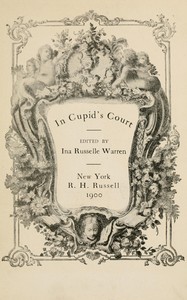
In Cupid's court — A Closer Reading
(0 User reviews)
57
Project Gutenberg
2023
Not confirmed
Love poetry; Cupid in literature
Readers of public-domain and historical texts
Project Gutenberg digital edition
en
Edition facts
Words
13,384
Reading time
59 min
Text sections
66
This digital edition of In Cupid's court — A Closer Reading is described by source-level measurements including 13,384 words, 59 min estimated reading time, and 66 detected text sections.
The text analysis averages about 24.5 words per sentence, while the detected sections provide another way to judge how the source is divided.
Project Gutenberg metadata also associates the work with “Love poetry,” connecting these edition facts with the source record’s subject description.
Source:
Project Gutenberg record #70118
An anthology of English poems about Cupid, edited by Ina Russelle Warren, featuring varied voices from the 16th to 19th centuries. The collection balances playful resistance and lyrical surrender, with poems ranging from courtly complaint to folk-like balladry.
Editorial Edition Score
4.7/5
★★★★★
★★★★★
Calculated from edition completeness, EPUB availability, text structure and catalogue metadata. Not a user rating.
How this score is calculated
- Description quality20 pts
- Title & short description10 pts
- Source metadata20 pts
- Text length15 pts
- Chapters / structure15 pts
- EPUB file integrity20 pts
Total of 100 points, scaled to a 2.5-5.0 range. Editions with an empty description or a missing EPUB file are not scored.
Edition quality
Read the Text
“You silly boy,” Dame Venus said, “Why did you waste your art? Go clip your curls and hide your head,— Belinda _has_ no heart!”
Why was Cupid a boy, And why a boy was he? He should have been a girl, For aught that I can see.
For he shoots with his bow, And the girl shoots with her eye; And they both are merry and glad, And laugh when we do cry.
Then to make Cupid a boy Was surely a woman’s plan, For a boy never learns so much Till he has become a man:
And then he’s so pierced with cares, And wounded with arrowy smarts, That the whole business of his life Is to pick out the heads of the darts.
A Lottery, a Lottery, In Cupid’s Court there used to be; Two roguish eyes The highest prize In Cupid’s scheming Lottery; And kisses, too, As good as new, Which weren’t very hard to win, For he who won The eyes of fun Was sure to have the kisses in. A Lottery, a Lottery, etc.
This Lottery, this Lottery In Cupid’s court went merrily, And Cupid played A Jewish trade In this his scheming Lottery; For hearts, we’re told, In _shares_ he sold To many a fond believing drone, And cut the hearts In sixteen parts So well, each thought the whole his own, A Lottery, a Lottery, etc.
My love is fair, my love is gay, As fresh as are the flowers in May; And of my love the roundelay, My merry, merry roundelay, Concludes with Cupid’s curse: They that do change old love for new, Pray gods they change for worse!
My love can pipe, my love can sing, My love can many a pretty thing, And of his lovely praises ring My merry, merry roundelays. Amen to Cupid’s curse! They that do change old love for new, Pray gods they change for worse!
When Love is coming, coming, Meet him with songs and joy, Bid him alight and enter, Flatter and feast the boy; Crown him with gems and roses, Charm him with winning wiles, Bind him with lovely garlands, And kisses, and smiles.
When Love is going, going, Leaving you all alone, Craving, the fickle tyrant, Some newer slave and throne, Hinder him not, but quickly, Even though your heart may bleed, Saddle a horse for his journey, And bid him God-speed!
Love’s tyranny now wherefore should I praise, Not being enamoured of my altered plight!
I often sigh who once sang roundelays; I know the sleepless gnomes that haunt the night.
I turn with feverish jealousy to hear Words that were spoken when I was not near.
I shroud my eyes from sights I dare not see, Yet who so spies must tell his tale to me.
Madman am I, who give my vote for death, Yet heed not the grim hand that beckoneth.
Love I entreat to go, and while I pray Grasp him with nervous fingers, lest he stray.
Ah! than love’s blessing is no deadlier curse, And yet—and yet—to live undamned were worse.
He came in busy hours— My holidays are few— He brought the scent of flowers, And whispered, dear, of you.
I vowed that I would flay him, And scourge him out of sight; Nay more, I vowed to slay him, The mischief-making sprite.
I gave him caustic chiding, Let fly a poisoned dart. Presto! the lad was hiding Safely within my heart!
There all day long he chatters Of some one’s charm and grace; Till nothing really matters Except to see your face.
I would I had not chidden, Nor tried the sprite to kill; For in my heart safe hidden, He works his wayward will.
O wary elf Cupid, O dimpled, coy Cupid, Are you lost in the moonbeams, or hid in a rose? Who saw you, so nimble, slip out of a thimble, And hang from the loops of a lily-maid’s bows?
Wee, spry little midget, the world’s in a fidget To snare and then coddle you, mischievous sprite; Your pranks and mad gambols and primrose-path rambles ’Mid briers and brambles are all my delight.
In ivy-clad bowers you nestle for hours, And lurk in the flowers that swing in the breeze; There counting the kisses, the sweet stolen blisses, Of Strephon and Phyllis in languorous ease.
We trifle and putter, our hearts in a flutter, In a tangled skein spun by the toiletted fair, The weary hours whiling, and dull care beguiling— Lo! dimpled and smiling, you’re loitering there!
The editor’s preface to In Cupid’s Court announces a harvest of “the choicest poems on Cupid scattered throughout English literature,” and the contents bear out a deliberate mix of canonical and lesser-known voices. The collection’s organizing principle is not chronology but attitude: the poems cycle through resistance, mockery, longing, and rueful submission. A recurring structural pattern is the dramatic monologue or address—speakers plead with Cupid, curse him, bargain, or describe his tricks. The tone shifts sharply between poems: Francis Davison’s “Love! if a god thou art” uses formal legal logic to question Cupid’s justice, while Charles W. Coleman’s “Love’s Going” weaves a hypnotic, repetitive villanelle-like meditation on sleeping love. The editor’s note that “the attitude towards Cupid has mostly been one of obstinate resistance” sets up a tension that the poems themselves complicate.
Voices of Resistance and Surrender
The anthology foregrounds speakers who resist Cupid’s power even as they acknowledge it. In Margaret J. Preston’s “The Begging Cupid,” the speaker initially sees only “innocent archness” and “childish grace,” but the poem pivots on a concealed arrow: the speaker is tricked into sympathy before realizing the deception. The final line—“I have nothing to give you,—Go!”—is a defiant refusal that still admits the rogue’s effectiveness. Similarly, Francis Davison’s sonnet-like plea uses syllogistic reasoning: if Cupid is a god, he must be just, yet he wounds only the speaker, not the beloved. The argument is logical but futile, a complaint that acknowledges the god’s arbitrary power. Other poems, like “Love’s Tyranny” and “Cupid’s Curse,” adopt a tone of mock-legal grievance, as if the speaker could sue the god. This adversarial stance gives way, however, to poems of surrender: “Love’s Going” and “The Growth of Love” trace a shift from resistance to acceptance, often through imagery of sleep, dreaming, or natural cycles.
Narrative and Lyric: Two Modes of Telling
The collection alternates between narrative poems that recount a specific encounter with Cupid and lyric poems that meditate on love’s effects. James B. Kenyon’s “Cupid’s Arrows” tells a complete story: Phœbe finds Cupid sleeping, kisses him, wakes him, and is shot as she flees. The poem ends with a moral warning—“Maidens, ere you wake Love, tarry / First to filch his every dart”—that turns the narrative into a cautionary tale. In contrast, Charles W. Coleman’s “Love’s Going” is purely lyrical, repeating the phrase “Love lies a-sleeping” as a refrain while the speaker urges a maiden not to wake him. The poem’s structure is circular, with each stanza returning to the sleeping figure, and the final line—“Love lies a-sleeping, and he may not sing”—leaves the situation unresolved. This juxtaposition of narrative clarity and lyrical ambiguity gives the anthology a varied pace: some poems move quickly through action, while others linger on a single image or emotion.
Recurring Imagery and the Shifting Role of the Beloved
Across the poems, certain images recur: arrows, bows, blindness, sleep, roses, and the figure of Cupid as a child or rogue. The beloved, however, is often absent or silent. In “Love! if a god thou art,” the lady is mentioned only as the one who “laughs thee to scorn”; in “Love’s Going,” the maiden is addressed but does not speak. The focus remains on the speaker’s internal state. A notable exception is “Cupid’s Arrows,” where Phœbe acts—she kisses Cupid—but her laughter after being shot suggests a playful complicity. The editor’s selection thus emphasizes the speaker’s perspective, making the beloved a catalyst rather than a character. The imagery of sleep and waking is particularly insistent: Cupid is often depicted asleep, and the poems debate whether to wake him or let him rest. This motif ties to the anthology’s broader concern with the uncontrollable nature of love—it arrives unbidden, like an arrow, or lingers in a dream state that the speaker cannot sustain.
Readers approaching In Cupid’s Court will find a deliberately curated sequence that rewards attention to shifts in tone and form. The poems are best read in order, as the editor has arranged them to create contrasts and echoes. Pay particular attention to the way each poem frames Cupid—as a child, a tyrant, a beggar, or a sleeping god—and how the speaker’s stance changes from poem to poem. The collection does not argue for a single view of love but instead presents a chorus of voices, each trying to negotiate with a power that cannot be reasoned with or escaped.
The rain kept time with the page’s rhythm, that old tug-of-war between mockery and longing in In Cupid’s Court. Years later, caught in another grey afternoon, I found myself thinking how the salty stubbornness of those verses might echo a different shoreline. It drifted me toward a tattered copy of On old Cape Cod — Themes and Context, just to feel that same weathered honesty again.
There are no reviews for this eBook.
There are no comments for this eBook.
Reader reflection
What did you think of this book?
Answer a few questions and save a private reflection on this device.
Your progress
0
/
10
2
How much did you enjoy the reading experience?
3
Is this a title you would suggest to others?
4
How easy was the book to follow?
5
How well did it match your expectations?
6
How would you describe its reading pace?
7
Did any part of the book feel personally relevant?
8
Could you apply anything you learned?
9
What did this book teach you most?
10