1

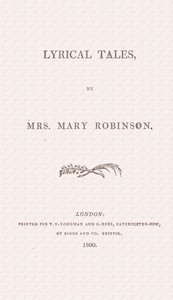
Lyrical tales — Context and Discussion
(0 User reviews)
803
Project Gutenberg
2023
Not confirmed
English poetry -- 18th century
Readers of public-domain and historical texts
Project Gutenberg digital edition
en
Edition facts
Words
27,674
Reading time
121 min
Text sections
31
The source record for Lyrical tales — Context and Discussion measures this digital text at 27,674 words, 2 hr 1 min estimated reading time, and 31 detected text sections.
The text analysis averages about 24.8 words per sentence, while the detected sections provide another way to judge how the source is divided.
Project Gutenberg metadata also associates the work with “English poetry -- 18th century,” connecting these edition facts with the source record’s subject description.
Source:
Project Gutenberg record #70266
Mary Robinson's 1800 collection of 22 narrative poems, each a compact tale of loss, injustice, or supernatural encounter. The verses shift between abandoned children, haunted beaches, and satirical court scenes, with a persistent focus on the voices of the powerless and the hypocrisy of authority.
Editorial Edition Score
4.8/5
★★★★★
★★★★★
Calculated from edition completeness, EPUB availability, text structure and catalogue metadata. Not a user rating.
How this score is calculated
- Description quality20 pts
- Title & short description10 pts
- Source metadata20 pts
- Text length15 pts
- Chapters / structure15 pts
- EPUB file integrity20 pts
Total of 100 points, scaled to a 2.5-5.0 range. Editions with an empty description or a missing EPUB file are not scored.
Edition quality
Read the Text
This little joke, Miss DEBBY taught him, To vex a young and pretty neighbour; But by her scandal-zealous labour To shame she brought him! For, the Old PARROT, like his teacher Was but a false and canting preacher, And many a gamesome pair had sworn Such lessons were not to be borne.
At last, Miss DEBBY sore was flouted And by her angry neighbours scouted; She never knew one hour of rest, Of ev’ry Saucy Boor, the jest: The young despis’d her, and the Sage Look’d back on Time’s impartial page; They knew that youth was giv’n to prove The season of extatic joy, That none but Cynics would destroy, The early buds of Love. They also knew that DEBBY sigh’d For charms that envious Time deny’d; That she was vex’d with jealous Spleen That Hymen pass’d her by, unseen.
For though the Spinster’s wealth was known, _Gold_ will not purchase Love—_alone_. She, and her PARROT, now were thought The torments of their little Sphere; He, because mischievously taught, And She, because a maid austere!— In short, she deem’d it wise to leave A Place, where none remain’d, to grieve.
Soon, to a distant town remov’d, Miss DEBBY’s gold an husband bought; And all she had her PARROT taught, (Her PARROT now no more belov’d,) Was quite forgotten. But, alas! As Fate would have it come to pass, Her Spouse was giv’n to jealous rage, For, both in _Person_ and in _Age_, He was the partner of his love, Ordain’d her second Self to prove!
One day, Old JENKINS had been out With merry friends to dine, And, freely talking, had, no doubt Been also free with wine. One said, of all the wanton gay In the whole parish search it round, None like the PARSON could be found, Where a frail Maid was in the way. Another thought the Parson sure To win the heart of maid or wife; And would have freely pledg’d his life That young, or old, or rich or poor None could defy The magic of his roving eye!
JENKINS went home, but all the night He dream’d of this strange tale! Yet, bless’d his stars! with proud delight, His partner was not young, nor frail. Next morning, at the breakfast table. The PARROT, loud as he was able, Was heard repeatedly to cry, “_Who with the Parson toy’d? O fie!_”
Old JENKINS listen’d, and grew pale, The PARROT then, more loudly scream’d, And MISTRESS JENKINS heard the tale And much alarm’d she seem’d! Trembling she tried to stop his breath, Her lips and cheek as pale as death! The more she trembled, still the more Old JENKINS view’d her o’er and o’er; And now her yellow cheek was spread With blushes of the deepest red.
And now again the PARROT’s Tale Made his old Tutoress doubly pale; For cowardice and guilt, they say Are the twin brothers of the soul; So MISTRESS JENKINS, her dismay Could not controul! While the accuser, now grown bold, Thrice o’er, the tale of mischief told.
Now JENKINS from the table rose, “_Who with the Parson toy’d?_” he cried. “So MISTRESS FRAILTY, you must play, “And sport, your wanton hours away. “And with your gold, a pretty joke, “You thought to buy a pleasant cloak; “A screen to hide your shame—but know “I will not _blind_ to ruin go.— “I am no _modern Spouse_, dy’e see, “_Gold_ will not _gild disgrace_, with me!” Some say he seiz’d his fearful bride, And came to blows! Day after day, the contest dire Augmented, with resistless ire! And many a drubbing DEBBY bought For mischief, she her PARROT taught!
Thus, SLANDER turns against its maker; And if this little Story reaches A SPINSTER, who her PARROT teaches, Let her a better task pursue, And here, the certain VENGEANCE view Which surely will, in TIME, O’ERTAKE HER.
Dark was the dawn, and o’er the deep The boist’rous whirlwinds blew; The Sea-bird wheel’d its circling sweep, And all was drear to view— When on the beach that binds the western shore The love-lorn ZELMA stood, list’ning the tempest’s roar.
Her eager Eyes beheld the main, While on her DRACO dear She madly call’d, but call’d in vain, No sound could DRACO hear, Save the shrill yelling of the fateful blast, While ev’ry Seaman’s heart, quick shudder’d as it past.
Mary Robinson's Lyrical Tales (1800) opens with a child weeping beside a churchyard grave, his yellow hair and torn russet coat described in precise, repetitive stanzas that mimic the slow ache of grief. This is not a book of abstract sentiment: the boy's bare feet are wounded by thorns, his pillow is a cold gravestone, and the winter winds are named as his only companions. Across the collection's twenty-two poems, Robinson consistently anchors emotion in physical detail—the brawling rill, the high grass that grows over a deserted cottage path, the nipping frost that freezes a child's bosom. These are tales told through objects and landscapes that bear witness to human neglect.
The Churchyard and the Cottage: Recurring Settings of Abandonment
Two settings recur with striking frequency: the churchyard and the deserted cottage. In All Alone, the orphan boy makes his home among gravestones, and the speaker addresses him directly, noting how the yew-tree shades shelter his nightly weeping. The poem The Deserted Cottage poses a series of unanswered questions—"Who dwelt in yonder lonely Cot, / Why is it thus forsaken?"—and answers only with images of ruin: broken thatch, high grass, a shallow rill that runs brawling but unheeded. These are not picturesque ruins; they are spaces where human warmth has been withdrawn. The cottage's casements are dark, its door is overgrown, and the poem refuses to supply a narrative of what happened to the inhabitants. Instead, the setting itself becomes the story: a record of absence that the reader must interpret.
Voices of the Powerless: Orphans, Beggars, and the Condemned
Robinson gives voice to characters who are typically silenced. The orphan boy speaks only once, in the ninth stanza of All Alone, to explain why he cannot join the village sports: "I cannot the green hill ascend." His speech is halting and physical, grounded in what his body can no longer do. In The Trumpeter, a braggart knight demands lands and vassals at a royal feast, only to be humiliated by the king, who appoints him a mere trumpeter. The poem's moral—that the monarch learns to value wisdom over flattery—is undercut by the fact that the trumpeter's voice is never heard again after his boast. Elsewhere, The Negro Girl and The Lascar present characters marked by race and exile, though the excerpts are too brief to reveal their full fates. What is clear is that Robinson repeatedly centers those whom society has cast out, and she lets them speak in their own rhythms.
Satire and the Banquetting Hall: The Critique of Power
Not all of Robinson's tales are somber. The Trumpeter unfolds as a satirical drama set in a "Banquetting Hall," where nobles compete for favors while a king listens, then abruptly reforms. The poem's structure mimics a courtly debate, with each speaker demanding more land, more vassals, more exemption from prayer. The king's final speech—"From this moment the counsel of fools I forego"—reads as a pointed critique of patronage and empty flattery. Yet the satire is complicated by the poem's ending: the monarch becomes "sober and good" and nests "with Birds of a different brood," a phrase that suggests the ease with which power can change its companions. The banquet hall, with its laughter and ribaldry, is a stage for exposing the gap between merit and reward, and Robinson leaves the reader to decide whether the king's conversion is genuine or merely another performance.
Readers approaching Lyrical Tales should attend to the interplay between the poems' simple ballad forms and their complex social observations. Robinson often repeats a word or phrase—"alone," "one and all"—to build a rhythm that feels both folkloric and deliberate. The collection rewards those who read across poems, noting how the abandoned child of the first tale echoes in the deserted cottage of the later one, and how the satirical voice of the banquet hall contrasts with the direct, grieving address of the churchyard speaker. No single poem contains the whole argument; the meaning emerges from the accumulation of these contrasting voices.
Reading those drowned children in Lyrical Tales, I remembered sitting on my grandmother’s porch, the air thick with salt, thinking of the Sibyl’s mountain—how both places hold stories of women who wait, unheeded. That ache of being forgotten surfaced again in The Legend of Monte della Sibilla; or, Le paradis de la reine Sibille — A Reader’s Guide, quiet as stones under water.
There are no reviews for this eBook.
There are no comments for this eBook.
Reader reflection
What did you think of this book?
Answer a few questions and save a private reflection on this device.
Your progress
0
/
10
2
How did the book work for you overall?
3
How likely are you to recommend this book?
4
What was the reading difficulty like?
5
How did the reading compare with what you expected?
6
What was its emotional impact?
7
Which element worked best for you?
8
Did the book give you something worth debating?
9
What changed or sharpened your thinking?
10