1

Plantation echoes — Background and Themes
(0 User reviews)
956
Project Gutenberg
2021
Not confirmed
American poetry -- African American authors; Dialect poetry, American
Readers of public-domain and historical texts
Project Gutenberg digital edition
en
Edition facts
Words
16,897
Reading time
74 min
Text sections
54
The catalog record for Plantation echoes — Background and Themes provides practical reading context through 16,897 words, 1 hr 14 min estimated reading time, and 54 detected text sections.
The text analysis averages about 14.1 words per sentence, while the detected sections provide another way to judge how the source is divided.
Project Gutenberg metadata also associates the work with “American poetry -- African American authors,” connecting these edition facts with the source record’s subject description.
Source:
Project Gutenberg record #66997
Elliott Blaine Henderson's 1904 collection of dialect poems, framed by an introduction that praises 'good cheer,' reveals tensions between the editor's romanticized view of plantation life and the poems' own humor, sentiment, and occasional references to Black soldiers.
Editorial Edition Score
4.7/5
★★★★★
★★★★★
Calculated from edition completeness, EPUB availability, text structure and catalogue metadata. Not a user rating.
How this score is calculated
- Description quality20 pts
- Title & short description10 pts
- Source metadata20 pts
- Text length15 pts
- Chapters / structure15 pts
- EPUB file integrity20 pts
Total of 100 points, scaled to a 2.5-5.0 range. Editions with an empty description or a missing EPUB file are not scored.
Edition quality
Read the Text
Transcriber’s Note: Henderson’s writing captures African American dialect of his time, but the poems contain slang words and racial stereotypes that the modern reader is likely to find offensive.
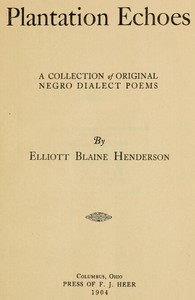
A COLLECTION _of_ ORIGINAL NEGRO DIALECT POEMS
_By_ ELLIOTT BLAINE HENDERSON
COLUMBUS, OHIO PRESS OF F. J. HEER 1904
Entered According to Act of Congress in the year 1904
In the office of the Librarian of Congress at Washington.
THIS BOOK IS RESPECTFULLY DEDICATED TO
HOWARD BURBA L. WALTER HARRISON PROF. L. M. LAYTON T. J. McCORMICK OSMAN C. HOOPER
Literary Editor of the Columbus Dispatch, Columbus, Ohio.
The music of the American negro, the fresh and spontaneous expression of a good and care-free heart, has long been one of the most pleasing features of American life. It is human nature in its first vocal garb—original and unique, often humorous and always true to the sentiment of the singer. If there ever was an illustration of the close relationship between language and thought, it is this.
What is true of the melodies of the negro as developed in the simple existence on the plantation is also true of that other form of singing, verse-making. Among the negroes there have sprung up a number of exponents of the wisdom, wit and humor of the race. They have caught the spirit of others—the humble philosophers of their kind—and they have employed the dialect to reproduce the thought in all its quaintness and originality. One of the most notable of these exponents or interpreters is an Ohio negro, Paul Lawrence Dunbar, who has taken high rank among the poets of the day. Another is Elliott Blaine Henderson, also a son of Ohio, whose first volume of verse is herewith presented.
In much that Mr. Henderson here presents, there is the rush of expression and the jingle of words that are so characteristic of the negro. There is also humor and there is sentiment, and always that other quality which makes verse in these days readable—good cheer.
He who correctly interprets the spirit of his race serves a good cause, and it is believed that Mr. Henderson will be found to have succeeded in his undertaking to make his people better and more widely understood.
E. G. BURKHAM, _Editor of the Columbus Dispatch, Columbus, Ohio_.
When the Moon Hangs Low 9
Seems Dey’s No Place 10
Good Bye, Honey, Good Bye 12
Whut We Gwine To Do 14
Kaze I kno’ I Kain’t Stop 16
Dahky Whut Yo’ Doin? 18
When De Fiah Am Kindlin’ Hot 20
When De Summah’s Dun Cum 23
The Coon’s Serenade 24
Blissful Anticipations 25
Pawson Johnson At Dinner 27
Go ’Way, Mah Honey 28
Brer Possum Declines 30
I Hain’t Foolin’ Honey 31
A Profuse Encomium 34
Peepin’ Th’ew De Husk 35
Axin’ Coon Cum Obeah 38
Kase De Sun Am Sinkin’ 41
Soft Falls The Night 43
Git On Board, Chillun 44
Uncle Ned An’ De Mockin’ Bird 46
Sambo’s Rain Philosophy 50
Jes’ Keep Er Lookin’ Up 51
Wished I’d Rode Mah Hoss 53
Eggs! Eggs!! Eggs!!! 54
It Am De Possum Time 55
Stick To Your Race 57
Is Yo’ Lonesum, Honey? 64
Larn To He’p Yo’se’f 64
Courtin’ O’ De Phone 66
Lonesum Valley Christmas Tree 68
Yes, Wees Got Er Flag 72
Dey’s Er Col’ Wave Breshin’ Nigh 77
The Passing Of Night 82
The Exstacy of Uncle Joe 85
Climin’ Up De Hill 88
The Gallant Blacks of San Juan Hill 93
WHEN THE MOON HANGS LOW.
A straying chicken Lost from home Bewildered, finds Itself a-roam. And innocently Stalks the ground, Not dreaming That a coon’s around.
As evening’s shadows Gently fall, The chicken, lonesome, Gives a call. A coon steals out Soft in the night, To catch him For his appetite.
The night is still! The moon is low! Not e’en a zephyr Seems to blow. The coon with sack Clutched in his hand, Moves silently Across the land.
The chicken gives Another squawk! The coon has got her Like a hawk. The moon now breaks Forth into light, The coon and chicken’s Out of sight.
SEEMS DEY’S NO PLACE.
Well er coon kin go to kollege Git his head chucked full o’ knowledge, Till he knows ez much ez Solomon de wise. He kin study an’ summize, Count de stars up in de skies, Seems dey’s no place Fo’ de eddeekayted coon.
Tawk erbout yo’ eddeekayshun Gittin’ in de cullahd nayshun, Gittin’ “lighten” in de head an’ sich ez dat, Yo’ kin larn sah, till yo’ hat On yo’ head woan’ fit exzac’, Seems dey’s no place Fo’ de eddeekayted coon.
Eddeekayshun am all right Ef er coon kin git er sight ’Stead o’ makin’ bread an’ buttah by de hoe, He kood entah any do’ Whah he’s qualified to go. Seems dey’s no place Fo’ de eddeekayted coon.
Elliott Blaine Henderson's Plantation Echoes (1904) arrives with an introduction by E. G. Burkham that sets a particular frame: the poems are presented as 'the fresh and spontaneous expression of a good and care-free heart,' a characterization that aligns with the catalog subject 'Dialect poetry, American' but sits uneasily alongside the poems themselves. The volume's dedication to several white Ohio gentlemen, including the literary editor of the Columbus Dispatch, further signals the work's intended audience. Yet the poems, written in a dialect that the Project Gutenberg transcriber's note warns contains 'racial stereotypes,' offer more than simple cheer. They include a 'Decoration Day' poem that explicitly acknowledges Black soldiers who 'fought and bled upon the field,' complicating the nostalgic plantation frame.
The Introduction's Claims vs. the Poems' Content
Burkham's introduction positions Henderson as an 'interpreter' of his race, alongside Paul Laurence Dunbar, and emphasizes 'humor' and 'good cheer' as the verse's defining qualities. But the poems themselves do not uniformly match this description. 'Trussy's Visit,' for example, is a boisterous, food-filled reunion full of dialect and comic exaggeration—'Ha! ha! Dina? look at Trussy / Kock dat lef' eye at dat coon!'—yet it also includes a prayer parody that undercuts piety. More strikingly, the untitled 'Decoration Day' poem (likely 'Memorial Day') shifts register entirely, using standard English and a solemn tone to honor 'the black man once a slave' who fought for the country. This poem's existence suggests that Henderson's range extends beyond the 'care-free' plantation humor Burkham promotes.
Dialect as Both Authenticity and Stereotype
The poems employ a thick dialect that the catalog labels 'Dialect poetry, American,' but the excerpts show variation in how that dialect is used. In 'Trussy's Visit,' dialect dominates every line: 'Bress mah life! why, dis hain't Trussey?' The effect is comic and rhythmic, with exaggerated spellings ('hooskerpalty,' 'sump-shus musherroon') that emphasize pronunciation. Yet the 'Decoration Day' poem uses no dialect at all, suggesting Henderson could write in standard English when the subject demanded seriousness. This raises questions about whether the dialect in the comic poems was a stylistic choice for a specific audience or a constraint of the genre. The transcriber's note flags the language as potentially offensive, and readers should consider how the dialect functions both as a representation of speech and as a literary convention of its time.
Recurring Motifs: Food, Community, and Memory
Across the excerpts, food appears as a central motif, grounding the poems in sensory, communal experience. 'Trussy's Visit' is built around a meal of 'chittlins,' 'hog feet,' 'coon,' and 'possum,' with the host urging his guest to 'jump in, Trussy; git to business!' The prayer parody even asks for 'chicken, an' all sech ez dat' and 'coon wid plenty lean an' fat.' This focus on eating creates a vivid, earthy texture that contrasts with the introduction's abstract praise of 'music' and 'sentiment.' Memory also threads through the poems: the speaker in 'Trussy's Visit' recalls 'dat fight at Possum Trot' and asks after old friends like 'Tootsy Tadpole' and 'Slipshod Beebe.' These details build a specific, if stereotyped, social world, one that the 'Decoration Day' poem expands to include national history.
Readers approaching Plantation Echoes should be alert to the gap between the framing introduction and the poems themselves. The volume is not a unified artifact but a collection that shifts between comic dialect pieces and more earnest, standard-English reflections. The catalog subjects emphasize 'African American authors' and 'dialect poetry,' but the work's relationship to those categories is complicated by its white-dedicatee audience and the transcriber's warning about offensive stereotypes. Henderson's poems reward attention to their specific details—food, names, rhythms—rather than to the generalizations of the preface.
That rainy afternoon, Plantation Echoes sat heavy in my lap, its cheerful introduction clashing with a soldier’s quiet verse—Henderson’s gloss felt thin against the poems’ own ache. I set it down, and my gaze drifted to On old Cape Cod — Themes and Context, thinking how every edited memory leaves something unsaid beneath the weather.
There are no reviews for this eBook.
There are no comments for this eBook.
Reader reflection
Your personal reading reflection
Build a private reading journal entry for this title.
Your progress
0
/
10
2
Was reading this book enjoyable?
3
Would you pass this book on to a friend?
4
Did the language feel accessible?
5
Was the book what you thought it would be?
6
How closely did the book connect with your experience?
7
Did anything about the book feel genuinely new?
8
Did you gain anything practical from the text?
9
Which lesson or insight stayed with you?
10