1

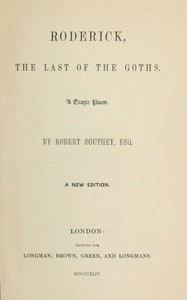
Roderick, the last of the Goths — Background and Themes
(0 User reviews)
641
Project Gutenberg
2023
Not confirmed
Roderick, King of the Visigoths, -711? -- Poetry
Readers of public-domain and historical texts
Project Gutenberg digital edition
en
Edition facts
Words
115,903
Reading time
504 min
Text sections
36
For Roderick, the last of the Goths — Background and Themes, the stored edition analysis reports 115,903 words, 8 hr 24 min estimated reading time, and 36 detected text sections.
The text analysis averages about 27.2 words per sentence, while the detected sections provide another way to judge how the source is divided.
Project Gutenberg metadata also associates the work with “Roderick, King of the Visigoths, -711? -- Poetry,” connecting these edition facts with the source record’s subject description.
Source:
Project Gutenberg record #71470
Robert Southey's tragic poem traces King Roderick's fall and redemption through shifting narrative voices, from solitary lament to battle cries, with a formal, archaic style and recurring motifs of light and darkness.
Editorial Edition Score
4.9/5
★★★★★
★★★★★
Calculated from edition completeness, EPUB availability, text structure and catalogue metadata. Not a user rating.
How this score is calculated
- Description quality20 pts
- Title & short description10 pts
- Source metadata20 pts
- Text length15 pts
- Chapters / structure15 pts
- EPUB file integrity20 pts
Total of 100 points, scaled to a 2.5-5.0 range. Editions with an empty description or a missing EPUB file are not scored.
Edition quality
Read the Text
his mind Open and passive to the influxes Of outward sense, his vacant eye was there, ... So be it, Heavenly Father, even so I Thus may thy vivifying goodness shed Forgiveness there; for let not thou the groans Of dying penitence, nor my bitter prayers Before thy mercy-seat, be heard in vain! And thou, poor soul, who from the dolorous house Of weeping and of pain, dost look to me To shorten and assuage thy penal term, Pardon me that these hours in other thoughts And other duties than this garb, this night Enjoin, should thus have past! Our mother-land Exacted of my heart the sacrifice; And many a vigil must thy son perform Henceforth in woods and mountain fastnesses, And tented fields, outwatching for her sake The starry host, and ready for the work Of day, before the sun begins his course.”[1]
_Il se livrait à toutes ces réflexions, quand la lumière des lampes et des cierges commença à pâlir, et que les premières teintes de l’aurore se montrèrent à travers les hautes croisées tournées vers l’orient. Le retour du jour ne ramena point dans ces murs des sons joyeux ni les mouvemens de la vie qui se réveille; les seuls papillons de nuit, agitant leurs ailes pesantes, bourdonnaient encore sous les voûtes ténébreuses. Bientôt le premier rayon du soleil glissant obliquement par-dessus l’autel, vint s’arrêter sur la tombe de la femme pécheresse, et la lumière du ciel sembla y pénétrer. “Que ce présage s’accomplisse,” s’écria Pelage, qui absorbé dans ses méditations, fixait en ce moment ses yeux sur le tombeau de sa mere; “Dieu de miséricorde, qu’il en soit ainsi! Puisse ta bonté vivifiante y verser de même le pardon! Que les sanglots de la pénitence expirante, et que mes prières amères ne montent point en vain devant le trône éternel. Et toi, pauvre âme, qui de ton séjour douloureux de souffrances et de larmes, espères en moi pour abréger et adoucir ton supplice, temporaire, pardonne moi d’avoir, sous ces habits et dans cette nuit, détourné mes pensées sur d’autres devoirs. Notre patrie commune a exigé de moi ce sacrifice, et ton fils doit dorénavant accomplir plus d’une veille dans la profondeur des forêts, sur la cime des monts, dans les plaines couvertes de tentes, observant, pour l’amour de l’Espagne, la marche des astres de la nuit, et préparant l’ouvrage de sa journée avant que le soleil ne commence sa course._”—T. i. pp. 175-177.
In the other translation the _motes_ are not converted into moths,—but the image is omitted.
_Consumées dans des soins pareils les rapides heures s’écouloient, les lampes et les torches commençoient à pâlir, et l’oblique rayon du matin doroit déjà les vitraux élevés qui regardoient vers l’Orient: le retour du jour ne ramenoit point, dans cette sombre enceinte, les sons joyeux, ni le tableau mouvant de la vie qui se reveille; mais, tombant d’en haut, le céleste rayon, passant au-dessus de l’autel, vint frapper le tombeau de la femme pécheresse. “Ainsi soit-il,” s’écria Pelage; “ainsi soit-il, ô divin Créateur! Puisse ta vivifiante bonté verser ainsi le pardon en ce lieu! Que les gémissemens d’une mort pénitente, que mes amères prières ne soient pas arrivées en vain devant le trône de miséricorde! Et toi, qui, de ton séjour de souffrances et de larmes, regardes vers ton fils, pour abréger et soulager tes peines, pardonne, si d’autres devoirs ont rempli les heures que cette nuit et cet habit m’enjoignoient de te consacrer! Notre patrie exigeoit ce sacrifice; d’autres vigiles m’attendent dans les bois et les défilés de nos montagnes; et bientôt sous la tente, il me faudra veiller, le soir, avant que le ciel ne se couvre d’étoiles, être prêt pour le travail du jour, avant que le soleil ne commence sa course._”—pp. 92, 93.
A very good translation in Dutch verse, was published in two volumes, 8vo. 1823-4, with this title:—“Rodrigo de Goth, Koning van Spanje. Naar het Engelsch van Southey gevolgd, door Vrouwe Katharina Wilhelmina Bilderdijk. Te ’s Gravenhage.” It was sent to me with the following epistle from her husband, Mr. Willem Bilderdijk.
“Roberto Southey, viro spectatissimo, Gulielmus Bilderdijk, S. P. D.
Robert Southey's Roderick, the last of the Goths (1814) is a tragic poem in twenty-five sections, each headed by a place or character name. The narrative voice shifts markedly across the work: early sections such as 'Roderick in Solitude' adopt a meditative, introspective tone, while later battle sequences accelerate into a rapid, exclamatory style. Southey frequently uses repetition of key phrases—'Roderick the Goth!', 'Victory and Vengeance!'—to build momentum and signal shifts in the protagonist's fortunes. The poem's language is consistently formal and archaic, with inverted syntax and elevated diction that align it with the epic tradition.
Voice and the Weight of the Past
The poem opens with a preface and a Wordsworth epigraph that frames virtue as a 'calm, a beautiful and silent fire'—a contrast to the turbulent action that follows. In the early sections, Roderick's voice is introspective and burdened by guilt. Southey renders his solitude through long, flowing lines and natural imagery: 'the deep stillness of a summer even'. As the narrative progresses, the voice becomes more public and martial. The cry 'Roderick the Goth!' is repeated across multiple sections, first as a personal war-cry, then echoed by Pelayo, Odoar, and the entire host. This repetition transforms a single voice into a collective roar, marking Roderick's reintegration into the community. The shift from solitary lament to shared battle cry is one of the poem's most striking structural features.
Pace and the Rhythm of Battle
Southey controls pace through line length, repetition, and syntactic stacking. In meditative passages, lines are end-stopped and balanced: 'Thy son hath now achieved, ... the victory / Over the world, his sins and his despair.' In battle scenes, enjambment and anaphora accelerate the rhythm: 'Smiting and slaying through the astonish'd ranks, / Till he beheld, where on a fiery barb, / Ebba, performing well a soldier's part, / Dealt to the right and left his deadly blows.' The repeated cries—'Roderick and Victory! Roderick and Vengeance!'—function as rhythmic anchors, driving the verse forward. Southey also varies pace by inserting brief, direct commands ('On, comrades, on!') that break the formal pattern and mimic the urgency of combat.
Recurring Motifs: Light, Darkness, and the War-Cry
Two motifs recur across the excerpts: light and the war-cry. The Wordsworth epigraph describes the moon 'Burning like an unconsuming fire of light'—an image of serene power. Later, Roderick's peace is described as 'heavenlier' than any other. Darkness appears in the context of guilt and despair, but light returns in the battle scenes, where the war-cry becomes a 'prophetic shout' that 'the hills and rocks / Caught ... and roll'd it round'. The cry itself is a verbal motif that Southey varies: 'Roderick the Goth!', 'Roderick and Victory!', 'Roderick and Vengeance!'. It functions as a leitmotif, marking Roderick's identity and his transformation from outcast to avenger. The repetition also creates a choral effect, as if the landscape itself participates in the action.
Readers may find it useful to attend to the poem's sectional divisions: each heading signals a shift in location or speaker, and the pace changes accordingly. Southey's notes (appended after the poem) provide historical context, but the verse itself rewards attention to its rhythmic and rhetorical patterns. The interplay between solitary voice and collective cry is the poem's central dynamic.
Years after first weeping over Roderick’s solitary laments, I found a quieter echo in Hazel bloom — A Closer Reading. Where Southey’s king cries into darkness, this book bends low to hear a small flower’s own slow turning toward light. Both keep a vigil, I think, for the grace that arrives after the shouting stops.
There are no reviews for this eBook.
There are no comments for this eBook.
Reader reflection
How did this book work for you?
Your answers remain private and are stored only in this browser.
Your progress
0
/
10
2
Did this book hold your interest?
3
Would you recommend this book to another reader?
4
What was the reading difficulty like?
5
Did the book meet your expectations?
6
Did it raise ideas you would like to talk about?
7
What was its emotional impact?
8
How understandable was the text?
9
What did this book teach you most?
10