1

The Goblin Groom: a Tale of Dunse — Story, Setting & Ideas
(0 User reviews)
61
Project Gutenberg
2021
Not confirmed
Fox hunting -- Poetry; Scott, Walter, 1771-1832 -- Parodies, imitations, etc.
Readers of public-domain and historical texts
Project Gutenberg digital edition
en
Edition facts
Words
16,175
Reading time
71 min
Text sections
3
This digital edition of The Goblin Groom: a Tale of Dunse — Story, Setting & Ideas is described by source-level measurements including 16,175 words, 1 hr 11 min estimated reading time, and 3 detected text sections.
The text analysis averages about 27.1 words per sentence, while the detected sections provide another way to judge how the source is divided.
Project Gutenberg metadata also associates the work with “Fox hunting -- Poetry,” connecting these edition facts with the source record’s subject description.
Source:
Project Gutenberg record #66950
An 1809 mock-heroic poem in which a fox hunt on the Scottish borders is narrated with playful allusions to Walter Scott and supernatural folklore, blending sport, satire, and antiquarian whimsy.
Editorial Edition Score
4.5/5
★★★★★
★★★★★
Calculated from edition completeness, EPUB availability, text structure and catalogue metadata. Not a user rating.
How this score is calculated
- Description quality20 pts
- Title & short description10 pts
- Source metadata20 pts
- Text length15 pts
- Chapters / structure15 pts
- EPUB file integrity20 pts
Total of 100 points, scaled to a 2.5-5.0 range. Editions with an empty description or a missing EPUB file are not scored.
Edition quality
Read the Text
fancy painted Marrowfat. She painted Walter as I’ve seen, When weeding D-- --h’s walks so green; To noble dames, just bent to bow; Dejected head, erected hoe, Proclaimed respect to ladye fair, And shewed her that defence was there. ’Twas diffidence and manly pride, That bows, yet shews the power to chide. Above the common height of man, My Walter stands at least a span: A brow of jet, a fiery eye, Like planet in a sable sky, Shone from my fancy’s painted chief; And then, to give the scene relief, A nose projecting curvedly; The nose befitting well the eye. Vails it not me, alas! to speak Of bushy lip, or cherry cheek; To say I saw my Walter smile, I’d rather pause a little while: For bootless is the task to paint, When fancy’s self is far too faint, To shew the gardener of B-- --h, In form exact, and colours true. How happy passed my early days, With thee in D-- --h’s groves of bays; When slinking sly, from bush to bush, We sought to catch the nestling thrush; Or when supported, friend, by thee, I climbed the giant cherry-tree; Or ran a race, dear Wat, with you, To please the gallant young B-- --h. The bower was still, and all was hushed, ’Twas eve, and modest nature blushed; The crimson setting of the sun, Waved o’er the night-cloud’s visage dun, And all creation, so serene, Enjoyed the still, the lovely scene. The thrush, upon the hazel bough, Pour’d calmly forth her evening vow, And every bird, from tree to tree, Joined in the heavenly melody; What heart so fraught with woe or care, But might have tasted pleasure there. Such, Watty, was the night when we Pursued the humming bumble bee;[2] When you averred the beast[3] could sting, And I responded, no such thing! “The question fierce, the stern reply,” Was heard to sound ’twixt U and I.[4] Anon: my Watty dared to fight The fancied foeman Wallace wight; And I, if pleasing mem’ry hold. Dared to the combat, Bruce the bold. Perhaps, my friend, you’ll wish to know Th’ event of each successive blow; How Bruce, transported, swore he’d die, But never, never yield or fly; How Wallace to the combat flew, With fancied pride, but courage true. Alas! my friend, your hopes are vain, For friendship still forbids the strain: The tale, alas! would only tend To make a foeman of a friend. And whilst I live, and whilst I breathe, I swear it is so much beneath The soul of man, to harbour hate Against the good, against the great, That I will ne’er to man disclose The purport of these bloody blows. Enough! enough! it is to me To hate the name of bumble bee.
Joy reign’d in Dunse’s[5] distant seat, Thro’ tavern, market place, and street, The scene of many a valiant feat In days of distant yore. But now those distant days are fled, Peace rears again her placid head, And gory feud I hope is staid To plague the land no more. Where garden is, was place of tilt Or tournament, where blood was spilt; Where stain’d was many a foeman’s hilt With blood of knight laid low; Now peeps the pea, from glowing bed, Forgetful of December dread; The broader bean, her leaf has spread Th’ unhallow’d spot to show.
Now why are Dunse’s people glad, Who once were wont to be so sad; How was the feudal hatred staid That waste their lovely fields had laid; Why rolls the Whittadder[6] so white, The scene of many a bloody fight; And how has peace reception found On such unhallowed bloody ground? I may not tell the change of time; It ill becomes my minstrel rhyme: ’Twere impious surely to relate The fancied works of fancied fate. Enough, the bloody feud is staid; Enough, the sword aside is laid; And Whittadder long may’st thou flow With spotless wave and crystal tide; And may’st thou never, never know, Again the strife of border side.
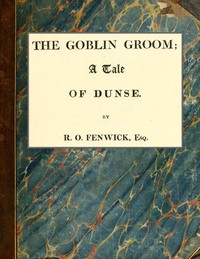
R. O. Fenwick’s The Goblin Groom (1809) announces itself as a mock-heroic poem, a “Tale of Dunse” that turns a fox hunt into a stage for supernatural mischief. The author’s advertisement immediately signals a playful, self-aware voice: he declines to kill his hero early, as Madame de Genlis did, and promises to restore him “in a form at once congenial to the spirit of poetry.” The poem opens on 30 April 1806 and concludes twenty-four hours later on Flodden Field, compressing the action into a single day’s chase. Fenwick’s preface also includes a lengthy Latin anecdote about angelic choirs, suggesting a taste for antiquarian lore that he will parody in the verses that follow.
A Self-Conscious Narrator and His Paratexts
The editorial apparatus of The Goblin Groom is as much a performance as the poem itself. Fenwick’s advertisement adopts a mock-serious tone, addressing “those admirers of English Poetry who wish to see it restored to its ‘old style of pathos.’” He then inserts a Latin passage from a “venerable historian” about a bishop hearing angelic song—a digression that delays the poem proper and establishes the narrator as a learned, slightly pedantic figure. The dedication to Walter Marrowfat, “Gardener to his Grace the Duke of…,” continues the joke, blending high-flown rhetoric with bathetic titles. These framing devices create a layered reading experience: the reader must navigate between earnest antiquarianism and playful parody, never quite sure where one ends and the other begins.
The Hunt as Supernatural Chase
The poem’s central conceit—a fox hunt presided over by a goblin groom—allows Fenwick to mix the mundane details of equestrian sport with folkloric elements. The goblin is introduced not as a terrifying specter but as a figure who “first made his appearance” at a favorite hunting rendezvous. The chase itself is described with the “rapid glance of a sportsman,” as the author admits, but the supernatural frame gives the pursuit an otherworldly urgency. The fox’s death on Flodden Field, a site of historical battle, adds a layer of historical resonance to what might otherwise be a simple sporting tale. Fenwick’s note that the story is “called a Tale of Dunse” because the goblin first appeared there grounds the fantasy in a specific Scottish locale, blending local legend with literary invention.
Pace and the Compression of Time
Fenwick explicitly limits the poem’s action to twenty-four hours, from the last day of April 1806 to the death of the fox on Flodden Field the following day. This tight temporal frame forces the narrative to move quickly, matching the speed of a hunt. The author’s preface acknowledges the “hasty and imperfect sketch” of the landscape, seen with a sportsman’s rapid glance rather than a topographer’s precision. Yet within this compressed timeframe, Fenwick inserts digressions—the Latin anecdote, the mock-heroic invocation—that slow the pace and create a contrast between the swift chase and the narrator’s leisurely commentary. This alternation between urgency and reflection gives the poem a distinctive rhythm, as if the reader is alternately galloping and pausing to catch breath.
Readers approaching The Goblin Groom should attend to its playful handling of genre: it is neither a straightforward hunting poem nor a pure supernatural tale, but a hybrid that uses each mode to undercut the other. Fenwick’s voice is consistently ironic, and his paratexts—the advertisement, the Latin quotation, the mock dedication—are essential to the work’s effect. The poem rewards those who enjoy literary gamesmanship and the border country between earnest imitation and satire.
The rain drummed on the Dunse rooflines all afternoon, and I drifted from that fox-hunt’s spectral hounds to Frost’s damp, unpretentious New Hampshire, where the landscape carries its own quiet superstitions. It felt less like changing subjects than turning a page. That old poem’s antiquarian chuckle softened into something nearer to a sigh. I found New Hampshire, A Poem; with Notes and Grace Notes — Themes and Context waiting beside it, as if it had rained in there too.
There are no reviews for this eBook.
There are no comments for this eBook.
Reader reflection
How did this book work for you?
Your answers remain private and are stored only in this browser.
Your progress
0
/
10
2
How much did you enjoy the reading experience?
3
Would you pass this book on to a friend?
4
How much effort did this book require?
5
Which aspect of the book did you value most?
6
How original did the book feel?
7
Do you expect to return to this book?
8
Would you like to discuss this book with someone?
9
Which lesson or insight stayed with you?
10