1

Two in Arcadia — Reading Notes
(0 User reviews)
238
Project Gutenberg
2022
Not confirmed
American poetry -- 20th century; Love poetry
Readers of public-domain and historical texts
Project Gutenberg digital edition
en
Edition facts
Words
3,706
Reading time
17 min
Text sections
1
This digital edition of Two in Arcadia — Reading Notes is described by source-level measurements including 3,706 words, 17 min estimated reading time, and 1 detected text section.
The text analysis averages about 21.7 words per sentence, while the detected sections provide another way to judge how the source is divided.
Project Gutenberg metadata also associates the work with “American poetry -- 20th century,” connecting these edition facts with the source record’s subject description.
Source:
Project Gutenberg record #67509
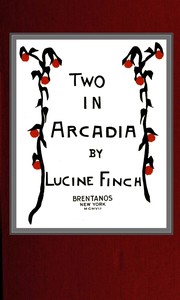
A 1907 poetry collection by Lucine Finch, 'Two in Arcadia' uses recurring natural imagery—moon, sun, sea, and seasons—to chart the emotional arc of a romantic relationship from longing to union to separation.
Editorial Edition Score
4.4/5
★★★★★
★★★★★
Calculated from edition completeness, EPUB availability, text structure and catalogue metadata. Not a user rating.
How this score is calculated
- Description quality20 pts
- Title & short description10 pts
- Source metadata20 pts
- Text length15 pts
- Chapters / structure15 pts
- EPUB file integrity20 pts
Total of 100 points, scaled to a 2.5-5.0 range. Editions with an empty description or a missing EPUB file are not scored.
Edition quality
Read the Text
There were no words, if I remember, But something subtler, deeper, Love. The night it was a cold December With a shiv’ry, silver moon above-- But in our hearts--the flame of love!
The moon, the moon and a wide, blue sea, A boat, a breeze, and you and me!
Every night is our night. But when the moon is high, I think the _world_ belongs to us, The earth, the sea, the sky!
There are snow peaks in your heart, And a grayness that is cold. But wisdom comes with loving, sweet, And all your moods my love can meet-- Because my love is bold!
Into the night we went, we two, Under the comfort of the moon. The sky was pale and the poplar-trees Swayed in the wind, Swayed and swung. And the dear night passed too soon!
In the twilight We parted, In the night, Broken-hearted, We dreamed a sweet dream. Then we met and we parted Again, broken-hearted. But--dreams come again!
Over the meadows-- To go! To go! Just You and Me-- In the afterglow!
The moon is the lovers’ lantern. With paths of palest gold She lights the lovers’ night way. The moon--is never old!
ON PASSING HER WINDOW
Through the midnight my soul comes winging, In the darkness my heart is singing. All my soul to your soul I am flinging! And I’m singing to draw you to me, All to me! To draw you to me!
Out of the midnight I hear you singing! O, my Beloved, I hear you singing, And, though I silent must lie, My heart sings with your heart, My heart sings with yours!
Spring in the hills, Beloved! On the side of a meadowed slope! And love in our hearts, Beloved, Love and Spring and Hope!
The sun is like a world of fire And I am like the sun! I shall burn through all the dreary worlds Until my flame is done. O, Heart’s Desire! My fire, my fire Shall burn for only one!
The sun is the flame of the desert, And you are the flame of my heart! Dreary indeed is the desert unsunned, And dreary without you, my heart.
Oh, the poor, pale moon, Beloved! She paled when you left me here. Come back to us, to the moon and me. The moon understands us, dear.
Oh, the glow of the sun And the red of the lake And the shade of the bending tree! Oh, the sound of the waves And the sight of a sail! Oh, the song in my heart for thee!
I hear the sea call to the moon, I hear the moon murm’ring as she sails, "I cannot fail thee, Why dost thou fear me?"
I hear the wind sing to the pine-tree, I hear the pine-tree whisp’ring as she sways, "I cannot fail thee, Why dost thou fear me?"
I hear my heart cry to your heart, I hear your heart beating ’gainst my own, "I cannot fail thee, Why dost thou fear me?"
You are so dear, so dear, That all things else seem dear, The wonder of our loving Has made all else seem dear!
Under the moon in the garden The pale lilies sleep and sway. And thou, dear white flower-woman, Sleep thou until the day!
Lucine Finch's Two in Arcadia (1907) opens with a 'Vorspiel' titled 'Wild Geese,' immediately establishing a pattern of pairing: 'Geese and Lovers, Lovers and Geese!' The collection's 3,706 words are organized into short lyric poems that trace a relationship through its seasons, from the first stirrings of desire to the ache of parting. The moon appears as a persistent companion, called 'the lovers’ lantern' in one poem, and the natural world—meadows, hills, the sea—serves as both setting and emotional barometer. Readers should note how the poems shift between direct address ('Come over the sea to me, to me') and reflective observation, and how the speaker's voice alternates between confident assertion and vulnerable longing.
The Moon as a Recurring Emblem
Across the excerpts, the moon is the most frequently invoked natural object, appearing in at least seven distinct poems. It is personified as a lantern, a confidante, and a witness: 'The moon understands us, dear,' one speaker pleads. In 'Her Reply,' the moon is said to have 'paled when you left me here,' linking its phases directly to the lover's absence. The moon also serves as a bridge between speakers—'I hear the sea call to the moon, / I hear the moon murm’ring as she sails'—suggesting a chain of communication that connects the lovers even when apart. This consistent imagery invites readers to track how the moon's role evolves: from a romantic backdrop in early poems to a symbol of shared memory in later ones.
Dialogue and the Two Voices
The collection's title hints at a duet, and the excerpts confirm a deliberate interplay between two speakers. Poems such as 'On Passing Her Window' and 'Her Reply' are explicitly paired, with one voice calling and the other answering from a distance. The first speaker declares, 'All my soul to your soul I am flinging,' while the second responds, 'My heart sings with your heart.' This call-and-response structure creates a sense of intimacy and tension, as the lovers are often separated—by a window, by the sea, by the night. Readers should attend to how the poems shift between first-person singular and plural, and how the 'we' emerges only in moments of imagined or remembered union.
Nature as Emotional Barometer
Finch consistently uses natural elements to externalize inner states. The sun is 'like a world of fire' and the speaker declares, 'I am like the sun! I shall burn through all the dreary worlds.' In contrast, cold and grayness signal emotional distance: 'There are snow peaks in your heart, / And a grayness that is cold.' The sea and wind become messengers, and the seasons mark the relationship's progression—from 'Spring in the hills' to a 'cold December' night. This technique allows the poems to convey complex feelings without explicit psychological analysis. Readers may notice how the natural world is never merely decorative; it actively participates in the lovers' drama, reflecting their moods and mediating their connection.
Structure and the Arc of the Collection
Although the full sequence is not provided, the excerpts suggest a narrative arc. Early poems are filled with anticipation and the thrill of pursuit: 'Over the meadows— / To go! To go! / Just You and Me— / In the afterglow!' Later poems introduce separation and longing, as in 'Oh, the poor, pale moon, Beloved! / She paled when you left me here.' The final excerpt includes a repeated refrain—'I cannot fail thee, Why dost thou fear me?'—which echoes across three stanzas, each time linking a different natural pair (sea and moon, wind and pine-tree, heart and heart). This repetition may signal a resolution or a plea for reassurance. Readers approaching the full collection should watch for how these patterns build toward a conclusion, and whether the 'two' of the title ultimately reunite or remain apart.
Two in Arcadia rewards a reading that attends to its interlocking images and voices. Because the excerpts are incomplete, the full emotional trajectory remains uncertain, but the poems' consistent use of natural symbols and paired speakers provides a clear framework. Readers may find it useful to read the poems aloud, as the rhythms and repetitions—'Swayed in the wind, / Swayed and swung'—are integral to the effect. The collection is brief enough to be experienced in a single sitting, yet its echoes may linger.
I kept thinking about how Two in Arcadia tracks the same tide turning—the moon pulling away, leaving that hollow quiet. It reminded me of something softer in Lyrical tales — Context and Discussion, where the separation isn’t loud, just a slow fading of shared light. That ache lingers long after the page closes.
There are no reviews for this eBook.
There are no comments for this eBook.
Reader reflection
What did you think of this book?
Answer a few questions and save a private reflection on this device.
Your progress
0
/
10
2
How much did you enjoy the reading experience?
3
Would you encourage someone else to read it?
4
How much effort did this book require?
5
How original did the book feel?
6
How much did the book move you?
7
What was the strongest part of the book?
8
Would you like to discuss this book with someone?
9
What is the main idea you are taking away?
10