1

Caroling dusk — Themes and Context
(0 User reviews)
299
Project Gutenberg
2025
Not confirmed
American poetry -- African American authors; African Americans -- Poetry
Readers of public-domain and historical texts
Project Gutenberg digital edition
en
Edition facts
Words
45,201
Reading time
197 min
Text sections
46
For Caroling dusk — Themes and Context, the stored edition analysis reports 45,201 words, 3 hr 17 min estimated reading time, and 46 detected text sections.
The text analysis averages about 20.7 words per sentence, while the detected sections provide another way to judge how the source is divided.
Project Gutenberg metadata also associates the work with “American poetry -- African American authors,” connecting these edition facts with the source record’s subject description.
Source:
Project Gutenberg record #76889
Countee Cullen's 1927 anthology gathers 38 African American poets, showcasing varied voices from Paul Laurence Dunbar to Langston Hughes. The collection balances formal sonnets with blues-inflected free verse, spirituals, and protest poems, revealing a community negotiating identity, faith, and artistic legacy.
Editorial Edition Score
4.8/5
★★★★★
★★★★★
Calculated from edition completeness, EPUB availability, text structure and catalogue metadata. Not a user rating.
How this score is calculated
- Description quality20 pts
- Title & short description10 pts
- Source metadata20 pts
- Text length15 pts
- Chapters / structure15 pts
- EPUB file integrity20 pts
Total of 100 points, scaled to a 2.5-5.0 range. Editions with an empty description or a missing EPUB file are not scored.
Edition quality
Read the Text
Copyright 1896 by Dodd, Mead & Company, Inc.
[3] Copyright 1896 by Dodd, Mead & Company, Inc.
[4] Copyright 1896 by Dodd, Mead & Company, Inc.
[5] Copyright 1896 by Dodd, Mead & Company, Inc.
[6] Copyright 1896 by Dodd, Mead & Company, Inc.
[7] Copyright 1896 by Dodd, Mead & Company, Inc.
[8] Copyright 1896 by Dodd, Mead & Company, Inc.
JOSEPH S. COTTER, SR.
“I was born in Nelson County, Ky., February 2nd, 1861, on a farm owned by my great grandfather, Daniel Stapp, a tanner. In 1829 he bought himself and a part of his master’s farm. Later he bought his daughter, Lucinda, my mother’s mother.
Martha, my mother, was born on a nearby farm owned by her English-Indian father, Fleming Vaughan. Prior to my birth she lived in Bardstown and was a servant at “My Old Kentucky Home.” She took me to Bardstown soon after my birth and brought me to Louisville in my fourth week, and here I have lived ever since.
I attended a private school and could read before my fourth year. Conditions were such that my attendance at school was very irregular. I quit school in my eighth year, having completed the third grade, and did not return until my twenty-second year.
During this time I picked up rags in the streets and worked in tobacco factories and brick-yards. My nineteenth year found me a distiller in one of the largest distilleries in Kentucky. A turn of fortune made me a teamster. I hauled cotton and tobacco and made up my mind to enter the prize ring. Another turn of fortune put me into a Louisville public night school. Here I began in the third grade where I left off in my eighth year.
At the end of two school sessions of five months each I was promoted to the high school. I keep this diploma under lock and key, for it is the only one I have ever received.
The man who turned my attention from prize-fighting to night school and then to school teaching, and who discovered my knack for writing verses, was Dr. W. T. Peyton of Louisville. He was my greatest benefactor.
My talent of whatever kind comes from Martha, my mother. She was poet, story-teller, dramatist and musician. My published works are: _A Rhyming_, _Links of Friendship_, _Caleb, the Degenerate_, a poetic drama, _A White Song And A Black One_ and _Negro Tales_. My unpublished works are: _Life’s Dawn And Dusk_, poems, _Caesar Driftwood and Other One Act Plays_ and _My Mother And Her Family_.”
There was a man Whose name was Pete, And he was a buck From his head to his feet.
He loved a dollar, But hated a dime; And so was poor Nine-tenths of the time.
The Judge said “Pete, What of your wife?” And Pete replied “She lost her life.”
“Pete,” said the Judge, “Was it lost in a row? Tell me quick, And tell me how.”
Pete straightened up With a hic and a sigh, Then looked the Judge Full in the eye.
“O, Judge, my wife Would never go To a Sunday dance Or a movie show.
“But I went, Judge, Both day and night, And came home broke And also tight.
“The moon was up, My purse was down, And I was the bully Of the bootleg town.
“I was crooning a lilt To corn and rye For the loop in my legs And the fight in my eye.
“I met my wife; She was wearing a frown, And catechising Her Sunday gown.
‘O Pete, O Pete’ She cried aloud, ‘The Devil is falling Right out of a cloud.’
“I looked straight up And fell flat down And a Ford machine Pinned my head to the ground.
“The Ford moved on, And my wife was in it; And I was sober, That very minute.
“For my head was bleeding, My heart was a-flutter; And the moonshine within me Was tipping the gutter.
“The Ford, it faster And faster sped Till it dipped and swerved And my wife was dead.
“Two bruised men lay In a hospital ward-- One seeking vengeance, The other the Lord.
“He said to me: ‘Your wife was drunk, You are crazy, And my Ford is junk.’
“I raised my knife And drove it in At the top of his head And the point of his chin.
“O Judge, O Judge, If the State has a chair, Please bind me in it And roast me there.”
There was a man Whose name was Pete, And he welcomed death From his head to his feet.
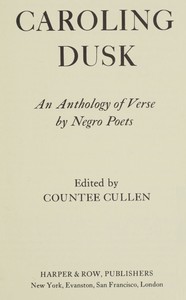
Countee Cullen’s Caroling Dusk (1927) brings together thirty-eight African American poets in an anthology that resists a single stylistic or thematic label. Cullen, in his preface, notes that the collection is “not a compendium of all the Negro poets of the day” but a selection reflecting his own taste. The result is a volume where a sonnet by Claude McKay sits beside a blues poem by Langston Hughes, and where James Weldon Johnson’s sermon-like “The Creation” shares space with Helene Johnson’s imagist lyrics. The title itself—Caroling Dusk—suggests a twilight hour of song, a moment of both celebration and melancholy that pervades many of the poems.
Formal Range and Poetic Inheritance
The anthology displays a deliberate formal breadth. Paul Laurence Dunbar’s dialect poems, such as “When Malindy Sings,” sit alongside his standard-English lyrics, illustrating a poet who moved between two linguistic worlds. Cullen includes sonnets by McKay and himself, as well as free verse by Jean Toomer and Georgia Douglas Johnson. The inclusion of W. E. B. Du Bois’s “A Litany of Atlanta” —a prose poem responding to the 1906 race riot—shows the anthology’s willingness to engage with public tragedy through experimental form. This range suggests that the editor valued technical mastery as much as thematic urgency, and that the “Negro poet” of the 1920s was not confined to a single mode of expression.
Recurring Motifs: Love, Loss, and the Body
Several poems in the excerpts share a vocabulary of physical and emotional extremity. In “To Jean,” the speaker describes love as “molten flame” poured into “pulsing veins,” while another poem speaks of “the silver sheen of passion’s flood” and “the ecstasy of pain.” The body is a site of both pleasure and wounding: a heart becomes “a crying thing,” and a kiss is followed by “the dark.” These poems often address a specific beloved by name—Telie, Wanda, Chick—creating an intimate, almost epistolary tone. The athletic metaphor in “To ‘Chick’” transforms a football game into a figure for death, with the speaker “slipping through / Fighting and squirming / Over the line / To victory.” This clustering of intense, embodied language suggests a shared emotional register among the anthology’s contributors.
The Chant as Counterpoint
One of the most striking poems in the excerpts is “NIGGER: A Chant for Children,” which juxtaposes a child’s taunt with a litany of Black historical figures: Hannibal, Othello, Crispus Attucks, Toussaint Louverture, and Jesus. The repeated refrain “Nigger, nigger never die / Black face an’ shiney eye” is both a playground rhyme and a grim assertion of endurance. The poem’s structure—short lines, repeated epithet, historical catalog—creates a cumulative effect that is both angry and celebratory. This piece stands in sharp contrast to the more private, lyrical poems elsewhere in the anthology, suggesting that Caroling Dusk accommodates both the personal and the political, the intimate and the public chant.
Readers approaching Caroling Dusk will find a collection that rewards attention to its juxtapositions: between dialect and standard English, between the sonnet and the blues, between the love poem and the protest chant. The anthology does not argue for a single “Negro voice” but instead presents a chorus of distinct poets, each working out their own relationship to tradition, race, and form. Cullen’s editorial hand is light, allowing the poems to speak for themselves and to one another across the page.
That rainy afternoon, Caroling Dusk sat open on my lap, the voices of Dunbar and Hughes mingling with the patter on the window. I kept circling back to Countee Cullen’s own formal elegance, how he fit grief into a sonnet’s cage. Later, thumbing through a friend’s shelf, I stumbled on The Pastime of Pleasure: An Allegorical Poem — Key Ideas to Explore—another kind of discipline, another patient march toward meaning, quieter but no less alive.
There are no reviews for this eBook.
There are no comments for this eBook.
Reader reflection
What did you think of this book?
Answer a few questions and save a private reflection on this device.
Your progress
0
/
10
2
Did this book hold your interest?
3
Would you recommend this book to another reader?
4
How easy was the book to follow?
5
How distinctive were its ideas or approach?
6
Did you relate to its people, ideas, or situations?
7
Did any part of the book stay with you emotionally?
8
Could you apply anything you learned?
9
What is the main idea you are taking away?
10