1

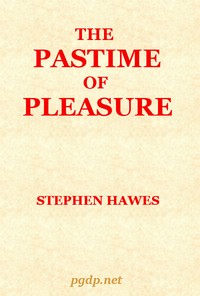
The Pastime of Pleasure: An Allegorical Poem — Key Ideas to Explore
(0 User reviews)
1550
Project Gutenberg
2018
Not confirmed
English poetry -- Early modern, 1500-1700
Readers of public-domain and historical texts
Project Gutenberg digital edition
en
Edition facts
Words
47,898
Reading time
209 min
Text sections
9
The catalog record for The Pastime of Pleasure: An Allegorical Poem — Key Ideas to Explore provides practical reading context through 47,898 words, 3 hr 29 min estimated reading time, and 9 detected text sections.
The text analysis averages about 29.4 words per sentence, while the detected sections provide another way to judge how the source is divided.
Project Gutenberg metadata also associates the work with “English poetry -- Early modern, 1500-1700,” connecting these edition facts with the source record’s subject description.
Source:
Project Gutenberg record #58037
Stephen Hawes's 16th-century allegorical poem follows the knight Graunde Amoure through a dream-vision landscape of personified virtues, mechanical marvels, and chivalric trials. The excerpts show a narrator who moves from prideful self-assurance to sudden wounding by love, framed by elaborate descriptions of a jasper tower with automated horsemen and a temple to Mars.
Editorial Edition Score
4.7/5
★★★★★
★★★★★
Calculated from edition completeness, EPUB availability, text structure and catalogue metadata. Not a user rating.
How this score is calculated
- Description quality20 pts
- Title & short description10 pts
- Source metadata20 pts
- Text length15 pts
- Chapters / structure15 pts
- EPUB file integrity20 pts
Total of 100 points, scaled to a 2.5-5.0 range. Editions with an empty description or a missing EPUB file are not scored.
Edition quality
Read the Text
e author of several other works besides the one here printed, for an account of which we refer the reader to “Warton’s History of English Poetry.” They are in general of very little importance. “The Pastime of Pleasure,” which Warton characterises as his “capital work,” is one of those allegorical writings which were popular with our forefathers, but which can now only be looked upon as monuments of the bad taste of a bad age. It is however a monument; and being one of the most remarkable productions between the age of Lydgate and that of Wyatt and Surrey, it deserves to be reprinted as one of the links in the history of English poetry, without which that history would be incomplete. The old editions of this poem are very rare.
The present edition is a reprint of that of 1555, of which there is a copy in the British Museum. In two passages the language is so gross in the original, that it has been considered necessary to omit a few lines. These relate chiefly to the _dénouement_ of a tale which was extremely popular in the Middle Ages, and which will be found told with somewhat more decency in the common chap-book story of the enchanter Virgil. It has been thought sufficient to print the simple text of this poem, without illustrative notes. From the nature of the work, the choice lay between giving a large mass of explanatory matter, or none at all, and the circumstances under which it has been published placed the former alternative entirely out of the question.
The History of GRAUND AMOURE and LA BEL PUCELL,
CALLED THE PASTIME OF PLEASURE,
Conteynyng the Knowledge of the Seven Sciences, and the Course of Mans Life in this Worlde.
Invented by STEPHEN HAWES, Grome of Kyng Henry the Seventh his chamber.
Stephen Hawes's The Pastime of Pleasure (first printed 1509, reprinted 1555) opens with a narrator who, at thirty-one, declares himself past "chyldly ygnoraunce" and confident that his wit can rule Venus and Cupid. That confidence is immediately undercut: in a temple, Venus wounds him with love, and the poem becomes a record of that reversal. The excerpted text reveals a work built from elaborate set-pieces—a tower of jasper with mechanical horsemen that trot and gallop by hidden wheels and cords, a temple to Mars decorated with the fall of Troy—rather than continuous narrative. These structures are described with a craftsman's attention to how they are made, not just what they represent.
Mechanical Marvels and Allegorical Architecture
The poem's most striking passages describe not characters but constructions. The tower in the "basse courte" is made of jasper "ful wonderly wrought," and its four armed horsemen are not static statues: they are animated by a system of wheels, cogs, and cords that make them trot, gallop, break their spears, and part for a tournament. Hawes specifies that the mechanism is "craftly Geometry," a phrase that points to a fascination with how things work—gears and joints—rather than with symbolic meaning alone. The temple of Mars is similarly detailed: its walls are painted with the destruction of Troy, and the god himself stands on a wheel with a two-faced lady. These descriptions occupy more space than any single action, suggesting that the poem's interest lies as much in the ingenuity of its imagined world as in the moral lesson it is supposed to convey.
The Narrator's Self-Assurance and Its Undoing
The narrator introduces himself at a specific age—"the xxxi. yere of my yonge flourynge aege"—and in a specific season, when the sun enters Gemini. He is walking in a temple, alone, when Venus appears and Cupid wounds him. The language of the wound is conventional—"Love had me wounded so sore inwardly"—but the poem frames it as a direct consequence of his earlier pride: "I thought that Venus might nothyng avaunce / Her strength against me." The excerpts do not show how this wound is resolved; they break off with the narrator still in distress, having lost his joy and pride. What is clear is that the poem's allegorical machinery does not protect the narrator from experience. The personifications do not remain abstract; they act on him, and he responds with a mixture of prayer and complaint.
Prayer as Action in a Personified World
When the narrator enters the temple of Mars, he kneels and prays directly to the god, addressing him as "O Mars! O god of the warre!" and asking for grace to "subverte / The hedyus monsters" and win victory. The prayer is a formal petition, complete with a promise to build a temple in return. This is not a passive observation of allegory; it is an attempt to intervene in the poem's own system. The narrator treats Mars as a being who can hear and respond, not merely as a figure on a wall. Similarly, the porter Stedfastnes is a personification who acts as a guide, leading the narrator into the courtyard. The poem thus operates on two levels at once: it describes a world of abstract qualities, but its protagonist moves through that world as if it were literal, praying to gods and walking through gates as if they were real places.
The excerpts offer a poem more interested in the texture of its imagined world than in straightforward moral instruction. Readers should attend to the density of physical detail—the jasper, the wheels, the painted walls—and to the way the narrator's voice shifts between confidence and vulnerability. The poem rewards attention to its craft, both in the mechanical sense of its descriptions and in the poetic craft of its seven-line stanzas. The 1555 reprint, from which this text is taken, includes editorial omissions in two passages, a reminder that even early editors found some content worth suppressing.
I’ve often thought how that knight’s jasper tower, with its silent automata, mirrors the strange stillness of a banquet hall before guests arrive. Both hold marvels meant for human joy, yet wait alone. Hilaria. The Festive Board — Key Ideas to Explore shares that quiet tension, a celebration poised between anticipation and memory, like a hundred abandoned feast-days I’ve shelved with fondness.
There are no reviews for this eBook.
There are no comments for this eBook.
Reader reflection
Record your reading impressions
A brief reflection can help important ideas stay with you longer.
Your progress
0
/
10
2
How much did you enjoy the reading experience?
3
Would you pass this book on to a friend?
4
How demanding did the text feel?
5
How much did the book move you?
6
Did any part of the book feel personally relevant?
7
How useful did the reading feel?
8
How did the reading compare with what you expected?
9
What did this book teach you most?
10