1

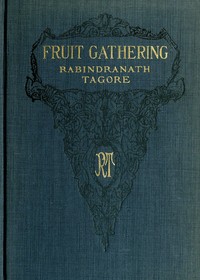
Fruit-Gathering — Key Ideas to Explore
(0 User reviews)
237
Project Gutenberg
2004
Not confirmed
Indic poetry -- Translations into English; Tagore, Rabindranath, 1861-1941 -- Translations into English; Bengali poetry -- Translations into English
Readers of public-domain and historical texts
Project Gutenberg digital edition
en
Edition facts
Words
13,995
Reading time
61 min
Text sections
87
This digital edition of Fruit-Gathering — Key Ideas to Explore is described by source-level measurements including 13,995 words, 1 hr 1 min estimated reading time, and 87 detected text sections.
The text analysis averages about 19.8 words per sentence, while the detected sections provide another way to judge how the source is divided.
Project Gutenberg metadata also associates the work with “Indic poetry -- Translations into English,” connecting these edition facts with the source record’s subject description.
Source:
Project Gutenberg record #6522
Tagore's 1916 collection of 86 poems, translated by the author, explores spiritual longing, the tension between attachment and renunciation, and the paradox of seeking the divine in the ordinary. The poems use natural imagery—flowers, rivers, seasons—to frame a journey from youthful abundance to mature offering, with recurring motifs of an unread letter, an unknown beloved, and the hidden signal in dust.
Editorial Edition Score
4.7/5
★★★★★
★★★★★
Calculated from edition completeness, EPUB availability, text structure and catalogue metadata. Not a user rating.
How this score is calculated
- Description quality20 pts
- Title & short description10 pts
- Source metadata20 pts
- Text length15 pts
- Chapters / structure15 pts
- EPUB file integrity20 pts
Total of 100 points, scaled to a 2.5-5.0 range. Editions with an empty description or a missing EPUB file are not scored.
Edition quality
Read the Text
Come, pilgrims of the march, hurrying on your journey!
The trumpet lies in the dust waiting for us.
I was on my way to the temple with my evening offerings, seeking for a place of rest after the day’s dusty toil: hoping my hurts would be healed and the stains in my garment washed white, when I found thy trumpet lying in the dust.
Was it not the hour for me to light my evening lamp?
Had not the night sung its lullaby to the stars?
O thou blood-red rose, my poppies of sleep have paled and faded!
I was certain my wanderings were over and my debts all paid when suddenly I came upon thy trumpet lying in the dust.
Strike my drowsy heart with thy spell of youth!
Let my joy in life blaze up in fire. Let the shafts of awakening fly through the heart of night, and a thrill of dread shake blindness and palsy.
I have come to raise thy trumpet from the dust.
Sleep is no more for me—my walk shall be through showers of arrows.
Some shall run out of their houses and come to my side—some shall weep.
Some in their beds shall toss and groan in dire dreams.
For to-night thy trumpet shall be sounded.
From thee I have asked peace only to find shame.
Now I stand before thee—help me to put on my armour!
Let hard blows of trouble strike fire into my life.
Let my heart beat in pain, the drum of thy victory.
My hands shall be utterly emptied to take up thy trumpet.
When, mad in their mirth, they raised dust to soil thy robe, O Beautiful, it made my heart sick.
I cried to thee and said, “Take thy rod of punishment and judge them.”
The morning light struck upon those eyes, red with the revel of night; the place of the white lily greeted their burning breath; the stars through the depth of the sacred dark stared at their carousing—at those that raised dust to soil thy robe, O Beautiful!
Thy judgment seat was in the flower garden, in the birds’ notes in springtime: in the shady river-banks, where the trees muttered in answer to the muttering of the waves.
O my Lover, they were pitiless in their passion.
They prowled in the dark to snatch thy ornaments to deck their own desires.
When they had struck thee and thou wert pained, it pierced me to the quick, and I cried to thee and said, “Take thy sword, O my Lover, and judge them!”
Ah, but thy justice was vigilant.
A mother’s tears were shed on their insolence; the imperishable faith of a lover hid their spears of rebellion in its own wounds.
Thy judgment was in the mute pain of sleepless love: in the blush of the chaste: in the tears of the night of the desolate: in the pale morning-light of forgiveness.
O Terrible, they in their reckless greed climbed thy gate at night, breaking into thy storehouse to rob thee.
But the weight of their plunder grew immense, too heavy to carry or to remove.
Thereupon I cried to thee and said, Forgive them, O Terrible!
Thy forgiveness burst in storms, throwing them down, scattering their thefts in the dust.
Thy forgiveness was in the thunder-stone; in the shower of blood; in the angry red of the sunset.
Upagupta, the disciple of Buddha, lay asleep on the dust by the city wall of Mathura.
Lamps were all out, doors were all shut, and stars were all hidden by the murky sky of August.
Whose feet were those tinkling with anklets, touching his breast of a sudden?
He woke up startled, and the light from a woman’s lamp struck his forgiving eyes.
It was the dancing girl, starred with jewels, clouded with a pale-blue mantle, drunk with the wine of her youth.
She lowered her lamp and saw the young face, austerely beautiful.
“Forgive me, young ascetic,” said the woman; “graciously come to my house. The dusty earth is not a fit bed for you.”
The ascetic answered, “Woman, go on your way; when the time is ripe I will come to you.”
Suddenly the black night showed its teeth in a flash of lightning.
The storm growled from the corner of the sky, and the woman trembled in fear.
. . . . . . . . . . . . . . . . . . .
The branches of the wayside trees were aching with blossom.
Gay notes of the flute came floating in the warm spring air from afar.
The citizens had gone to the woods, to the festival of flowers.
From the mid-sky gazed the full moon on the shadows of the silent town.
The first poem of Fruit-Gathering immediately establishes a voice of readiness and incompletion: the speaker asks to be bid to gather fruits, though some are lost and some not ripe. This opening tension—between fullness and loss, between the call to action and the awareness of imperfection—runs through the collection. Tagore, who translated these poems from his own Bengali, uses a spare, lyrical English that often turns on paradox: the garden has yielded its all, yet the call comes in the weary hour of evening. The poems are numbered but untitled, creating a sequence that feels like a single unfolding meditation rather than a set of discrete pieces.
The Unread Letter and the Hidden Signal
Several poems return to the image of a message that cannot be read by conventional means. In poem IV, the speaker wakes to find a letter but cannot read it; he will not trouble the wise man with his books. Instead, he lets the rustling leaves read it aloud, the rushing stream chant it, and the seven wise stars sing it from the sky. The unread letter lightens burdens and turns thoughts into songs—a knowledge that bypasses intellect. Poem V reframes this: a handful of dust once hid the signal, but now the speaker reads it in all that hid it before—petals, waves, hill summits. The error was in turning the face away. These poems suggest that spiritual insight is not acquired through study but through a shift in attention, a willingness to find meaning in the material world.
The Woman Who Waits for the Unknown Name
A striking figure appears in poems LVI and LVII: a woman who dwells in the speaker's heart, described as forlorn forever. She is the woman in sorrow who rejects wreaths, jewelled anklets, a golden bed, and even a car of triumph. She cries, 'I have no joy in thee,' 'I have no joy in these,' 'I have no joy in conquest.' When asked whom she seeks, she answers: 'I wait for him of the unknown name.' This figure is both a personification of the soul's longing and a counterpoint to the earlier poem LV, where Tulsidas guides a widow to find her husband not in heaven but in her own heart. The woman in LVII remains unfulfilled, her waiting unresolved within the excerpt—a reminder that the collection does not offer easy closure.
Paradoxes of Loss and Gain
Tagore frequently inverts expected values. Poem LVIII declares: 'Yours is the gift that still is a gain when everything is a loss, and the life that flows through the caverns of death.' The heaven that lies in common dust, the light that breaks from dark, the good that sprouts from strife—these are not consolations but assertions that opposites coexist. Poem LIX shifts to a more intimate register: the speaker cries not for the friend's voice but for the touch, and feels anguish for the burden of riches not given. The hand reached through the night becomes a tangible connection across loneliness. The collection's structure, moving from the general to the personal and back, mirrors this pattern of seeking the eternal in the immediate, the whole in the fragment.
Readers approaching Fruit-Gathering will find a sequence best taken slowly, poem by poem, allowing the recurring images—the boat, the road, the bud, the dust—to accumulate meaning. Tagore's English, while polished, retains a syntax that sometimes echoes Bengali rhythms; reading aloud can reveal the musicality beneath the spare lines. The poems do not argue a thesis but enact a search, and the gaps between them are as significant as the words. Pay attention to the shifts in address: the Master, the king, the friend, the unknown beloved—each names a different facet of longing.
Reading Tagore’s unread letter, I remembered sitting on my grandmother’s porch, waiting for a sign I couldn’t name. Years later, a slim volume of playful imitations brought back that same ache—how homage and longing both reach for something just out of grasp. A Century of Parody and Imitation — A Reader’s Guide felt like finding her old letters, half-joking, half-tender, never sent.
There are no reviews for this eBook.
There are no comments for this eBook.
Reader reflection
What did you think of this book?
Answer a few questions and save a private reflection on this device.
Your progress
0
/
10
2
How much did you enjoy the reading experience?
3
Is this a title you would suggest to others?
4
How much effort did this book require?
5
How personally connected did you feel to the book?
6
How useful were the ideas in this book?
7
How would you describe its reading pace?
8
How would you rate its originality?
9
What did this book teach you most?
10