1

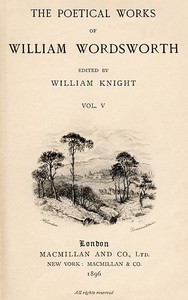
The Poetical Works of William Wordsworth — Volume 5 (of 8) — Key Ideas to Explore
(0 User reviews)
1428
Project Gutenberg
2018
Not confirmed
English poetry -- 19th century; English poetry -- 18th century
Readers of public-domain and historical texts
Project Gutenberg digital edition
en
Edition facts
Words
113,300
Reading time
493 min
Text sections
34
The catalog record for The Poetical Works of William Wordsworth — Volume 5 (of 8) — Key Ideas to Explore provides practical reading context through 113,300 words, 8 hr 13 min estimated reading time, and 34 detected text sections.
The text analysis averages about 24.4 words per sentence, while the detected sections provide another way to judge how the source is divided.
Project Gutenberg metadata also associates the work with “English poetry -- 19th century,” connecting these edition facts with the source record’s subject description.
Source:
Project Gutenberg record #56361
This editorial note examines Wordsworth's diction, dialogue, and descriptive choices in The Excursion, focusing on the churchyard scene's architectural details, the Wanderer's speech patterns, and the interplay of natural and built environments.
Editorial Edition Score
4.9/5
★★★★★
★★★★★
Calculated from edition completeness, EPUB availability, text structure and catalogue metadata. Not a user rating.
How this score is calculated
- Description quality20 pts
- Title & short description10 pts
- Source metadata20 pts
- Text length15 pts
- Chapters / structure15 pts
- EPUB file integrity20 pts
Total of 100 points, scaled to a 2.5-5.0 range. Editions with an empty description or a missing EPUB file are not scored.
Edition quality
Read the Text
But had I been born in a class which would have deprived me of what is called a liberal education, it is not unlikely that, being strong in body, I should have taken to a way of life such as that in which my Pedlar passed the greater part of his days. At all events, I am here called upon freely to acknowledge that the character I have represented in his person is chiefly an idea of what I fancied my own character might have become in his circumstances. Nevertheless much of what he says and does had an external existence, that fell under my own youthful and subsequent observation.
An individual, named Patrick, by birth and education a Scotchman, followed this humble occupation for many years, and afterwards settled in the town of Kendal.[B] He married a kinswoman of my wife's, and her sister Sarah was brought up from her ninth year under this good man's roof.[C] My own imaginations I was happy to find clothed in reality, and fresh ones suggested, by what she reported of this man's tenderness of heart, his strong and pure imagination, and his solid attainments in literature, chiefly religious, whether in prose or verse. At Hawkshead also, while I was a schoolboy, there occasionally resided a Packman (the name then generally given to persons of this calling), with whom I had frequent conversations upon what had befallen him, and what he had observed, during his wandering life; and, as was natural, we took much to each other; and, upon the subject of _Pedlarism_ in general, as _then_ followed, and its favourableness to an intimate knowledge of human concerns, not merely among the humbler classes of society, I need say nothing here in addition to what is to be found in _The Excursion_, and a note attached to it.
Now for the Solitary. Of him I have much less to say. Not long after we took up our abode at Grasmere, came to reside there, from what motive I either never knew or have forgotten, a Scotchman, a little past the middle of life, who had for many years been chaplain to a Highland regiment. He was in no respect, as far as I know, an interesting character, though in his appearance there was a good deal that attracted attention, as if he had been shattered in fortune, and not happy in mind. Of his quondam position I availed myself to connect with the Wanderer, also a Scotchman, a character suitable to my purpose, the elements of which I drew from several persons with whom I had been connected, and who fell under my observation during frequent residences in London at the beginning of the French Revolution. The chief of these was, one may now say, a Mr. Fawcett, a preacher at a Dissenting meeting-house at the Old Jewry. It happened to me several times to be one of his congregation through my connection with Mr. Nicholson of Cateaton Street, Strand, who, at a time when I had not many acquaintances in London, used often to invite me to dine with him on Sundays; and I took that opportunity (Mr. N. being a Dissenter) of going to hear Fawcett, who was an able and eloquent man. He published a poem on War, which had a good deal of merit, and made me think more about him than I should otherwise have done. But his Christianity was probably never very deeply rooted; and, like many others in those times of like shewy talents, he had not strength of character to withstand the effects of the French Revolution, and of the wild and lax opinions which had done so much towards producing it, and far more in carrying it forward in its extremes. Poor Fawcett, I have been told, became pretty much such a person as I have described, and early disappeared from the stage, having fallen into habits of intemperance, which I have heard (though I will not answer for the fact) hastened his death. Of him I need say no more. There were many like him at that time, which the world will never be without, but which were more numerous then, for reasons too obvious to be dwelt upon.
Wordsworth's The Excursion, as presented in this fifth volume of the Poetical Works, reveals a poet attentive to the precise weight of words in both description and dialogue. The churchyard scene, for instance, is built not through grand pronouncements but through careful enumeration: the church is 'large and massy; for duration built,' its 'naked rafters intricately crossed' compared to 'leafless underboughs.' Such diction grounds the sacred in the organic, a recurring strategy in the poem.
The Wanderer's speech, too, is marked by a measured, almost legalistic cadence—'This said, oft pausing, we pursued our way'—that suggests a mind accustomed to reflection. Wordsworth's editorial notes, included in this volume, further illuminate his compositional process, noting that lines describing Margaret's affliction drew on 'observations made in Dorsetshire' and later at Alfoxden.
Architectural Description and Natural Analogy
Wordsworth's description of the village church in Book Sixth relies on a vocabulary of solidity and age: 'large and massy; for duration built.' The interior is rendered through tactile and visual details—'pillars crowded,' 'naked rafters intricately crossed'—that evoke a sense of weight and enclosure. The comparison of rafters to 'leafless underboughs, in some thick wood, / All withered by the depth of shade above' is a striking instance of the poet's habit of reading the built environment through natural forms. This analogy does not merely decorate; it suggests a continuity between human construction and the organic world, a theme that recurs throughout The Excursion. The 'admonitory texts' on the walls, each 'in its ornamental scroll, enclosed,' and the 'rudely-painted Cherubim' further emphasize a space where the sacred is mediated through the handmade and the imperfect.
The Wanderer's Diction and Cadence
The Wanderer's speech is characterized by a deliberate, almost judicial pacing. The line 'This said, oft pausing, we pursued our way' captures a rhythm of reflection and movement that defines his role as guide and commentator. His observations are often introduced with phrases like 'I read,—how in his manhood's earlier day,' which frame the act of reading as a form of moral inquiry. Wordsworth's own note on the character, included in the preface, describes the Wanderer as a figure for whom 'Books were in fact his passion,' a detail that aligns with the poem's emphasis on textual interpretation—whether of epitaphs, landscapes, or human faces. The Wanderer's voice is not merely expository; it carries a weight of experience, as when he deciphers 'the ordinary chronicle of birth, / Office, alliance, and promotion—all / Ending in dust,' a line that compresses a life's trajectory into a single, somber cadence.
The Solitary's Posture and Silence
In contrast to the Wanderer's verbosity, the Solitary is introduced through a striking tableau of stillness. He stands 'apart; with curvèd arm reclined / On the baptismal font; his pallid face / Upturned, as if his mind were rapt, or lost / In some abstraction.' The description emphasizes posture and pose: 'gracefully he stood, / The semblance bearing of a sculptured form / That leans upon a monumental urn.' This visual simile aligns the living man with funerary art, hinting at his despondency without explicit statement. The Sexton's entrance—'humming carelessly a tune'—provides a jarring contrast, a mundane interruption that breaks the Solitary's reverie. Wordsworth's choice to present the Solitary through physical attitude rather than dialogue in this passage is a deliberate narrative strategy, allowing the reader to infer his inner state from external signs.
Epitaphic Voices and Historical Layering
The churchyard's 'marble monuments' and 'sepulchral stones' are not merely decorative; they are texts to be read, each offering a compressed narrative. Wordsworth's speaker reads 'the ordinary chronicle of birth, / Office, alliance, and promotion' and encounters specific histories: a page of Henry VIII, a knight 'tried in the sea-fights of the second Charles,' and a father who found solace in marriage during 'intestine war.' These epitaphs create a layered historical texture, juxtaposing personal and national events. The 'brazen plate, / Not easily deciphered' and the 'faded narrative' of other inscriptions underscore the fragility of memory. Wordsworth's own notes reveal that the poem's composition spanned from 1795 to 1814, a period of political upheaval, and the epitaphic voices in The Excursion can be read as an attempt to anchor individual lives against the backdrop of historical change.
Readers approaching this volume will find that Wordsworth's editorial apparatus—his prefaces and notes—offers a rare window into his compositional choices, from the dating of specific passages to the geographical origins of his observations. The poem rewards attention to its verbal textures: the way a simile can link a rafter to a bough, or a posture can speak louder than speech. These are not incidental details but the very fabric of Wordsworth's poetic method.
Wordsworth’s wanderer in that fifth volume speaks of stone and moss as if they held a human hush. I have long felt that quiet kinship in A Book for Kids — Reading Notes, where small corners of a room become worlds. Both understand that the simplest architecture, noticed slowly, teaches the heart its gentlest lessons.
There are no reviews for this eBook.
There are no comments for this eBook.
Reader reflection
What was your reading experience?
Capture what you thought, learned, and would like to remember.
Your progress
0
/
10
2
How did the book work for you overall?
3
Would you encourage someone else to read it?
4
How demanding did the text feel?
5
What did you think about the pace?
6
How did the reading compare with what you expected?
7
How useful were the ideas in this book?
8
How personally connected did you feel to the book?
9
What is the main idea you are taking away?
10