1

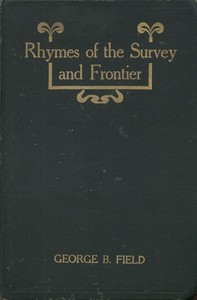
Rhymes of the Survey and Frontier — Inside the Classic
(0 User reviews)
1433
Project Gutenberg
2019
Not confirmed
Canadian poetry -- 20th century; Canada -- History -- Poetry
Readers of public-domain and historical texts
Project Gutenberg digital edition
en
Edition facts
Words
12,263
Reading time
54 min
Text sections
2
Before opening Rhymes of the Survey and Frontier — Inside the Classic, the edition data offers a quick orientation: 12,263 words, 54 min estimated reading time, and 2 detected text sections.
The text analysis averages about 26.8 words per sentence, while the detected sections provide another way to judge how the source is divided.
Project Gutenberg metadata also associates the work with “Canadian poetry -- 20th century,” connecting these edition facts with the source record’s subject description.
Source:
Project Gutenberg record #59940
George Blackstone Field's 1911 collection of poems about Canadian surveyors and frontier life, using rough rhymes and direct address to honor the men who mapped and built the land, while contrasting their hardships with the comforts of those who stay home.
Editorial Edition Score
4.4/5
★★★★★
★★★★★
Calculated from edition completeness, EPUB availability, text structure and catalogue metadata. Not a user rating.
How this score is calculated
- Description quality20 pts
- Title & short description10 pts
- Source metadata20 pts
- Text length15 pts
- Chapters / structure15 pts
- EPUB file integrity20 pts
Total of 100 points, scaled to a 2.5-5.0 range. Editions with an empty description or a missing EPUB file are not scored.
Edition quality
Read the Text
They were needed there, there were none to spare, In stemming disaster's tide.
Not a smile was seen, as the strange array Was mustered, and still they came From the Southern Cross and the midnight sun, The desert and from the plain: They came from the mountains and Grosvenor Square, The trapper beside the knight, The men of the jungle and Labrador, In eagerness for the fight.
They came in detachments, they came alone, They paid or they worked their way, In moccasins, chaps, or in overalls, The young with the old and grey: Their law was the law of the _Forty-four_, And grimly across the waves They came, for the King was in need of them, His men of the damn-fool trades.
They came from the mist of a future dawn, The lands of to-morrow's sun; The lands that in exile and weariness Had awaited the man to come. They came from the shade of a Moslem mosque, The desert of long ago; These men who had welcomed the Legion's call, Their loyalty e'en to show.
They came from the shanty and lumber camp, They came from a prairie shack, The office and camp of the engineers, The Irishman and the Mac; They came from the land of the Golden Fleece, And far from an Indian shore, Obeying the word that was passed along, The Frontiersman's call to war.
For the call had reached, God alone knew how, And Britons beyond the seas Caught its wailing cry, as it passed them by, Borne on by the evening breeze; In the fevered zone, or the Northern home, O'er wilderness, dark and bare, It spoke, and its note was o'er-pregnant, With weariness, pain, and care.
Then I seemed to be in a land of strife, With Britain against the wall, Where the pride of an empire was falling For ever beyond recall; And the flag that had waved in its glory Was drooping amid the gloom. 'Twas the end, and I fancied I heard it, The song of Britannia's doom.
But its notes were hushed, as with, vengeance flushed, In anger, the Legion came, Like a surging sea, for a moment free, Avengers of England's fame; And the flag was saved, but the lonely graves Recorded the price they paid, Ere the work of the Legion was ended, The doom of an Empire stayed.
And, then, thro' the mist of the cordite's gloom, I saw them return again, But many who gathered were missing now, And others were streaked with pain: For the desert would grieve for her children, The plains would resound no more With the voices of they who were sleeping Afar on that awful shore.
They turned them again to the wilderness Like shadows amid the night, Away to the silence and lonely camp, For ever from England's sight; But they heard the call, and the ones to fall Remembered throughout their pain, When the King was in need of their service The King had not called in vain.
_Would ye know them, these men of the Legion? Then seek where the trails divide; In the gloom they are waiting the message, Recalling them to your side. When the squares shall be shattered and broken. And victory's songs are stilled, Then the dream that I dreamed of to-morrow, The dream shall be e'en fulfilled._
(A Story of the Suez Canal)
Alone, yes, alone, a deserted coast, Though once I was lord of all; A king, and a fear, in the Southern Sea, To men who obeyed my call. Yet long was my reign, and my triumphs great, In days that are dead and gone; And now I am waiting, my voices dumb, A giant of my glory shorn.
I know they are passing me in the North By way of the great canal, And mocking the passage around the Cape, Where I and my victims dwell; Forsaken, undone, but I wait my chance, With wanderers, sorely pressed, The ones who at last will my boundaries pass, To fall on my waiting breast.
Alone, but for one who will ever sail, For aye in my mighty grasp; The Dutchman, who, trying to round my coast, Was felled by my raging blast; For the story's true of the spectral crew Who wander amid the gloom, While my surges sing a deathless hymn, The song of the Dutchman's doom.
He'd a mighty ship, and he dared my wrath With haughty contempt and pride, And a scornful sneer, which I turned to fear As vainly escape he tried; Well I knew his woe, as he tried to go, In spite of my raging storm, With a bragging curse, which could not disperse The fear that was in him born.
George Blackstone Field addresses his poems not to a general reader but to a specific audience: the men who 'have conquered the wilderness' and are 'building the land.' The opening poem, 'To You Who Will Understand,' sets a tone of shared experience and mutual recognition, while its companion piece, 'To You Who Can Never Understand,' draws a sharp line between those who have endured the frontier and those who have not. Field's rhymes are deliberately plain, favoring direct statement over ornament, and his subjects are the anonymous workers of the survey line—rodmen, packers, and pioneers—rather than famous figures.
The Surveyor as Nation-Builder
Field consistently frames the surveyor's labor as foundational to Canada's future. In 'The Coming of the Line,' the land itself is personified as a waiting entity that 'surrendered itself to our hands / To fall as a child in the making, / To rise as a king in the lands.' The poem imagines the land as a bride or a child, passive until the surveyors arrive to 'mould' it. This vision is echoed in 'To You Who Will Understand,' where the men are 'Paying the price of a nation's need' and leading the way 'o'er the ancient clay.' Field does not dwell on the technical details of surveying; instead, he emphasizes the moral and national significance of the work, often using biblical or epic language to elevate the mundane labor of laying track and marking boundaries.
Contrasts of Comfort and Hardship
A recurring tension in the collection is the gap between the frontier worker's experience and the civilian's ignorance. 'To You Who Can Never Understand' explicitly addresses those who 'by your fireside' have 'forgotten' the men 'whose lives are mingled with the wild.' Field defends the rough pleasures of the surveyors against 'judgment stern' from outsiders who 'have little desire to learn.' In 'Sunny Ltd.,' he uses a whimsical fantasy—a rapid-transit system attached to the sun—to mock the comforts of modern travel, contrasting them with the slower, harder movement of the frontier. Even in lighter poems, the underlying theme is that the frontier exacts a price that settled society cannot comprehend.
Loss, Memory, and the Unfinished Line
Several poems dwell on the cost of the frontier in human life. 'Unforgotten' is a memorial to Cecil Rhodes, but it also speaks to a broader theme of sacrifice: 'Dreamer of yesterday, sleep thy sleep; / Rest, for thy stent is done!' The poem 'The Price of the Line' (from the table of contents) and the fragment about a man 'raving of her who awaited his message' suggest that the surveyor's work often ends in death or madness, leaving behind grieving families. Field does not sentimentalize these losses; he presents them as the inevitable price of 'a nation's fame.' The land itself, in 'The Coming of the Line,' is indifferent to individual suffering, having 'levelled them, dust to the dust' when earlier seekers abused its trust.
Field's collection is best read as a series of occasional verses meant to be shared among the men he describes. The rhymes are functional, the sentiments direct, and the imagery drawn from the daily life of the survey camp. Readers should not expect polished literary craft but rather a documentary record of how these workers saw themselves and their mission. The poems gain power when considered as a collective voice—one that insists on the dignity and importance of labor that is usually invisible to history.
The rain kept rhythm with Field’s rough-edged lines about men who measured wilderness, their loneliness sharp against my warm room. That ache for distant voices lingered, and by evening I found myself reaching for Ara vus prec — Reading Companion, its quiet reflections on longing feeling like the same mapped country, only walked from the other side.
There are no reviews for this eBook.
There are no comments for this eBook.
Reader reflection
Before you leave, reflect on the book
Use these questions to collect your thoughts before moving on.
Your progress
0
/
10
2
How much did you enjoy the reading experience?
3
Would you pass this book on to a friend?
4
How demanding did the text feel?
5
What did you think about the pace?
6
Would you like to discuss this book with someone?
7
How distinctive were its ideas or approach?
8
How did the reading compare with what you expected?
9
What did this book teach you most?
10