1

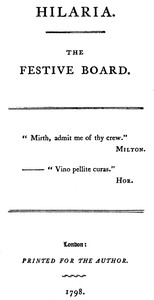
Hilaria. The Festive Board — Key Ideas to Explore
(0 User reviews)
1464
Project Gutenberg
2022
Not confirmed
Humorous poetry; Humorous songs -- Texts
Readers of public-domain and historical texts
Project Gutenberg digital edition
en
Edition facts
Words
21,689
Reading time
95 min
Text sections
44
Hilaria. The Festive Board — Key Ideas to Explore can be approached with a clearer sense of reading commitment from its source measurements: 21,689 words, 1 hr 35 min estimated reading time, and 44 detected text sections.
The text analysis averages about 28.2 words per sentence, while the detected sections provide another way to judge how the source is divided.
Project Gutenberg metadata also associates the work with “Humorous poetry,” connecting these edition facts with the source record’s subject description.
Source:
Project Gutenberg record #67815
An anonymous 1798 collection of bawdy songs and comic verse celebrating wine, love, and conviviality, with satirical club rules and mock-serious prefaces that frame the pursuit of pleasure as a philosophical stance.
Editorial Edition Score
4.7/5
★★★★★
★★★★★
Calculated from edition completeness, EPUB availability, text structure and catalogue metadata. Not a user rating.
How this score is calculated
- Description quality20 pts
- Title & short description10 pts
- Source metadata20 pts
- Text length15 pts
- Chapters / structure15 pts
- EPUB file integrity20 pts
Total of 100 points, scaled to a 2.5-5.0 range. Editions with an empty description or a missing EPUB file are not scored.
Edition quality
Read the Text
Then a breeze springing up, down the RED STRAITS he ran, And, o’erjoy’d with his voyage, he fir’d off a GREAT GUN. Toll de roll, &c.
High from the MAST HEAD, by the help of ONE EYE, The HEART of the BAY did old Adam espy; And, alarm’d at a noise—to him Nature did say, That it was the TRADE WIND, which blows always ONE WAY. Toll de roll, &c.
So transported was Adam in BOTANY BAY, He dame Nature implor’d to SPEND there night and day, And curious he try’d the BAY’S bottom to sound, But his LINE was too short by a YARD from the ground. Toll de roll, &c.
The time being out, Nature’s sentence had pass’d, Adam humbly a favour of her bounty ask’d, That when stock’d with provisions, and ev’ry thing sound, To BOTANY BAY he again might be bound. Toll de roll, &c.
Nature granted the boon both to him and his race, And said, oft I’ll transport you to that charming place; But never, cry’d she, as you honour my word, Set sail with a Clap, Pox, or Famine on board. Toll de roll, &c.
Then this BOTANY BAY, or whate’er be the name, I have prov’d is the spot from whence all of us came; May we there be transported, like Adam our sire, And never _return ’fore the time shall expire_. Toll de roll, &c.
THE NEWLY-DUBB’D JEW.
My muse, t’other day, having laughter in view, Selected George Gordon, the now no more Jew, Resolving to state, with Mosaic precision, What befel poor Crop’s P⸺ on the late circumcision.
The Rabbi appear’d, and the Christian’s foreskin Was about to be banish’d, to cleanse Crop of sin; But Gentiles and Jews, mark the cream of the joke, By Prometheus inspir’d, his P⸺ suddenly spoke.
Tho’ with fear first poor P⸺o had prudently shrunk, And, like snail in its shell, snugly hid lay his trunk; To the Priest then he cry’d, put your knife in its case, Or, you terrible Cut P⸺k, I’ll piss in your face.
My Lord stood amaz’d, and the Rabbi was mum, To hear a thing talk that had ever been dumb; Tho’ Crop said his P⸺ ne’er obey’d his command, But always _lay down_ when he wish’d him to _stand_.
This damnable riot in Crop’s private part, Baffl’d the Priest and resisted his art, So he swore, if P⸺ did not cease making a route, He’d pull out his c—d—m, and muffle his snout.
Not a crab-louse car’d P⸺ for the Priest and his laws; He stood up for his _prepuce_, and spoke to the cause; His language was nervous, his reasoning clear, And he spoke full as well as the _Members_ elsewhere.
Your life, cry’d he, Crop’s a mere mock of devotion; Well spoken, said Cods, who was backing each motion; Such conduct, he said, combin’d madness and sin; And Cods swore his friend P⸺ should sleep in a whole skin.
Now in Akerman’s synagogue Crop’s got a place, A beard like a Jew doth his pious front grace; In time ’tis to grow so enormously big, As to make TOMMY ERSKINE a full-bottom’d wig.
Mr. P⸺, said Crop, to turn Turk I intend, And ’mongst smack and smooth eunuchs my days will I end; Poor P⸺ took the hint, and did woefully weep, Till his _flesh cap_ flipp’d o’er him, then he fell asleep.
_The FLATS and the SHARPS of the NATION._
Of Handel’s fam’d Commemoration, And what was let loose there, I sing, When the Flats and the Sharps of our nation Assembled along with their King. Madam Mara (now mark what will follow) Her ravishing sounds was imparting; Momus play’d off a trick on Apollo, And set the sweet lady a f—t—g.
At Sowgelders’ Hall, rural scene, The seat of a Knight and his swine, The musical Madam had been Invited by Mawbey to dine: So the cause of this windy commotion Was owing, if we’re not mistaken, To her bolting too great a proportion Of pease-pudding and gammon of bacon.
Sir John Hawky, the musical Knight, Who in wit all the Quorum surpasses, And to whom, if we judge of him right, The wise men of Greece were mere asses, Has defin’d Antient Music to be What sprung from the bottom of Madam, And that under the wisdom-fraught tree Eve f—t—d in concert with Adam.
The anonymous Hilaria. The Festive Board (1798) opens with a mock-learned preface that sets the tone for the entire collection. The author, possibly Charles Morris, declares that "the delights of love and joys of wine, happily blended, will enable us to attain the summit of human enjoyment." This is not a modest claim, and the verse that follows aims to deliver on it. The preliminary section quotes Horace and Milton, then engages in a playful rebuttal of Lord Monboddo's advocacy for watering down wine. The author insists on drinking wine "pure, unadulterated," and the first toast after dinner is to "the first thing that ever was created for the enjoyment of their sex." This blend of classical allusion and bawdy humor characterizes the entire work.
The Preface as Performance
The preliminary section is not merely an introduction; it is a performance of erudition and wit. The author cites Dr. Johnson as "that leviathan of literature" and invents a pseudo-etymological link between "vinosity" and "libidinosity" through fermentation. This is a deliberate parody of scholarly discourse. The target of this satire is Lord Monboddo, whose serious argument for mixing water with wine is quoted at length and then dismissed with Horace's supposed irony. The preface establishes the collection's ethos: pleasure is a serious pursuit, and those who would dilute it are fools. The reader is invited to join a circle of "convivial gaiety" and "indulgent beauty," with the promise that life without this union is "like wine without fermentation, perfectly insipid."
Songs of the Table and the Bed
The body of the work consists of songs and poems that celebrate drinking, love, and often both. The language is direct and earthy, as in the ballad of Paddy, who from his deathbed bequeaths his "thing" to his wife and hopes she will "think of Pat's thing if she gets such another." The humor is coarse and unapologetic. Other pieces, like "The Toy," narrate a comic scene at Hampton Court where a waiter mistakes a captain and ensign for lovers and the household staff threatens them with violence. The verse is metrically regular and designed for singing, with refrains and choruses. The collection does not shy away from explicit content, but it is always framed as part of the festive board's entertainment.
The Coffin Club: Mock Mourning
One of the most striking pieces is the "Coffin Club" section, which presents a "Constitutional Dirge" sung to the tune of "Jack Ran." The club's rules require members to appear in black crape cravats, with pipes tipped in mourning wax, and a heavy fine for laughter. The song urges "giddy youth" to "change your ways" and embrace grief, with a chorus that wishes upon them "Horrors jet black, and devils dark blue." This is a parody of the solemn clubs and societies popular in the 18th century, and it inverts the collection's usual celebration of mirth. The dirge's final stanza recommends suicide as a solution: "Go off by water, rope, or knife." The satire is dark and ironic, a counterpoint to the preceding bawdy songs.
Structure and Voice: A Reader's Path
The excerpts reveal a collection organized not by narrative but by mood and genre. The preface establishes a philosophical framework, then the songs alternate between celebratory and satirical. The "Coffin Club" dirge is a deliberate shift in tone, showing the author's range. The voice throughout is that of a male, convivial insider, addressing an audience assumed to be familiar with tavern life and classical allusions. The poems are meant to be performed, with repeated choruses and stage directions (e.g., "Coffins to be shewn"). A first-time reader should approach Hilaria as a period piece of Georgian sociability, where wit and obscenity coexist, and where the pleasure of the text lies in its playful defiance of decorum.
Hilaria. The Festive Board rewards a reader willing to engage with its 18th-century context. The classical references, the mock-serious debates, and the explicit humor all belong to a specific culture of male conviviality. The collection is best read aloud, or at least with an ear for rhythm and rhyme. The Coffin Club dirge, in particular, gains force when imagined as a performance. This is not a work of deep psychology or plot, but of social satire and celebration. Approach it as a guest at a Georgian dinner party: expect wit, wine, and a willingness to laugh at death itself.
I keep coming back to that anonymous 1798 book, with its mock-serious toasts and the way it treats pleasure as something worth defending. It makes me think of Fruit-Gathering — Key Ideas to Explore, a quieter, more patient companion. Both feel like old friends who have seen enough evenings to know that laughter and longing are often the same thing.
There are no reviews for this eBook.
There are no comments for this eBook.
Reader reflection
How will you remember this book?
Save your reaction, strongest insight, and memorable passage.
Your progress
0
/
10
2
Did this book hold your interest?
3
Would you encourage someone else to read it?
4
Did the language feel accessible?
5
Did the book deliver what you hoped for?
6
How useful did the reading feel?
7
How would you rate its originality?
8
How closely did the book connect with your experience?
9
What changed or sharpened your thinking?
10