1

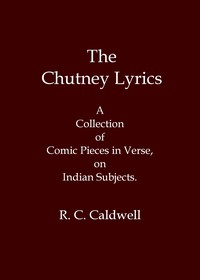
The chutney lyrics: A collection of comic pieces in verse on Indian subjects — Text and Context
(0 User reviews)
3179
Project Gutenberg
2022
Not confirmed
Humorous poetry, English; British -- India -- Social life and customs -- Poetry
Readers of public-domain and historical texts
Project Gutenberg digital edition
en
Edition facts
Words
13,137
Reading time
58 min
Text sections
2
This digital edition of The chutney lyrics: A collection of comic pieces in verse on Indian subjects — Text and Context is described by source-level measurements including 13,137 words, 58 min estimated reading time, and 2 detected text sections.
The text analysis averages about 17.9 words per sentence, while the detected sections provide another way to judge how the source is divided.
Project Gutenberg metadata also associates the work with “Humorous poetry, English,” connecting these edition facts with the source record’s subject description.
Source:
Project Gutenberg record #68640
A collection of comic verse set in colonial India, using exaggerated dialects, absurd situations, and satirical maxims to mock British and Indian social mores, with recurring motifs of heat, insects, and bureaucratic folly.
Editorial Edition Score
4.5/5
★★★★★
★★★★★
Calculated from edition completeness, EPUB availability, text structure and catalogue metadata. Not a user rating.
How this score is calculated
- Description quality20 pts
- Title & short description10 pts
- Source metadata20 pts
- Text length15 pts
- Chapters / structure15 pts
- EPUB file integrity20 pts
Total of 100 points, scaled to a 2.5-5.0 range. Editions with an empty description or a missing EPUB file are not scored.
Edition quality
Read the Text
uiries were made. It was seen, When the stuff was put to the test, That DR. PYRETIC SALINE Had discovered a fine mare's nest.
For holes in the cliff were spied Where bat and pigeon abode, From whence, in an odorous tide, This wondrous "petroleum" flow'd.
Of this they analyzed some;-- And discover'd--oh horrible!--that The Doctor's "petroleum" Was the DUNG OF PIGEON AND BAT!
Dr. Little's Grand Antidote for Snake-Bites
Sapient Dr. Little to the public papers wrote,-- "At length, for bites of Cobras, I found an antidote. On all my native servants this remedy I've tried, And though they've oft been bitten, not one of them has died. This remedy is simple, empyric, and complete,-- One pint of brandy hourly, and taken almost neat."
Thus wrote Dr. Little. But his letter had Been perfect, had he added, the Post Scripts that I add.--
"Such treatment is effective. A drowsiness sets in: O'er the features of the patient there spreads a languid grin. With low and gentle hiccups, he croones an Indian lay, Then with a final stagger, falls down, and snores away. Not till the following morning, when high has climb'd the sun, Is his slumber broken, or his snoring done. The poison then is conquer'd. But it often leaves behind A thirstiness, a head-ache, a depression of the mind. But this to cure is easy. The head-ache quickly flies If the patient round his forehead a well-wet towel ties. His mind's prostration likewise, likewise his thirstiness, Are quickly counteracted by a dose of B. and S."
(_Post Script, No. II._) "But very strange to say Those who've been once bitten, and treated in this way, Within a week are certain, to come, with groans of pain, To tell me that a cobra has bitten them again!"
The Good Sir Gammon Row.
O who has not heard of that wonderful man, SIR GAMMON ROW, the great Dewan, Who has ruled for the last ten years, or more, The Protected State of Cocoanutcore? This State, if judged from "Reports" you read, Is a very wonderful State indeed;-- A "_Model State_," in which you may see Every thing is just as it should be. Where dwells a worthy and well-oil'd nation, Blest with a faultless administration; The brightest land, with the lightest tax, And an annual surplus of fifty lacs: Where happy ryots, ne'er pester'd by famines, Till fields, in subjection to blessed Brahmins. A land of peace, a land of delight, Where everyone, everywhere, always does right. Where whitemen, living in meek minority, Acknowledge Brahminical superiority. In short, and I'm sure I cannot say more, 'Tis a heaven upon earth, this Cocoanutcore!
And in this terrestrial elysium, the man Who is most like an angel, is the Dewan. From Comorin's foam to Himmaleh's snows, A man that's his match, sure nobody knows! In his gay free mien, and his honied laugh, He is perfect,--yes almost too perfect by half! How courtly his bow, his smile how sweet, And how soft is the tread of his cat-like feet! Then how frank his look! you might think you could view The soul through the eye of this good Hindoo. How chaste his manners, his English how choice! How liquid, how mellow, the tones of his voice! His whole demeanour seems to import That _doing good_ is his one great forte. But since 'tis beyond the powers of my pen To pourtray, as I should, this most perfect of men, I'll relate, instead, a remarkable story Which will picture Sir Gammon in all his glory, His goodness, the justice he loves, and the claim His deeds have to noto--I mean, to fame!
In the heart of the country of Cocoanutcore Lies the Brahmin city of Brahminipore. Though you search'd through India up and down, You could never discover a holier town. For the blessed Twice-born, who chance to live there, By deigning to breathe it, have hallowed the air-- The houses are holy, and holy each street, And even the dust has been blessed by their feet. Each pot in each hut, of brass or of clay, Has been sanctified in some wonderful way. And the sacred carpets in every house Are the daily gift of Brahminical cows!
The Chutney Lyrics opens with a threat: “I’ll smash the head of that goose Jenkins, of the Revenue Survey.” This line, set apart as a kind of epigraph, immediately establishes the collection’s tone—aggressive, farcical, and preoccupied with the petty grievances of British India. The poems that follow are built around recurring structural patterns: a speaker in distress, a sudden reversal, and a punchline that undercuts any sentiment. The verse moves rapidly between scenes—from a lovesick engineer on a swollen riverbank to an Irishman roasting in the “thirsty counthry”—creating a patchwork of voices that share a common exasperation with heat, insects, and bureaucratic absurdity.
Dialect as a Comic Engine
Several poems rely on heavy dialect to mark speakers as outsiders or buffoons. Pat O’Brien’s lament is written in stage Irish: “Begorrah, it’s simply a Foire land.” The Engineer’s Love-Song uses a mock-heroic refrain (“Sweet Miss Annie Cut”) that clashes with the mundane setting. These voices are not individualized but typed—the Irish soldier, the besotted engineer, the Tamil translator. The effect is less about character than about the pleasure of verbal excess. The dialect becomes a kind of costume, allowing Caldwell to ventriloquize stereotypes while keeping the reader at a safe ironic distance.
Recurring Images of Heat and Vermin
Across the collection, the Indian climate is depicted as a hostile force. Pat O’Brien catalogs “scorp yins, and chayters, / Loikewoise man-aters, / Bloodsuckers, and foxes that floi.” The Engineer’s Love-Song sets its romance against a “turbidly and wide” river. Even the Hindoo Maxims, ostensibly translated from the Kural, include a complaint about “Sanitation” and a warning to “Conciliate devils—and white men too!” Heat, insects, and disease form a continuous backdrop, turning every scene into a struggle for survival. This repetition gives the collection a cumulative, almost obsessive quality: the same complaints recur in different voices, as if no one can escape the environment.
The Structure of the Anti-Pastoral
Caldwell repeatedly invokes pastoral conventions only to invert them. The love poem to Anna begins with moonlight and lilies but ends with the speaker noting “You are old and thin, dear Anna, / And I am old and fat.” The Engineer’s grand declaration is undercut by the absurd name “Annie Cut.” Even the preface, written as a verse address to the book, adopts the language of a sea voyage (“Sail forth”) before descending into a plea to avoid the “Mail” and the “Times.” This pattern—elevated opening, deflating close—structures nearly every piece. The reader is trained to expect the rug to be pulled, which makes the rare moments of sincerity (such as the Anna poem’s regret) feel all the more startling.
Movement Between Public and Private Voice
The collection shifts abruptly between genres: a publisher’s preface in prose, a verse preface, love songs, a translated maxim sequence, and a monologue. This variety creates the impression of a speaker moving through different social spaces—the club, the veranda, the bazaar. The Hindoo Maxims section is particularly telling: it presents itself as a translation of the Kural, but the content is a series of cynical proverbs about caste, litigation, and bribery. The effect is to blur the line between ethnographic observation and satire. The reader cannot be sure whether Caldwell is mocking Tamil culture or British perceptions of it. This ambiguity is central to the collection’s structure, which refuses to settle into a single stance.
Readers will find the most pleasure in attending to the verse’s rhythm and its sudden tonal shifts. The poems reward rereading for their layered ironies: a line that seems straightforward may reveal itself as a joke at the speaker’s expense. Because the excerpts are incomplete, the full range of Caldwell’s targets remains uncertain, but the patterns of heat, dialect, and deflation are consistent throughout. Approach these lyrics as performances rather than confessions, and the comedy sharpens.
This reminded me of sitting on my grandmother’s veranda, the heat thick as syrup, while she read aloud from her old colonial-era chapbook. We laughed at the pompous Englishmen and the cicadas. That same amused, tender distance came back when I later found Divine Comedy, Longfellow's Translation, Paradise — Key Ideas to Explore; both show us human folly and light, quietly, from above.
There are no reviews for this eBook.
There are no comments for this eBook.
Reader reflection
How did this book work for you?
Your answers remain private and are stored only in this browser.
Your progress
0
/
10
2
What was your overall reaction to the book?
3
Would you encourage someone else to read it?
4
How easy was the book to follow?
5
Which part made the strongest impression?
6
Is this a title worth rereading?
7
How strongly did the book affect you emotionally?
8
How would you rate its originality?
9
Which lesson or insight stayed with you?
10