1

The complete works of John Gower, volume 2 — Key Ideas to Explore
(0 User reviews)
959
Project Gutenberg
2023
Not confirmed
Poetry
Readers of public-domain and historical texts
Project Gutenberg digital edition
en
Edition facts
Words
237,036
Reading time
1031 min
Text sections
56
The source record for The complete works of John Gower, volume 2 — Key Ideas to Explore measures this digital text at 237,036 words, 17 hr 11 min estimated reading time, and 56 detected text sections.
The text analysis averages about 20.4 words per sentence, while the detected sections provide another way to judge how the source is divided.
Project Gutenberg metadata also associates the work with “Poetry,” connecting these edition facts with the source record’s subject description.
Source:
Project Gutenberg record #71162
This volume of Gower's English works presents the first part of the Confessio Amantis, a Middle English poem structured as a confession by a lover to a priest of Venus. The text reveals tensions between envy and covetousness, as in the tale of the Travellers and the Angel, where one man's malice spoils another's greed.
Editorial Edition Score
4.9/5
★★★★★
★★★★★
Calculated from edition completeness, EPUB availability, text structure and catalogue metadata. Not a user rating.
How this score is calculated
- Description quality20 pts
- Title & short description10 pts
- Source metadata20 pts
- Text length15 pts
- Chapters / structure15 pts
- EPUB file integrity20 pts
Total of 100 points, scaled to a 2.5-5.0 range. Editions with an empty description or a missing EPUB file are not scored.
Edition quality
Read the Text
aucer and Gower in literary merit; but Bale suggests that our author was ‘alter Dantes ac Petrarcha’ (no less), adding the remark, taken perhaps from Berthelette’s preface, ‘sui temporis lucerna habebatur ad docte scribendum in lingua vulgari[A].’ In Bullein’s _Dialogue against the Fever Pestilence_ (1564) Gower is represented as sitting next to the Classical poets, Homer, Hesiod, Ennius and Lucan. Puttenham in the _Art of English Poesie_ (1589), and Sidney in the _Defence of Poesie_ (1595), equally class Gower and Chaucer together. The latter, illustrating his thesis that the first writers of each country were the poets, says, ‘So among the Romans were Livius Andronicus and Ennius, so in the Italian language ... the poets Dante, Boccace and Petrarch, so in our English, Gower and Chaucer, after whom, encouraged and delighted with their excellent foregoing, others have followed to beautify our mother tongue, as well in the same kind as in other arts.’
In Robert Greene’s _Vision_, printed about 1592, Chaucer and Gower appear as the accepted representatives of the pleasant and the sententious styles in story-telling, and compete with one another in tales upon a given subject, the cure of jealousy. The introduction of Gower into the play of _Pericles, Prince of Tyre_ has already been referred to.
The uncritical exaggeration of Gower’s literary merits, which formerly prevailed, has been of some disadvantage to him in modern times. The comparison with Chaucer, which was so repeatedly suggested, could not but be unfavourable to him; and modern critics, instead of endeavouring to appreciate fairly such merits as he has, have often felt called upon to offer him up as a sacrifice to the honour of Chaucer, who assuredly needs no such addition to his glory. The true critical procedure is rather the opposite of this. Gower’s early popularity and reputation are facts to be reckoned with, in addition to the literary merit which we in our generation may find in his work, and neither students of Middle English, nor those who aim at tracing the influences under which the English language and literature developed during the fifteenth and sixteenth centuries, can afford to leave Gower’s English work out of their account.
i. LITERARY CHARACTERISTICS.--The reason of the success of the _Confessio Amantis_ was naturally the fact that it supplied a popular need. After endeavouring to ‘give an account of his stewardship’ in various ways as a moralist, the author at length found his true vocation, and this time happily in his native tongue, as a teller of stories. The rest is all machinery, sometimes poetical and interesting, sometimes tiresome and clumsy, but the stories are the main thing. The perception of the popular taste may have come to him partly through the success of Chaucer in the _Legend of Good Women_, and the simple but excellent narrative style which he thereupon developed must have been a new revelation of his powers to himself as well as to others. It is true that he does not altogether drop the character of the moralist, but he has definitely and publicly resigned the task of setting society generally to rights,
‘It stant noght in my sufficance So grete thinges to compasse, . . . . . . . . . Forthi the Stile of my writinges Fro this day forth I thenke change And speke of thing is noght so strange,’ &c. (i. 4 ff.)
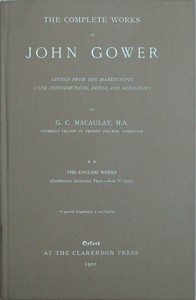
The second volume of G. C. Macaulay's edition of John Gower's complete works contains the first portion of the Confessio Amantis, a Middle English poem of some 30,000 lines. The text is based primarily on the Fairfax manuscript, which Macaulay argues 'may claim the highest rank as an authority for his language.' The editorial apparatus includes a substantial introduction, notes, and a glossary, with corrections silently applied to punctuation and a few noted errata.
The poem itself is framed as a dialogue between a Lover (Amans) and Genius, a priest of Venus, who instructs him on the seven deadly sins through exemplary tales. The excerpt provided illustrates the vice of Envy through the story of a covetous man and an envious man who encounter an angel in disguise. The envious man chooses to lose one eye so that his companion loses both, a stark demonstration of malice outweighing self-interest.
The Confessional Frame and Its Tensions
The Confessio Amantis adopts a confessional structure that sets up a persistent tension between the lover's personal desires and the moral instruction he receives. The Lover opens by admitting that he takes 'game' in another man's sorrow, knowing that man shares his unrequited love. This confession immediately introduces the problem of envy as a sin that corrupts even the experience of love. Genius, the confessor, responds not with sympathy but with a tale that condemns such feelings, insisting that envy 'wole sette himself behinde / To hindre with an othre wyht.' The dialogue thus enacts a conflict between the lover's emotional reality and the moral framework that judges it.
The Angel's Test: Envy Versus Covetousness
The tale of the Travellers and the Angel is a compact exemplum that pits two vices against each other. Jupiter sends an angel 'in a mannes forme' to investigate human complaints. The angel offers a gift: whatever one man asks, the other shall receive double. The covetous man, hoping to maximize his gain, insists his companion ask first. The envious man, understanding the terms, asks to lose one eye so that his fellow loses both. The narrative economy is striking: the angel's test exposes not just individual sin but the way vices interact. Covetousness is outwitted by envy, and the result is mutual loss. Gower's Latin marginal note summarizes the moral: 'the envy of one stained the covetousness of the other.'
Macaulay's Editorial Choices and Their Implications
Macaulay's edition is notable for its reliance on the Fairfax manuscript, which he considers 'proceeding directly from the author, though not written by his hand.' This decision shapes the text's linguistic and orthographic character. The editor also includes a detailed analysis of the poem's sources, noting that summaries are 'intentionally briefer' where Gower follows well-known originals. The apparatus reveals a concern for accuracy: a list of errata is provided, and typographical errors in punctuation have been 'silently corrected.' Macaulay's prefatory note acknowledges that the errata list 'may be taken to indicate not so much the carelessness of the editor, as his desire to be absolutely accurate.'
Readers approaching this volume should be aware that it contains only the first part of the Confessio Amantis (Prologue through Book V, line 1970). The poem's structure rewards attention to the interplay between the lover's narrative and the confessor's exempla, as well as to the Latin marginal notes that often gloss the English text. Macaulay's introduction and notes provide essential context for understanding Gower's sources and linguistic choices, making this edition a valuable resource for scholars of Middle English literature.
I keep thinking about how Gower’s confessional frame lets envy and greed quietly trip over each other, like two friends who can’t stop misunderstanding the same joke. It reminded me of the gentle absurdity in The Bashful Earthquake, & Other Fables and Verses — Story, Setting & Ideas, where small human flaws also ripple outward, unannounced. That book stayed with me the same way—less a lesson, more a lingering glance at how we stumble, softly.
There are no reviews for this eBook.
There are no comments for this eBook.
Reader reflection
How will you remember this book?
Save your reaction, strongest insight, and memorable passage.
Your progress
0
/
10
2
What was your overall reaction to the book?
3
Would you recommend this book to another reader?
4
What was the reading difficulty like?
5
How useful did the reading feel?
6
How personally connected did you feel to the book?
7
Do you expect to return to this book?
8
How much did the book move you?
9
What changed or sharpened your thinking?
10