1

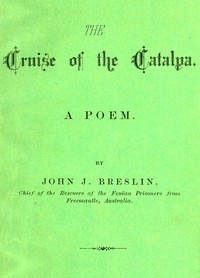
The Cruise of the Catalpa: A Poem — Key Ideas to Explore
(0 User reviews)
1512
Project Gutenberg
2020
Not confirmed
Fenians -- Poetry; Catalpa (Bark) -- Poetry
Readers of public-domain and historical texts
Project Gutenberg digital edition
en
Edition facts
Words
6,310
Reading time
28 min
Text sections
5
This digital edition of The Cruise of the Catalpa: A Poem — Key Ideas to Explore is described by source-level measurements including 6,310 words, 28 min estimated reading time, and 5 detected text sections.
The text analysis averages about 25.0 words per sentence, while the detected sections provide another way to judge how the source is divided.
Project Gutenberg metadata also associates the work with “Fenians -- Poetry,” connecting these edition facts with the source record’s subject description.
Source:
Project Gutenberg record #61372
John J. Breslin's 1876 poem recounts the rescue of Fenian prisoners from Freemantle, Australia, aboard the whaling bark Catalpa. The narrative mixes gallows humor, nautical detail, and Irish patriotic verse, with footnotes glossing colonial slang and officials.
Editorial Edition Score
4.5/5
★★★★★
★★★★★
Calculated from edition completeness, EPUB availability, text structure and catalogue metadata. Not a user rating.
How this score is calculated
- Description quality20 pts
- Title & short description10 pts
- Source metadata20 pts
- Text length15 pts
- Chapters / structure15 pts
- EPUB file integrity20 pts
Total of 100 points, scaled to a 2.5-5.0 range. Editions with an empty description or a missing EPUB file are not scored.
Edition quality
Read the Text
was racing and chasing and bother, you know, For the Fenians had sliddered[3] right off in a row; But what’s that to any one, whether or no?
Oh! Wilson and Cranston and Hogan are gone, With Darragh and Hassett and staunch Harrington; For Collins and Johnston have opened the ball, And to join in the dancing, out step Jones and Hall, And they tripped to a tune that was far from being slow; But what’s that to any one, whether or no?
Cops,[4] warders and soldiers are running a race And the mounted policemen prepare to give chase; In the pensioner’s barracks the trumpet did blow, And old Finnerty’s[5] bugle was purple, I know; But the boys know their road, and are bound for to go; So what’s that to any one, whether or no?
There are two trotting teams on the Rockingham road, From the gloom of a prison each bearing its load, And full hearts are beating with freedom and joy, As they sweep ’round the sand hills and through the Blackboy. With the sunlight of Hope every face is aglow; But what’s that to any one, whether or no?
On, on through the bush, as they ride to the beach, In vain for his captives may Robinson[6] screech, And Harvest[7] may swagger to cover his fears As they drag out the guns of the Perth volunteers; But the Fenians are off; they may puff, pant and blow; For what’s that to any one, whether or no?
Near Rockingham jetty, upon the white sand, With revolvers and rifles the Fenians stand— Gay, fearless and free, stepping into their boat; Shove her off! then out oars! on the waters afloat! Now a right saucy Yankee tar takes them in tow; And what’s that to any one, whether or no?
Now Silvee and Toby and Mopsa give way, For the good ship _Catalpa_ lies out in the bay. “Come down, you big Louis,” the captain did roar, “Now what do you say, men? pull off from the shore; You Lombar, keep stroke; pull, men, cheerily, oh!” And what’s that to any one, whether or no?
Now past Garden Island, and clear off the Sound, Make sail on the boat, pass the liquor around; Shift your seats, trim the boat, as she bends to the breeze, And light as a sea-gull skims over the seas; There’s a rest from the oar, while the fair breezes blow; And what’s that to any one, whether or no?
At six in the evening we sighted the bark, And we steered on her track till the evening grew dark, When a squall coming down, with its venomous blast, Almost swamped our good boat, as it tore out her mast; So all night on the billows we tossed to and fro; But what’s that to any one, whether or no?
Next morning at seven we raised her again, Topsails, mainsails and hull—we were nearing her plain, When we spied the _Georgette_, steaming out of the Sound, And we knew by her course for the bark she was bound; So we hauled down our sail, then lay to and lay low; But what’s that to any one, whether or no?
So the _Georgette_ passed by bearing down on our ship; All safe for the present—now, boys, let her rip; Then we pulled in her wake for to see what she’d do, And beside the _Catalpa_ we saw her heave to, And lay alongside her ten minutes or so; But what’s that to any one, whether or no?
See the _Georgette_ steams off, and is running inshore; Make sail on the boat, out with paddle and oar; For with every sail set, on her course down the bay, The good ship _Catalpa_ is bearing away. To gain on her now we’ve a hard row to hoe; But what’s that to any one, whether or no?
To follow our bark we were pulling amain, When we saw the _Georgette_ coming for us again. In search of our boat she was steaming right back, And we almost despaired as we lay in her track; So we hauled down our sail and again we lay low; And what’s that to any one, whether or no?
Still nearer and nearer the steamer came on, And our plan of escape seemed all shattered and gone; Hope faded away to a very small speck, As we saw her lookout and the men on her deck; But she passed us unseen—Fate had ordered it so; And what’s that to any one, whether or no?
The poem opens with a refrain—'But what’s that to any one, whether or no?'—that immediately establishes a tone of defiant nonchalance. Breslin, who identifies himself as 'Chief of the Rescuers,' narrates the escape from Freemantle prison on Easter Monday 1876, naming warders, soldiers, and colonial officials with a mix of insider slang and mockery. The opening stanzas list the escaped prisoners by surname—Wilson, Cranston, Hogan, Darragh, Hassett, Harrington—and track their flight through the bush to Rockingham jetty, where they board a boat for the Catalpa. The poem’s voice is that of a participant, not a distant observer, and its brisk, anapestic meter drives the action forward.
Gallows Humor and Colonial Officials
Breslin peppers his account with footnotes that decode prison slang and identify real figures. The prison chaplain is called 'Amen-timbertoe'; Major Finnerty’s 'bugle' is glossed as his nose, 'fuddled up to the orthodox rosy red.' Governor W. F. C. Robinson is mocked for personally helping to load cannons in a futile pursuit. These asides undercut the authority of the colonial administration, turning the chase into a farce. The repeated refrain 'But what’s that to any one, whether or no?' dismisses the officials’ panic, framing the escape as a private triumph that the authorities cannot comprehend.
Nautical Motion and Physical Detail
The poem’s middle section shifts to the sea, describing the rowing and sailing of the whaleboat. Commands are shouted—'Come down, you big Louis,' 'pull off from the shore'—and the boat is trimmed as it 'bends to the breeze.' Breslin notes the sailors’ names: Silvee, Toby, Mopsa, Lombar. The Catalpa itself is 'the good ship,' a vessel of rescue. Later stanzas evoke the Southern Cross and the Gulf-weed, the latter footnoted as a sign of land that encouraged Columbus. These details ground the escape in practical seamanship, contrasting with the earlier land-based chaos.
Patriotic Flags and the Closing Vision
The final section abandons narrative for lyric celebration. Three flags are saluted: the 'Green' of Ireland, the 'Sunburst flag,' and the 'Tricolor' of green, white, and gold. Each is described as 'old' or 'young,' 'torn and tried,' and destined to 'wave again / O’er earth and main.' The language becomes incantatory, with repeated refrains and a shift to a slower, more stately meter. This patriotic coda reframes the escape as part of a larger national struggle, but the poem does not describe any future events—only the hope that the flag will be 'unrolled' among the free.
Readers should note that Breslin’s poem is a first-hand account, not a work of fiction. The footnotes are essential to understanding the slang and local references; without them, the mockery of officials and the prison argot lose their edge. The poem’s structure—from fast-paced escape to meditative flag-waving—mirrors the emotional arc of the rescue itself. Approach it as a historical document in verse, where the author’s presence as a participant shapes every line.
Reading Breslin’s Catalpa, I remembered the old wharf at home, grey and salt-stung, and how the men’s laughter covered their fear. That same held breath comes back to me in Dante’s slow climb, where hope feels heavy, not bright. Divine Comedy, Longfellow's Translation, Purgatory — Story, Setting & Ideas carries that patient ache, a morning rising without any clear sign. Both poems feel like waiting, not winning.
There are no reviews for this eBook.
There are no comments for this eBook.
Reader reflection
How will you remember this book?
Save your reaction, strongest insight, and memorable passage.
Your progress
0
/
10
2
Did this book hold your interest?
3
How likely are you to recommend this book?
4
How much effort did this book require?
5
How clear did the writing feel?
6
Would you read this book again?
7
Did this book create an emotional response?
8
Did you gain anything practical from the text?
9
In one sentence, what did you learn?
10