1

The poetical works of Janet Little, the Scotch milkmaid — Story, Setting & Ideas
(0 User reviews)
858
Project Gutenberg
2023
Not confirmed
Scottish poetry -- 18th century; English poetry -- Scottish authors -- 18th century
Readers of public-domain and historical texts
Project Gutenberg digital edition
en
Edition facts
Words
27,764
Reading time
121 min
Text sections
61
The poetical works of Janet Little, the Scotch milkmaid — Story, Setting & Ideas can be approached with a clearer sense of reading commitment from its source measurements: 27,764 words, 2 hr 1 min estimated reading time, and 61 detected text sections.
The text analysis averages about 17.2 words per sentence, while the detected sections provide another way to judge how the source is divided.
Project Gutenberg metadata also associates the work with “Scottish poetry -- 18th century,” connecting these edition facts with the source record’s subject description.
Source:
Project Gutenberg record #71781
Janet Little's 1792 collection of poems, written while working as a milkmaid, reveals a self-aware author navigating neoclassical conventions, Scottish vernacular, and social commentary through epistles, elegies, and satirical allegories.
Editorial Edition Score
4.8/5
★★★★★
★★★★★
Calculated from edition completeness, EPUB availability, text structure and catalogue metadata. Not a user rating.
How this score is calculated
- Description quality20 pts
- Title & short description10 pts
- Source metadata20 pts
- Text length15 pts
- Chapters / structure15 pts
- EPUB file integrity20 pts
Total of 100 points, scaled to a 2.5-5.0 range. Editions with an empty description or a missing EPUB file are not scored.
Edition quality
Read the Text
vy’s self approv’d, Which time or sickness never can efface.
[1] The Residence of the celebrated Poet, Robert Burns.
THE _LOTTERY TICKET_.
Celia, fair, beyond description, Soon became the fav’rite toast; Charms unrival’d ev’n by fiction, Did the lovely maiden boast.
Beaux and sages, panting, dying, Did of love and her complain, While the nymph, his darts defying, Triumph’d o’er her thousands slain.
With their woes too rashly sporting, Still more fatal darts were sought; Anxious to augment her fortune, She a lott’ry-ticket bought.
But old Plutus, sullen power, Can the fair and brave withstand; He, in the decisive hour, Shov’d a blank to Celia’s hand:
While Brunetta, short of stature, Limbs distorted, shoulders round, Gain’d new charms, in spite of Nature, By good thirty thousand pound.
Celia now, with looks dejected, Seem’d the erring wheel to blame, When the god, with brows erected, Did a moment’s audience claim.
Go bright Celia, fair and cruel, Still of countless charms secure, Would you heedless add more fuel To the flames you will not cure?
View the maid to grief inclined, Though she grasps the golden prize, O how gladly she’d resign it, For the conquests of your eyes!
Ye maidens attend to my tale, Of love that sly archer take care; His darts o’er all ranks do prevail, The wealthy, the wise, and the fair.
When once his fierce arrow he throws, Contentment will bid you adieu; No potion the doctor bestows, Can then be of service to you.
Experience prompts me to tell, I felt his tyrannical sway; The time I remember too well; It was a long month and a day.
The youth, I’ll not mention his name, Who was the sole cause of my smart, His deeds were unnotic’d by fame, His manners unpolish’d by art.
His person could boast of no charm, His words of no conquering power; Yet his footsteps did give the alarm, Which made my heart beat for an hour.
When absent from him I ador’d, One minute as ages did prove; Though plenty replenish’d my board, I fasted and feasted on love.
My couch but augmented my pain; No sleep ever closed my eyes; One glance of my rustic young swain Was what I more highly did prize.
None ever bemoan’d my sad case; They laugh’d at the ills I endur’d; But time did my sorrows efface, And spite of the imp I was cur’d.
I saw my lov’d youth in the shade, Soft whisp’ring to Susan apart; Resentment came quick to my aid, And I banish’d him quite from my heart.
But be not too forward, ye fair, Nor take too much courage from me, How many have fall’n in the snare That got not so easily free?
_DAMON AND PHILANDER._
The sun with keenness darts his sultry ray; To some cool shade Philander haste away, Nigh yon smooth riv’let, where the southern breeze So softly plays among the bord’ring trees. Beneath yon spreading elm let’s rest a while, And with our songs the tedious hours beguile: There will I tune my pipe to Delia’s praise, While ev’ry swain’s attentive to my lays.
O Damon! how insipid is thy theme? Philander’s sick of thy lov’d Delia’s name: Nor can the fairest nymph enslave my heart; Man’s soul was form’d to act a nobler part. This gewgaw train can ne’er my thoughts employ; Such would dispel but can’t augment my joy. I’ll sing the beauties of the breathing spring, The treasures Autumn to my barns will bring. To notes of transport ever tune my reed, While on the plains my num’rous flocks I feed.
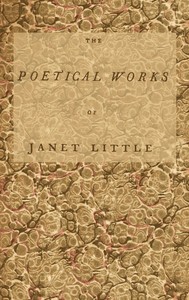
Janet Little's 1792 collection, published while she worked as a milkmaid at Loudoun Castle, presents a poet acutely conscious of her unusual position. The title page itself—The Poetical Works of Janet Little, the Scotch Milkmaid—advertises her occupation as a credential, a framing that the poems both embrace and complicate. In "Given to a Lady who asked me to write a Poem," Little jokes about the hazards of Parnassus, noting that "Hard was it then the hill to climb; / Some broke a neck, some lost a limb," before playfully aligning herself with Pope and Thomson. This self-deprecating wit coexists with a serious engagement with literary tradition: the volume includes an epistle to Robert Burns, acrostics, and allegorical poems like "On the New Year" that personify Prudence and Sloth in elaborate couplets.
Occupational Identity and Poetic Persona
The catalog subject "Scottish poetry -- 18th century" accurately places Little within a national tradition, but the excerpts show her negotiating that identity with pointed humor. In "On a Visit to Mr. Burns," she frames her encounter with the celebrated poet through a mock-heroic accident: "Pegasus kneel'd, his rider's arm / Was broken by a fall." The poem shifts from awe ("Is this the place where deigns to dwell / The honour of our isle?") to domestic realism ("His lovely wife stood drown'd in tears"), undercutting bardic elevation. Little's self-presentation as a milkmaid poet is not merely biographical fact but a rhetorical stance: she uses her laboring-class perspective to claim sincerity, as in "To a Lady who sent the Author some Paper," where she thanks a patron while gently asserting her own voice. The subscription list at the front of the volume, naming dozens of local gentry, further underscores the social transaction embedded in her publication.
Allegory, Morality, and the Calendar
Several poems in the collection adopt allegorical frameworks that the catalog's "general-literature" tag only vaguely suggests. "On the New Year" (dated January 1, 1792) is a sustained personification allegory in which the New Year is a "lazy warrior" with a sword "with rust adorn'd," flanked by Prudence and Sloth. Little gives Sloth a vivid, almost Hogarthian description: "Lank hunger painted on her face, / Her scanty raiment torn." The moral warning—"Sloth, of society the pest, / Of ev'ry bliss the bane"—is conventional, but the poem's structure, with its procession of figures and direct address to the reader, shows Little working confidently within neoclassical didactic forms. Other poems, like "On Happiness" and "On Contentment," similarly treat abstract virtues through personified tableaux, though the excerpts do not reveal whether these maintain the same level of detail.
Epistolary Forms and Social Networks
The volume is rich in epistolary poems, many addressed to named or implied recipients. "Epistle to Nell, wrote from Loudoun Castle" and its companion pieces create a small social world of female friendship and literary exchange. In "An Epistle to a Lady," Little adopts a familiar, conversational tone while discussing poetic composition itself. The acrostics—including "An Acrostic upon a young Woman, written by her Lover" and "An extemporary Acrostic"—demonstrate a facility with occasional verse that was expected of eighteenth-century poets, especially those seeking patronage. The catalog's subject "English poetry -- Scottish authors" captures the linguistic duality: Little writes in standard English but occasionally drops Scots words like "brae" and "aff." Her epistle to Burns is particularly interesting for its blend of admiration and self-assertion; she calls him "the honour of our isle" but also records her own emotional response ("With beating breast I view'd the bard"), making the poem as much about her own sensibility as about Burns.
Readers approaching this collection should attend to the tension between Little's self-presentation as a humble milkmaid and her evident literary ambition. The poems reward attention to their formal choices—couplets, allegories, epistles—and to the social contexts encoded in dedications and subscription lists. The excerpts suggest a poet who uses neoclassical conventions to comment on her own anomalous position, but the full volume may reveal more about how she navigated patronage, gender, and class. The 1792 edition, now available digitally, offers a window into the literary culture of late eighteenth-century Scotland from an uncommon vantage point.
I keep thinking about Janet Little, writing those verses after the milking was done, weighing every word against her own quiet knowing. It reminded me of that long climb in the Divine Comedy, Longfellow's Translation, Purgatory — Story, Setting & Ideas, where the light gets gentler but the path still asks everything of you. Both felt like honest companions for solitary hours.
There are no reviews for this eBook.
There are no comments for this eBook.
Reader reflection
Your personal reading reflection
Build a private reading journal entry for this title.
Your progress
0
/
10
2
Did this book hold your interest?
3
Would you recommend this book to another reader?
4
How much effort did this book require?
5
How useful were the ideas in this book?
6
Did this book create an emotional response?
7
How strong was your personal connection to the text?
8
Would you read this book again?
9
What changed or sharpened your thinking?
10