1

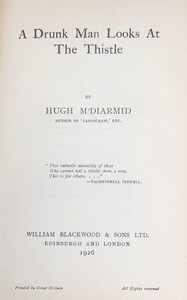
A drunk man looks at the thistle — Reading Notes
(0 User reviews)
614
Project Gutenberg
2024
Not confirmed
Scotland -- Poetry; Scottish poetry; Dialect poetry, Scottish
Readers of public-domain and historical texts
Project Gutenberg digital edition
en
Edition facts
Words
23,681
Reading time
103 min
Text sections
10
The source record for A drunk man looks at the thistle — Reading Notes measures this digital text at 23,681 words, 1 hr 43 min estimated reading time, and 10 detected text sections.
The text analysis averages about 22.3 words per sentence, while the detected sections provide another way to judge how the source is divided.
Project Gutenberg metadata also associates the work with “Scotland -- Poetry,” connecting these edition facts with the source record’s subject description.
Source:
Project Gutenberg record #72731
Hugh MacDiarmid's long poem follows a drunk speaker's shifting, hallucinatory meditation on a thistle, weaving synthetic Scots with theological and political imagery. The structure mimics intoxication through abrupt tonal shifts, recurring motifs of crucifixion and growth, and a deliberate refusal of section breaks.
Editorial Edition Score
4.7/5
★★★★★
★★★★★
Calculated from edition completeness, EPUB availability, text structure and catalogue metadata. Not a user rating.
How this score is calculated
- Description quality20 pts
- Title & short description10 pts
- Source metadata20 pts
- Text length15 pts
- Chapters / structure15 pts
- EPUB file integrity20 pts
Total of 100 points, scaled to a 2.5-5.0 range. Editions with an empty description or a missing EPUB file are not scored.
Edition quality
Read the Text
ke is rich —_Pairt soul, pairt skeleton’s come up; They kentna which was which!_...
Thou Daith in which my life Sae vain a thing can seem, Frae whatna source d’ye borrow Your devastatin’ gleam?
Nae doot that hidden sun ’Ud look fu’ wae ana’, Gin I could see it in the licht That frae the Earth you draw!...
Shudderin’ thistle, gi’e owre, gi’e owre! A’body’s gi’en in to the facts o’ life; The impossible truth’ll triumph at last, And mock your strife.
Your sallow leafs can never thraw, Wi’ a’ their oorie shakin’, Ae doot into the hert o’ life That it may be mistak’n....
_O Scotland is =The= barren fig. Up, carles, up And roond it jig._
_Auld Moses took A dry stick and Instantly it Floo’ered in his hand._
_Pu’ Scotland up, And wha can say It winna bud And blossom tae._
_A miracle’s Oor only chance. Up, carles, up And let us dance!_
Puir Burns, wha’s bouquet like a shot kail blaws —Will this rouch sicht no’ gi’e the orchids pause? The Gairdens o’ the Muses may be braw, But nane like oors can breenge and eat ana’!
And owre the kailyaird-wa’ Dunbar they’ve flung, And a’ their countrymen that e’er ha’e sung For ither than ploomen’s lugs or to enrichen Plots on Parnassus set apairt for kitchen.
Ploomen and ploomen’s wives—shades o’ the Manse May weel be at the heid o’ sic a dance, As through the polish’t ha’s o’ Europe leads The rout o’ bagpipes, haggis, and sheep’s heids!
The vandal Scot! Frae Branksome’s deidly barrow I struggle yet to free a’e winsome marrow, To show what Scotland micht ha’e hed instead O’ this preposterous Presbyterian breed.
(Gin Glesca folk are tired o’ Hengler, And still need breid and circuses, there’s Spengler, Or gin ye s’ud need mair than ane to teach ye, Then learn frae Dostoevski and frae Nietzsche.
And let the lesson be—to be yersel’s, Ye needna fash gin it’s to be ocht else. To be yersel’s—and to mak’ that worth bein’. Nae harder job to mortals has been gi’en.
To save your souls fu’ mony o’ ye are fain, But de’il a dizzen to mak’ it worth the daein’. I widna gi’e five meenits wi’ Dunbar For a’ the millions o’ ye as ye are).
I micht ha’e been contentit wi’ the Rose Gin I’d had ony reason to suppose That what the English dae can e’er mak’ guid For what Scots dinna—and first and foremaist should.
I micht ha’e been contentit—gin the feck O’ my ain folk had grovelled wi’ less respec’, But their obsequious devotion Made it for me a criminal emotion.
I micht ha’e been contentit—ere I saw That there were fields on which it couldna draw, (While strang-er roots ran under’t) and a’e threid O’t drew frae Scotland a’ that it could need,
And left the maist o’ Scotland fallow (Save for the patch on which the kail-blades wallow), And saw hoo ither countries’ genius drew Elements like mine that in a rose ne’er grew....
Gin the threid haud’n us to the rose were snapt, There’s no’ a’e petal o’t that ’ud be clapt. A’ Scotland gi’es gangs but to jags or stalk, The bloom is English—and ’ud ken nae lack!...
O drumlie clood o’ crudity and cant, Obliteratin’ as the Easter rouk That rows up frae the howes and droons the heichs, And turns the country to a faceless spook.
Like blurry shapes o’ landmarks in the haar The bonny idiosyncratic place-names loom, Clues to the vieve and maikless life that’s lain Happit for centuries in an alien gloom....
_Eneuch! For noo I’m in the mood, Scotland, responsive to my thoughts, Lichts mile by mile, as my ain nerves, Frae Maidenheid to John o’ Groats!_
What are prophets and priests and kings, What’s ocht to the people o’ Scotland? Speak—and Cruivie’ll goam at you, Gilsanquhar jalouse you’re dottlin!
And Edinburgh and Glasgow Are like ploomen in a pub. They want to hear o’ naething But their ain foul hubbub....
The fules are richt; an extra thocht Is neither here nor there. Oor lives may differ as they like —The self-same fate we share.
And whiles I wish I’d nae mair sense Than Cruivie and Gilsanquhar, And envy their rude health and curse My gnawin’ canker.
Guid sakes, ye dinna need to pass Ony exam. to dee —Daith canna tell a common flech Frae a performin’ flea!...
The poem opens with an epigraph from Sacheverell Sitwell that sets up a central tension: the inability to distinguish a thistle from a rose. MacDiarmid’s speaker immediately adopts a voice that is both confessional and combative, addressing a figure named Jean and a “stickit God.” The language moves between Scots dialect and abstract philosophical reflection, creating a texture that resists easy categorization. The author’s note warns readers against seeking conventional intelligibility, framing the poem as a “gallimaufry” with its own drunken logic.
A Structure That Refuses Handrails
MacDiarmid explicitly chose not to divide his poem into sections, calling such divisions “hand-rails” that raise false hopes. The text flows as a single, unbroken sequence of stanzas, mirroring the continuous, associative logic of intoxication. Transitions are abrupt: a passage on the thistle’s growth may shift without warning into a meditation on Christ or a digression on Russian literature. This structural choice forces the reader to navigate without conventional markers, replicating the speaker’s own disorientation. The absence of section breaks also emphasizes the poem’s cyclical nature, as images of the thistle, Calvary, and Scotland recur and transform.
Recurring Images: Thistle, Cross, and Growth
The thistle is the poem’s central image, but it is never static. It appears as a weed, a symbol of Scotland, a source of pain, and a vehicle for transcendence. The speaker describes the thistle growing “by slow degrees until it rends your flesh apairt,” linking it directly to the crucifixion. Calvary becomes a recurring motif: “this is Calvary—to bear / Your Cross wi’in you frae the seed.” The image of internal growth—of a cross or a thistle taking root inside a person—recurs across multiple stanzas, suggesting that suffering is not an external event but an organic process. The speaker also invokes Melville’s vision of Christ “corrupted into creeds malign,” tying the thistle to institutional religion’s failures.
Movement Between Scales: From Cell to Cosmos
The poem constantly shifts between microscopic and macroscopic perspectives. The speaker refers to “the cells that mak’ a’e sliver wi’m” and the “threidy knit” of human connection, then zooms out to consider “mankind’s great synthesis” and the fate of Scotland. This movement is not linear but vertiginous: a line about a “stickit God” may be followed by a domestic image of Jean and Mary, then by a geopolitical reference to Russia. The speaker’s drunken logic allows these leaps to feel natural, as if the thistle’s prickles connect all levels of existence. The poem’s refusal to settle on one scale mirrors its refusal to settle on one meaning.
The Speaker’s Voice: Confession and Defiance
The speaker oscillates between self-mockery and grandiosity. He admits his vision may be “nocht but cussedness,” yet he insists on seeing “a kennin’ mair / Than ither folk.” He addresses Jean directly, confesses to being “fu’ o’ a stickit God,” and then pivots to a sweeping critique of Scottish culture. The voice is intimate and abrasive, using Scots dialect for immediacy while deploying complex theological and literary allusions. This combination creates a persona that is both vulnerable and arrogant, drunk on language as much as alcohol. The speaker’s final stance is one of defiant acceptance: “I’m content gin a’ my thocht / Can dae nae mair than let me see.”
Readers should approach the poem as a single, sustained performance rather than a linear argument. The lack of section breaks means that any stanza may be a starting point. Pay attention to how the thistle image recurs and mutates, and note the shifts in scale and register. MacDiarmid’s synthetic Scots rewards reading aloud, but the poem’s intellectual range—from Melville to Russian philosophy—requires patience. The drunken logic is not an excuse for incoherence but a deliberate method for exploring contradiction.
Some nights, that thistle kept growing in my mind, refusing neat endings the way a hangover refuses sleep. I found myself thinking of Eliot’s fragments afterwards, especially in Ara vus prec — Reading Companion, where broken voices also linger without resolution. It felt less like reading, more like remembering something I hadn’t quite lived yet.
There are no reviews for this eBook.
There are no comments for this eBook.
Reader reflection
What did you think of this book?
Answer a few questions and save a private reflection on this device.
Your progress
0
/
10
2
What was your overall reaction to the book?
3
Is this a title you would suggest to others?
4
Did the language feel accessible?
5
What was the strongest part of the book?
6
How clearly were the main ideas presented?
7
Did any part of the book feel personally relevant?
8
Could you see yourself revisiting this book?
9
What changed or sharpened your thinking?
10